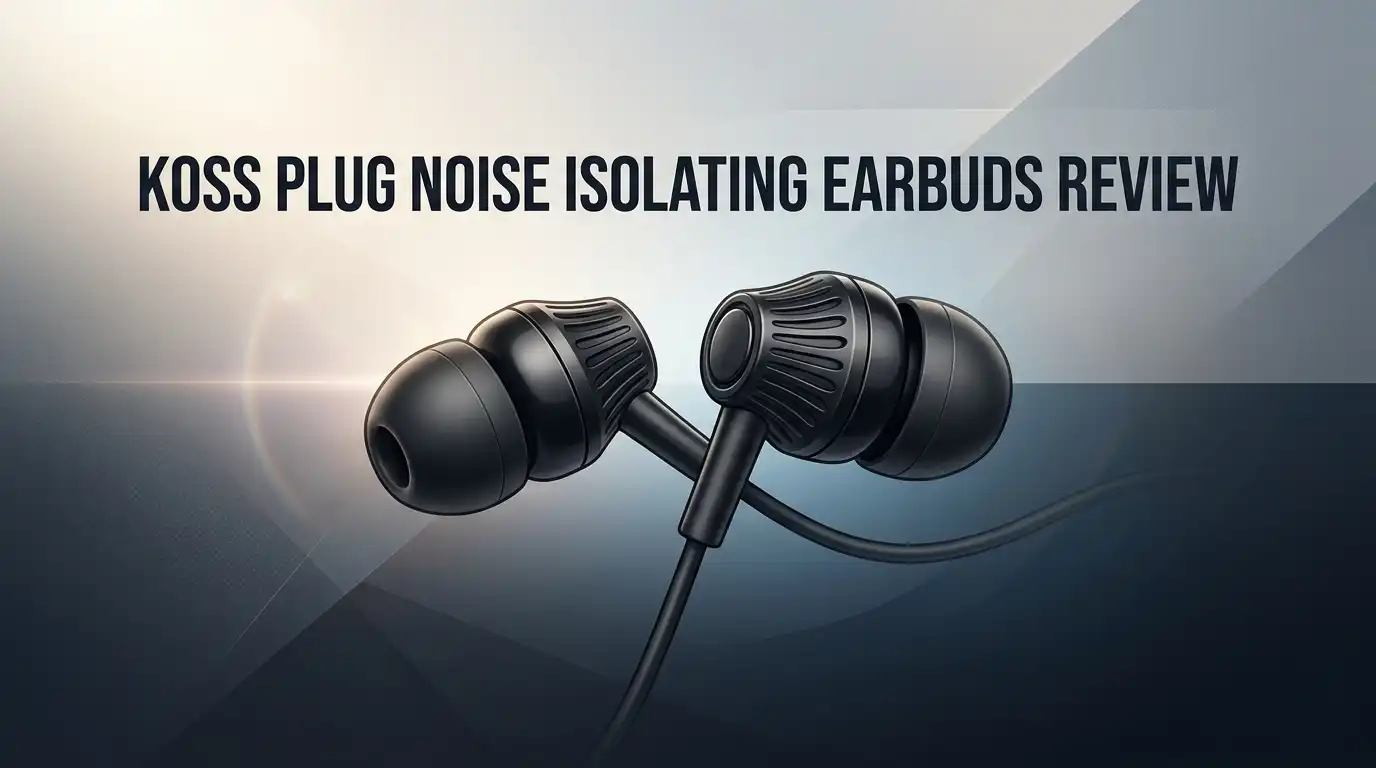
Koss Plug Noise Isolating Earbuds Review 2026: Worth It?
Koss is one of the oldest names in headphones. The company built the first stereo headphone back in 1958, and it still sells earbuds for the price of a sandwich. That mix of history and low prices makes people curious.
So the real question in 2026 is simple. Can a brand that refuses to chase trends still give you earbuds worth buying? I spent weeks with the main Koss earbud lineup to find out.
This review covers The Plug, The Plug Wireless, and the cheaper wired models like the KEB9i and KEB25i. I talk about sound, comfort, build quality, and the parts Koss gets wrong. There are plenty of flaws, and I will not hide them.
Key Takeaways:
- Koss earbuds win on price and sound value. The Plug costs about the same as two coffees and delivers bass that shames many thirty dollar earbuds. You pay for sound, not for features.
- Memory foam is the star feature. The foam sleeves squeeze into your ear canal and block outside noise passively. Isolation feels closer to earplugs than to normal silicone tips.
- Comfort depends on your ears. Some people love the foam seal after a week. Others find the deep insertion tiring after thirty minutes.
- Build quality is the weak spot. Cables feel thin, strain reliefs are basic, and the foam sleeves wear out and need replacing every few months.
- Wireless models are behind the market. The Plug Wireless uses older Bluetooth, offers no active noise cancelling, and gives modest battery life compared with cheap true wireless rivals.
- Best for gym, sleep, commutes, and study. Koss earbuds shine as backup pairs and rough use pairs. They are not premium daily drivers in 2026.
Koss The Plug Review: The Classic Bass Machine

Last update on 2026-10-13 / Affiliate links / Images from Amazon Product Advertising API Some of the links on this website are affiliate links, which means that at no additional cost to you, I earn a commission if you click through and make a purchase. I only recommend products and services that I believe will add value to my readers. Thank you for your support!
The Plug has been on sale since the late 1990s, and the recipe barely changed. You get a small plastic barrel body, a black cord, and thick memory foam sleeves. Nothing here looks modern.
The sound explains its long life. Bass hits hard and low, with a rumble you normally hear in earbuds costing five times more. The low end is big, warm, and slightly loose.
Frequency response is listed at 10 Hz to 20,000 Hz with 16 ohm impedance. That means your phone drives them loudly with no amplifier. Volume levels get high enough to worry me on behalf of your hearing.
Mids sit behind the bass. Vocals sound a little distant on busy tracks, and acoustic guitar loses some bite. Treble rolls off early, so cymbals sound soft rather than sharp.
That tuning suits hip hop, electronic music, and film soundtracks. It suits classical and jazz much less well. I noticed detail smearing on complex orchestral passages.
Isolation is the second big draw. With the foam compressed and inserted properly, train noise and gym music drop away. I stopped needing high volume in loud places, which protects your ears over time.
The current version ships with a detachable 3.5mm cord on some variants and a fixed cord on others. Check the listing before you buy, because the detachable model is easier to keep alive long term.
Koss The Plug Wireless Review: Convenience With Compromises

Last update on 2026-10-13 / Affiliate links / Images from Amazon Product Advertising API Some of the links on this website are affiliate links, which means that at no additional cost to you, I earn a commission if you click through and make a purchase. I only recommend products and services that I believe will add value to my readers. Thank you for your support!
The Plug Wireless takes the same foam and driver idea and cuts the cord to your phone. The two buds stay joined by a neckband style cable with an inline remote and microphone. This is not a true wireless design.
Pairing takes seconds. Hold the button, find the name on your phone, done. Bluetooth 4.2 handles the connection, which is old by 2026 standards.
Sound stays recognisably Koss. Bass leads, mids sit back, treble stays polite. Compared with the wired version, I heard slightly less punch and a touch more haze.
Battery life lands in the six hour range with moderate volume. That covers a workday with a lunchtime charge, but it embarrasses nothing. Charging uses a micro USB port on many units, which feels dated.
The inline remote works well for calls and track skips. Buttons click firmly, and you learn the positions by feel within a day. I prefer physical buttons to touch panels that misfire in the rain.
Codec support stays basic. There is no LDAC, no aptX, and no active noise cancelling. The foam does the noise blocking job instead, and it does it surprisingly well.
Range is fine across a small flat but drops through thick walls. I got occasional stutters when my phone sat in a back pocket during runs.
Value depends entirely on the price you see. Around thirty dollars it makes sense for foam fans who hate cords to their phone. Above that, cheap true wireless rivals win.
Unboxing Experience: Plain Packaging, No Drama
Koss packaging tells you exactly where the money went. It did not go here.
The Plug arrives in a small cardboard and plastic blister pack. You cut it open with scissors, and the buds fall out with a coiled cord. There is no soft tray, no magnetic flap, and no printed thank you card.
Inside the box you find the earbuds, spare foam sleeves in small, medium, and large, and a thin drawstring pouch on some versions. Some retail packs also include a 3.5mm utility adapter. That is the entire contents list.
The Plug Wireless comes in a slightly nicer box with a charging cable and spare sleeves. The cable is short, roughly the length of your hand.
First impressions of the hardware are mixed. The buds feel light, almost hollow, and the plastic has a matte finish that hides scratches. The cord feels thinner than I expected.
The foam sleeves feel better than the rest of the package. They compress between your fingers and slowly expand back, exactly like foam earplugs.
There is a charm to this simplicity. Nothing distracts you from the product, and you are listening within one minute. Buyers who love a premium unboxing ritual will feel let down, and that is a fair complaint.
Top 3 Alternative for Koss The Plug

Last update on 2026-10-13 / Affiliate links / Images from Amazon Product Advertising API Some of the links on this website are affiliate links, which means that at no additional cost to you, I earn a commission if you click through and make a purchase. I only recommend products and services that I believe will add value to my readers. Thank you for your support!
Koss KEB9i Earbuds

Last update on 2026-10-13 / Affiliate links / Images from Amazon Product Advertising API Some of the links on this website are affiliate links, which means that at no additional cost to you, I earn a commission if you click through and make a purchase. I only recommend products and services that I believe will add value to my readers. Thank you for your support!
Koss KSC75 On Ear Headphones

Last update on 2026-10-13 / Affiliate links / Images from Amazon Product Advertising API Some of the links on this website are affiliate links, which means that at no additional cost to you, I earn a commission if you click through and make a purchase. I only recommend products and services that I believe will add value to my readers. Thank you for your support!
Koss BT115i Wireless Bluetooth Earbuds
Sound Quality Breakdown: Where Koss Wins And Loses
Let me split the sound into parts, because a single score hides too much.
Bass is the headline. Sub bass extends deep and stays audible on tracks with 40 Hz content. Kick drums sound thick rather than tight, so fast metal double kicks blur together.
Mids get pushed back by that bass. Male vocals keep body, while female vocals lose some sparkle. Podcast voices still sound clear, which matters more than audiophile purists admit.
Treble is the biggest limitation. Hi hats and strings sound rounded and soft, and air disappears above roughly 10 kHz to my ears. You trade detail for fatigue free listening.
Soundstage is narrow. Instruments sit close to your head, which is normal for sealed earbuds at this price. Imaging places left and right correctly but offers little depth.
Detail retrieval is average. You hear the main layers of a mix and lose small background textures. Compared with a modern thirty dollar true wireless set with app EQ, Koss gives more raw bass and less refinement.
Source matters. A phone dongle drives them fine, and a cheap dongle DAC tightens the bass noticeably. An amplifier is unnecessary.
One practical note on the foam. Fresh sleeves sound fuller than worn sleeves, and old flattened foam kills bass. Replace the foam and your earbuds sound new again.
Comfort And Fit: Memory Foam Feels Different
The foam sleeve system splits opinion more than anything else about Koss earbuds.
You roll the foam between your fingers to compress it, insert the bud, then hold it while the foam expands. The seal that follows is tight and quiet. This process takes practice.
Once sealed, the buds feel secure. I jogged, cycled, and moved around the house without a single bud falling out. No wing tips or hooks are needed.
Comfort over time is another story. The foam sits deeper in the canal than silicone tips, and some ears reject that pressure. My right ear felt tired after about ninety minutes.
Three sleeve sizes ship in the box, which helps. Smaller ears should start with the small size, since the medium can feel like a plug in a keyhole.
Weight is not an issue. Each bud weighs almost nothing, so there is no downward pull. The cord is the main comfort annoyance because it transmits touch noise up to your ears.
Hygiene needs attention. Foam absorbs earwax and moisture, and it cannot be washed properly. Plan on replacing sleeves every two or three months with regular use.
Sleep use works well for side sleepers with shallow pillows. The barrel body still sticks out enough to press when you roll over, so this is not a perfect sleep earbud.
Build Quality And Durability: The Honest Problem
This is where I have to be blunt. Koss builds earbuds to a price, and it shows.
The cable on The Plug feels thin and slightly rubbery. It tangles easily and holds kinks after being stuffed in a pocket. Strain relief at the plug is minimal.
I have seen many long term owner reports of cable failure near the Y splitter or the jack. My review sample survived weeks of use, but I treated it carefully. Rough handling shortens the life of these earbuds.
The plastic housings hold up better. They resist cracking and shrug off drops onto hard floors. Scratches barely show on the matte finish.
Foam sleeves are the true consumable. They tear at the edges, compress permanently, and darken with wear. Replacement packs are cheap, so budget for them.
There is one genuine bright spot. Koss offers a limited lifetime warranty on many wired models in the United States. You pay a handling fee and get a replacement, which changes the value story completely.
That warranty turns a fragile product into a sensible long term purchase for domestic buyers. International buyers get much less benefit, since shipping costs eat the savings.
Wireless models carry a shorter warranty and a battery that degrades. Treat The Plug Wireless as a two to three year product, not a lifetime one.
Microphone And Call Quality
Most current Koss earbuds include an inline microphone and remote, and call performance matters to buyers.
Voice pickup is clear in quiet rooms. Callers told me I sounded natural, if slightly thin. The microphone handles video meetings and phone calls without complaint.
Background noise is the weakness. The microphone lacks strong noise suppression, so street traffic and cafe chatter bleed into your voice. Windy conditions make you hard to understand.
Position affects results. The inline microphone hangs near your chest, which is farther from your mouth than a boom microphone. Speaking a little louder fixes most issues.
Sidetone is missing. You cannot hear your own voice, and the foam seal blocks your ears, so you naturally speak too loudly. This is the most common complaint I have from people using sealed earbuds for calls.
The remote is simple and effective. One click answers, one click ends, and the volume buttons work on both Android and iPhone in my testing. Track skipping with a double click works on most phones.
The Plug Wireless microphone performs similarly. Bluetooth compression adds a slight fuzz to your voice, so I preferred the wired version for important calls.
If calls are your main use, a headset with a stalk microphone serves you better. For occasional calls between music sessions, these are fine.
Battery Life And Charging On Wireless Models
Wired Koss earbuds need no battery, which is a genuine advantage in 2026. Plug in and listen forever.
The wireless models need more scrutiny. The Plug Wireless delivers roughly six hours of playback at moderate volume in my use. Loud volume drops that closer to five.
The BT115i style neckband models claim around 18 hours, and that class of Koss earbud lasts much longer between charges. Battery life across the lineup is inconsistent, so check the specific model.
Charging speed is average. A full charge takes about two hours from empty, and there is no fast charge feature worth mentioning. Some models use micro USB and newer ones use USB C.
There is no charging case, because these are not true wireless earbuds. That means no case top ups and no extra pocket bulk either. You charge the buds directly and remember to do it.
Standby drain is low. I left a pair unused for a week and found most of the charge intact.
Battery health declines like every lithium battery. Expect noticeably shorter playback after two years of daily cycles.
Koss does not offer battery replacement, so wireless models are effectively disposable. That fact pushes me toward recommending the wired versions to most readers.
Koss KEB9i And KEB25i: The Cheaper Wired Options
Not every Koss earbud uses memory foam, and the silicone tip models deserve a mention.
The KEB9i uses an angled nozzle and silicone tips with a 13.5mm driver. Sound is brighter and more balanced than The Plug, with less bass weight. Vocals sound clearer here.
Comfort is easier for newcomers. Silicone tips sit shallower, insert instantly, and wipe clean. Isolation drops compared with foam, so noisy trains intrude.
The KEB25i sits between the two. It pairs memory foam cushions with a modest bass lift and adds an inline microphone with volume control. I found it the most balanced Koss earbud for mixed use.
Build quality mirrors the rest of the lineup. Thin cables, light housings, and simple strain relief. The same warranty applies to many of these wired models in the United States.
Prices run from about ten to twenty dollars. At that level, expectations should stay realistic, and these earbuds meet them.
Schools and libraries buy these models in bulk for a reason. They sound clear, they cost little, and losing one hurts nobody.
Choose the KEB9i if you dislike deep insertion. Choose the KEB25i if you want foam isolation with a microphone. Choose The Plug if bass and isolation matter most.
Pros And Cons Of Koss Earbuds In 2026
Here is the balanced view after weeks of listening.
Pros
- Outstanding price to sound value. Bass depth and isolation beat many pricier earbuds.
- Excellent passive noise blocking from memory foam sleeves, without any battery drain.
- Limited lifetime warranty on many wired models in the United States, which offsets fragile cables.
- No battery anxiety on wired versions, and easy compatibility with any 3.5mm source.
- Secure fit for gym sessions, running, and commuting once the foam expands.
- Simple physical controls that work reliably in cold weather and rain.
Cons
- Thin cables with weak strain relief that fail more often than premium rivals.
- Rolled off treble that costs you detail, air, and sparkle.
- Foam sleeves need frequent replacement and cannot be cleaned properly.
- Microphone struggles with background noise, so outdoor calls suffer.
- Wireless models use older Bluetooth, offer no active noise cancelling, and lack app support.
- No true wireless flagship to compete with modern earbuds at similar prices.
- Plain packaging and no premium accessories, which disappoints gift buyers.
What Koss Earbuds Do Not Do Well
Honest reviews name the failures clearly, so here they are without softening.
Koss earbuds do not deliver detail. If you love hearing reverb tails, string texture, and cymbal shimmer, these will frustrate you. Treble simply is not there.
They do not offer modern features. There is no active noise cancelling, no transparency mode, no multipoint pairing, and no companion app. Competitors at thirty dollars now include several of those.
They do not survive abuse. Yanking the cord out by pulling the wire will eventually kill a pair. Cable failure is the single most reported issue by long term owners.
They do not suit every ear. Deep foam insertion causes pressure discomfort for a meaningful share of users, and no amount of size swapping fixes that.
They do not handle calls in noisy places. Wind and traffic overwhelm the microphone, and callers ask you to repeat yourself.
They do not look impressive. The design is functional, dated, and plain. Nobody will compliment your earbuds.
They do not hold resale value or offer repairs. Wireless models die with their batteries.
Knowing all this before you buy prevents disappointment. Buy Koss for bass, isolation, and price, and nothing else.
Who Should Buy Koss Earbuds
Some buyers get real joy from these earbuds, and others regret the purchase. Let me sort that out.
Gym users benefit most. The foam seals out clanging weights and loud music, the fit stays put, and a cheap pair surviving sweat is no tragedy.
Commuters on a tight budget come second. Train and bus noise drops dramatically, so you protect your hearing by listening at lower volume.
Students and office workers who mostly hear voices will do well with the KEB9i or KEB25i. Clarity beats bass for lectures and meetings.
Bass lovers with fifteen dollars to spend should buy The Plug immediately. Nothing at that price rumbles like it.
Backup pair buyers should also look here. Keep one in a bag, a car, or a desk drawer for emergencies.
Skip Koss earbuds if you want active noise cancelling, premium detail, or true wireless convenience. Modern budget brands beat Koss on features every time.
Also skip them if your ears reject deep tips. Try foam tips on any earbud first to test your tolerance.
Frequent flyers should think twice too. Foam isolation helps, but active noise cancelling handles engine drone better.
Price And Value Check For 2026
Prices shift constantly, so treat these as guides rather than quotes.
The Plug usually sells between fifteen and twenty five dollars. The KEB9i and KEB6i sit near ten to fifteen dollars. The Plug Wireless typically lands between thirty and forty five dollars.
At those numbers, the wired models represent strong value. You get sound quality that punches well above the price.
The wireless models face harder competition. Thirty dollars now buys true wireless earbuds with a charging case, Bluetooth 5.3, and basic noise cancelling. Koss cannot match that feature list.
Factor in consumables. Replacement foam sleeves cost a few dollars per pack, and you will buy them regularly.
Factor in the warranty too. A limited lifetime warranty on a fifteen dollar earbud is unusual and valuable if you live in the United States.
Watch for sales around major shopping events. Koss discounts often push The Plug into impulse buy territory.
My value verdict is simple. Wired Koss earbuds earn a recommendation on price alone. Wireless Koss earbuds only make sense on discount for people who specifically want foam isolation without a phone cable.
Final Verdict: Are Koss Earbuds Worth It In 2026?
Yes, with clear limits.
Koss earbuds remain one of the best cheap ways to get big bass and strong isolation. The Plug is still a cult favourite for good reasons, and the warranty makes it a smart buy in the United States.
Buy the wired models and buy spare foam sleeves. That combination gives you years of use for the price of one restaurant meal.
The wireless models are harder to recommend. Older Bluetooth, modest battery life, and no noise cancelling put them behind modern rivals unless you find a deep discount.
Do not expect audiophile detail, premium build, or clever features. Koss sells honest sound at an honest price, nothing more.
If that trade sounds fair to you, you will enjoy these earbuds. If it does not, spend a little more on a modern true wireless set and skip the nostalgia.
FAQs
Are Koss earbuds good for bass?
Yes. The Plug delivers deep, powerful bass that outperforms most earbuds under twenty dollars. The bass is warm and slightly loose rather than tight and precise.
Do Koss earbuds have a lifetime warranty?
Many wired Koss models carry a limited lifetime warranty in the United States. You pay a handling fee and receive a replacement pair. Wireless models come with a shorter standard warranty.
How long do Koss memory foam sleeves last?
Plan on two to three months with daily use. Foam flattens, absorbs wax, and tears at the edges. Fresh sleeves restore bass and isolation immediately.
Are Koss earbuds good for noise blocking?
Yes, passively. The memory foam seals your ear canal like an earplug and cuts steady noise well. There is no active noise cancelling, so engine drone survives better than voices.
Which Koss earbud is best for calls?
The KEB25i and KEB9i with inline microphones work well in quiet places. Background noise reduces call clarity on every current Koss model.
Does Koss make true wireless earbuds?
Koss has offered true wireless models such as the TWS250i, but availability changes often. The main current lineup focuses on wired earbuds and neckband style wireless models.
Are Koss earbuds comfortable for sleeping?
Side sleepers with soft pillows manage short sessions. The barrel housing sticks out and presses against your ear when you roll over, so dedicated sleep earbuds work better.
Do Koss earbuds work with iPhone?
Yes. Wired models need a 3.5mm to Lightning or USB C adapter, and the inline volume controls work normally. Wireless models pair over Bluetooth without issues.
Prices, model availability, and specifications change often, so check current listings before you buy.

Hi, my name is Lily you can say i am a gadget hunter at this point. Welcome to Gadget Gallery The Gallery of Gadget Reviews