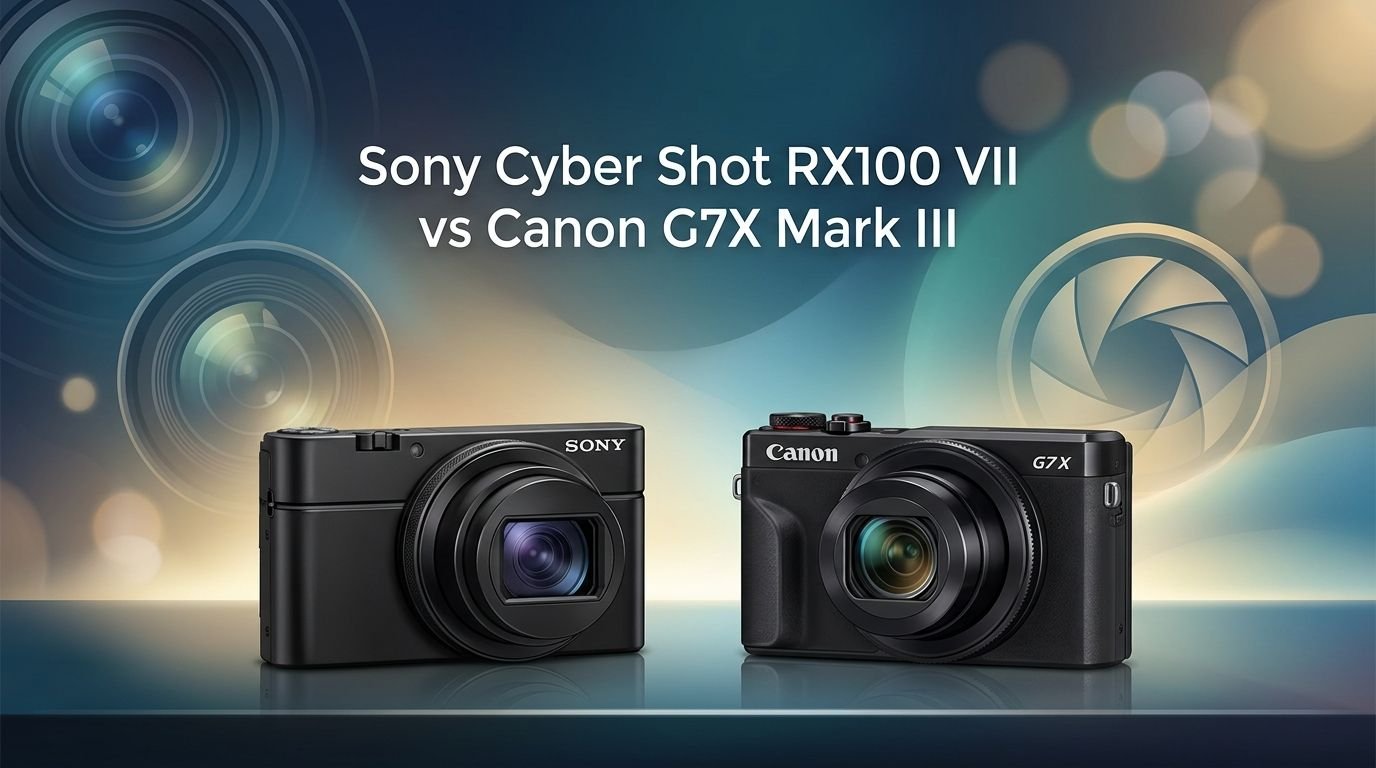
Sony Cyber Shot RX100 VII vs Canon G7X Mark III
Are you torn between the Sony Cyber Shot RX100 VII and the Canon G7X Mark III? You are not alone. These two premium compact cameras have dominated the pocket camera market for years.
Both pack a 1 inch sensor, shoot 4K video, and fit easily into a jacket pocket. But they serve very different types of shooters. One offers a massive zoom range and blazing autofocus.
The other delivers a faster lens and a friendlier price tag. Choosing between them can feel like picking a favorite child. This detailed comparison breaks down every feature, spec, and real world performance difference so you can make the right call for your photography and video needs.
Key Takeaways:
- The Sony RX100 VII offers a 24 to 200mm zoom lens, which gives it far more reach than the Canon’s 24 to 100mm. This makes the Sony a better pick for travel photography and wildlife.
- The Canon G7X Mark III has a faster f/1.8 to f/2.8 lens, which lets in more light. This gives it a clear advantage for low light photography and shallow depth of field shots.
- The Sony RX100 VII costs about $1,200 to $1,500, while the Canon G7X Mark III sits around $750 to $880. The price gap is significant, so budget matters here.
- Autofocus on the Sony is class leading. It uses 357 phase detection points and 425 contrast detection points. Real time tracking and Eye AF make it excellent for fast moving subjects.
- The Canon G7X Mark III supports live streaming to YouTube directly from the camera. It also records uncropped 4K video and 1080p at 120fps for smooth slow motion.
- Battery life is similar on both cameras. The Sony is rated at about 260 shots and the Canon at about 265 shots per charge. Both will need spare batteries for long shooting days.
Sony Cyber Shot RX100 VII: A Closer Look

Last update on 2026-08-29 / Affiliate links / Images from Amazon Product Advertising API Some of the links on this website are affiliate links, which means that at no additional cost to you, I earn a commission if you click through and make a purchase. I only recommend products and services that I believe will add value to my readers. Thank you for your support!
The Sony Cyber Shot RX100 VII is the seventh generation of Sony’s legendary compact camera series. It packs a 20.1 megapixel 1 inch stacked CMOS sensor paired with the BIONZ X image processor. This combination delivers sharp, detailed photos with impressive dynamic range.
The standout feature here is the 24 to 200mm Zeiss Vario Sonnar T lens*. You get a wide angle perspective for landscapes and a telephoto reach for distant subjects, all in one tiny body. The lens aperture ranges from f/2.8 at the wide end to f/4.5 at full zoom.
Sony also included an electronic viewfinder (EVF) that pops up from the body. This is a huge bonus for shooting in bright sunlight where LCD screens wash out. The 2.36 million dot OLED viewfinder is crisp and accurate.
The camera shoots 4K video at 30fps and 1080p at up to 120fps. It also supports S Log2 and S Log3 picture profiles for filmmakers who want maximum flexibility in color grading. HLG support is present for HDR content creation.
Pros:
- 24 to 200mm zoom range is extremely versatile
- 357 phase detection AF points with real time tracking
- Built in pop up electronic viewfinder
- 20fps blackout free continuous shooting
- 4K video with S Log profiles
Cons:
- High retail price around $1,200 to $1,500
- Lens aperture of f/2.8 to f/4.5 is slower than the Canon
- Battery life is modest at 260 shots per charge
- Small body can be tricky to grip
- Menu system can overwhelm beginners
Canon G7X Mark III: A Closer Look


Last update on 2026-08-29 / Affiliate links / Images from Amazon Product Advertising API Some of the links on this website are affiliate links, which means that at no additional cost to you, I earn a commission if you click through and make a purchase. I only recommend products and services that I believe will add value to my readers. Thank you for your support!
The Canon PowerShot G7X Mark III is Canon’s answer to the premium compact camera demand. It features a 20.1 megapixel 1 inch stacked CMOS sensor paired with Canon’s DIGIC 8 image processor. Image quality is excellent, with natural colors and pleasing skin tones.
The lens is a 24 to 100mm f/1.8 to f/2.8 zoom. This is notably faster than the Sony’s lens. The wider aperture lets in more light, which helps in dim conditions and creates smoother background blur in portraits.
Canon designed this camera with vloggers and content creators in mind. It can live stream directly to YouTube over Wi Fi. It records uncropped 4K video at 30fps and offers 1080p at 120fps for slow motion clips. A flip up touchscreen makes self recording easy.
The body weighs just 304 grams with the battery and memory card. It has a clean, minimal design with a textured grip on the front. The control ring around the lens lets you adjust settings quickly.
Pros:
- Fast f/1.8 to f/2.8 lens performs well in low light
- Live streaming to YouTube built in
- Lower price around $750 to $880
- 1080p at 120fps for smooth slow motion
- Compact and lightweight at 304 grams
Cons:
- No electronic viewfinder
- 4K video has a recording time limit
- Autofocus is slower than the Sony RX100 VII
- Zoom range tops out at 100mm
- Battery life is average at 265 shots per charge
Image Quality Comparison
Both cameras use a 1 inch type sensor with 20.1 megapixels. They produce comparable resolution in good lighting. However, the differences appear when you look at specific shooting conditions.
The Sony RX100 VII uses a stacked CMOS design with DRAM. This enables faster readout speeds and reduces rolling shutter. Images are sharp throughout the zoom range, thanks to the high quality Zeiss lens.
The Canon G7X Mark III produces images with warmer tones and slightly better color rendering. Canon’s DIGIC 8 processor handles noise reduction effectively. The faster lens also means you can shoot at lower ISO values in dim settings, which keeps noise levels down.
At high ISO values, both cameras show similar noise patterns. The Sony holds detail slightly better at ISO 3200 and above. The Canon produces smoother but slightly softer results at the same settings. For everyday shooting, most people will not notice a major difference between the two.
Lens Performance: Zoom vs Speed
This is one of the biggest differences between these cameras. The Sony RX100 VII gives you a 24 to 200mm equivalent zoom. That is an impressive 8.3x optical zoom range. You can go from wide group shots to tight telephoto frames without changing cameras.
The Canon G7X Mark III offers a 24 to 100mm equivalent zoom with a 4.2x range. It covers wide angle to moderate telephoto. This is enough for most everyday photography but falls short for sports, wildlife, or distant subjects.
Where the Canon wins is aperture speed. Its f/1.8 at the wide end is a full stop faster than the Sony’s f/2.8. At full zoom, the Canon is at f/2.8 while the Sony sits at f/4.5. This gives the Canon a significant advantage for low light shooting and creating shallow depth of field.
If you value reach and versatility, the Sony is the better choice. If you prioritize low light performance and background blur, the Canon takes the lead.
Autofocus System
The Sony RX100 VII has one of the best autofocus systems ever placed in a compact camera. It uses 357 phase detection points and 425 contrast detection points. This hybrid AF system covers about 68% of the image frame.
Sony’s real time tracking uses AI to follow subjects across the frame. Real time Eye AF works for humans and animals. The camera acquires focus in just 0.02 seconds, which matches many professional mirrorless cameras.
The Canon G7X Mark III uses a contrast detection AF system with 31 points. It is reliable for static subjects and everyday shooting. However, it struggles with fast moving subjects and does not offer the same level of tracking accuracy.
For video, the Sony maintains smooth, continuous autofocus with minimal hunting. The Canon occasionally hunts in low light or when subjects move quickly. If autofocus speed and accuracy are important to you, the Sony is the clear winner.
Video Recording Capabilities
Both cameras record 4K video at 30fps. The Sony RX100 VII uses full pixel readout without binning. It supports S Log2, S Log3, and HLG picture profiles. These give filmmakers serious control over color grading in post production.
The Canon G7X Mark III records uncropped 4K at 30fps. It also offers 1080p at 120fps for slow motion. A standout feature is the built in live streaming to YouTube. Content creators can go live directly from the camera without extra hardware.
The Sony offers 4K high frame rate recording at 30fps with oversampled footage. The Canon has a recording time limit in 4K, which can interrupt longer shoots. Both cameras support external microphone input through a 3.5mm jack.
For professional video work, the Sony provides more flexibility. For quick social media content and live streaming, the Canon is more practical. Both cameras produce good quality footage for vlogging.
Stabilization Comparison
The Sony RX100 VII uses Optical SteadyShot image stabilization. It reduces camera shake during handheld shooting and video recording. The system works well for minor vibrations and slow walking.
The Canon G7X Mark III features optical image stabilization as well. Canon’s system is effective for both photos and video. It smooths out handheld footage and allows slower shutter speeds without blur.
Neither camera has in body image stabilization (IBIS). Both rely on lens based systems. For serious video work, you may want an external gimbal for perfectly smooth footage. The stabilization on both cameras is adequate for casual vlogging and everyday shooting, but neither is perfect for active movement.
Build Quality and Ergonomics
The Sony RX100 VII measures 101.6 x 58.1 x 42.8mm and weighs about 302 grams. It has an all metal body with a premium feel. The pop up EVF and flash are built into the compact frame.
The Canon G7X Mark III is slightly larger at 105.5 x 60.9 x 41.4mm and weighs 304 grams. It also has a metal body with a textured front grip. The flip up touchscreen tilts 180 degrees for selfies and vlogging.
The Sony feels more tool like and professional in hand. The Canon feels friendlier and more intuitive for casual shooters. The Canon’s touchscreen is responsive and makes menu navigation faster. The Sony’s menu system is deeper but requires more time to learn.
Both cameras fit easily in a pants pocket or small bag. They are well built for their size and can handle light rain with reasonable care.
Battery Life and Connectivity
Battery life is a weak point for both cameras. The Sony RX100 VII is rated at approximately 260 shots per charge using the NP BX1 battery. Continuous video recording lasts about 70 minutes.
The Canon G7X Mark III gets about 265 shots per charge with the NB 13L battery. An Eco mode can extend this slightly. Both cameras support USB charging, which means you can top up with a power bank.
For connectivity, the Sony offers Wi Fi, Bluetooth, and NFC. The Canon includes Wi Fi and Bluetooth along with the unique live streaming feature. Both cameras transfer photos wirelessly to smartphones for quick sharing.
Carrying at least one spare battery is strongly recommended for both cameras. Long shooting days will drain these small batteries quickly.
Best Uses for Each Camera
The Sony RX100 VII excels at travel photography. Its 200mm zoom covers nearly every situation from wide landscapes to distant street scenes. The fast autofocus handles action and moving subjects with ease.
It also works well for sports, wildlife, and event photography where you need reach and speed. Filmmakers will appreciate the S Log profiles and oversampled 4K output.
The Canon G7X Mark III shines for vlogging and social media content. Its faster lens, flip up screen, and live streaming make it a top pick for YouTube creators. The lower price also makes it accessible to beginners.
It is a great choice for street photography and casual daily shooting. The faster aperture lets you shoot in dimmer environments without cranking up the ISO. If you mostly shoot within the 24 to 100mm range, you will not miss the extra zoom.
Price and Value Comparison
The Sony RX100 VII retails for around $1,200 to $1,500. This is a premium price for a compact camera. You get exceptional autofocus, a versatile zoom, and professional video features. The value is high if you need those specific capabilities.
The Canon G7X Mark III sells for about $750 to $880. This is roughly half the price of the Sony. You get a faster lens, live streaming, and very good image quality. The value proposition is hard to beat for most casual shooters.
The price gap is substantial. If budget is a concern, the Canon delivers excellent results for significantly less money. If you need the autofocus speed and zoom range, the Sony justifies its higher cost. Your shooting style and priorities should guide this decision.
Which Camera Should You Buy?
Choose the Sony RX100 VII if you want the best autofocus in a compact camera, need a long zoom range for travel, or shoot video with professional color grading tools. It is the more capable camera overall, but you pay a premium for those features.
Choose the Canon G7X Mark III if you prioritize low light performance, want to live stream, or need a capable compact camera at a reasonable price. It is the better choice for vloggers, beginners, and anyone who shoots mostly in the 24 to 100mm range.
Both cameras are excellent. Neither will disappoint you for everyday photography. The right choice depends on your specific needs, shooting style, and budget. Consider what features matter most to you before making a final decision.
Frequently Asked Questions
Is the Sony RX100 VII worth the extra money over the Canon G7X Mark III?
It depends on your needs. The Sony offers a longer zoom range, faster autofocus, and a built in electronic viewfinder. If these features matter to your shooting style, the extra cost is justified. For casual shooting and vlogging, the Canon provides great results at a lower price.
Which camera is better for vlogging?
The Canon G7X Mark III is generally the more popular vlogging camera. Its faster lens, flip up screen, and live streaming feature make it ideal for content creators. The Sony RX100 VII also works well for vlogging but costs more and has a slower aperture at the wide end.
Can both cameras shoot 4K video?
Yes. Both the Sony RX100 VII and Canon G7X Mark III record 4K video at 30fps. The Sony offers additional picture profiles like S Log2 and S Log3. The Canon provides uncropped 4K and 1080p at 120fps for slow motion.
Which camera has better autofocus?
The Sony RX100 VII has a significantly better autofocus system. It uses 357 phase detection points with real time tracking and Eye AF. The Canon G7X Mark III uses contrast detection, which is reliable but slower for moving subjects.
Do these cameras have a microphone input?
Yes. Both cameras feature a 3.5mm external microphone jack. This is useful for vloggers and filmmakers who want better audio quality than the built in microphones can provide.
Which camera is better for low light photography?
The Canon G7X Mark III performs better in low light thanks to its f/1.8 to f/2.8 lens. This faster aperture allows more light to reach the sensor. The Sony RX100 VII has a slower f/2.8 to f/4.5 lens, which requires higher ISO settings in dim conditions.

Hi, my name is Lily you can say i am a gadget hunter at this point. Welcome to Gadget Gallery The Gallery of Gadget Reviews