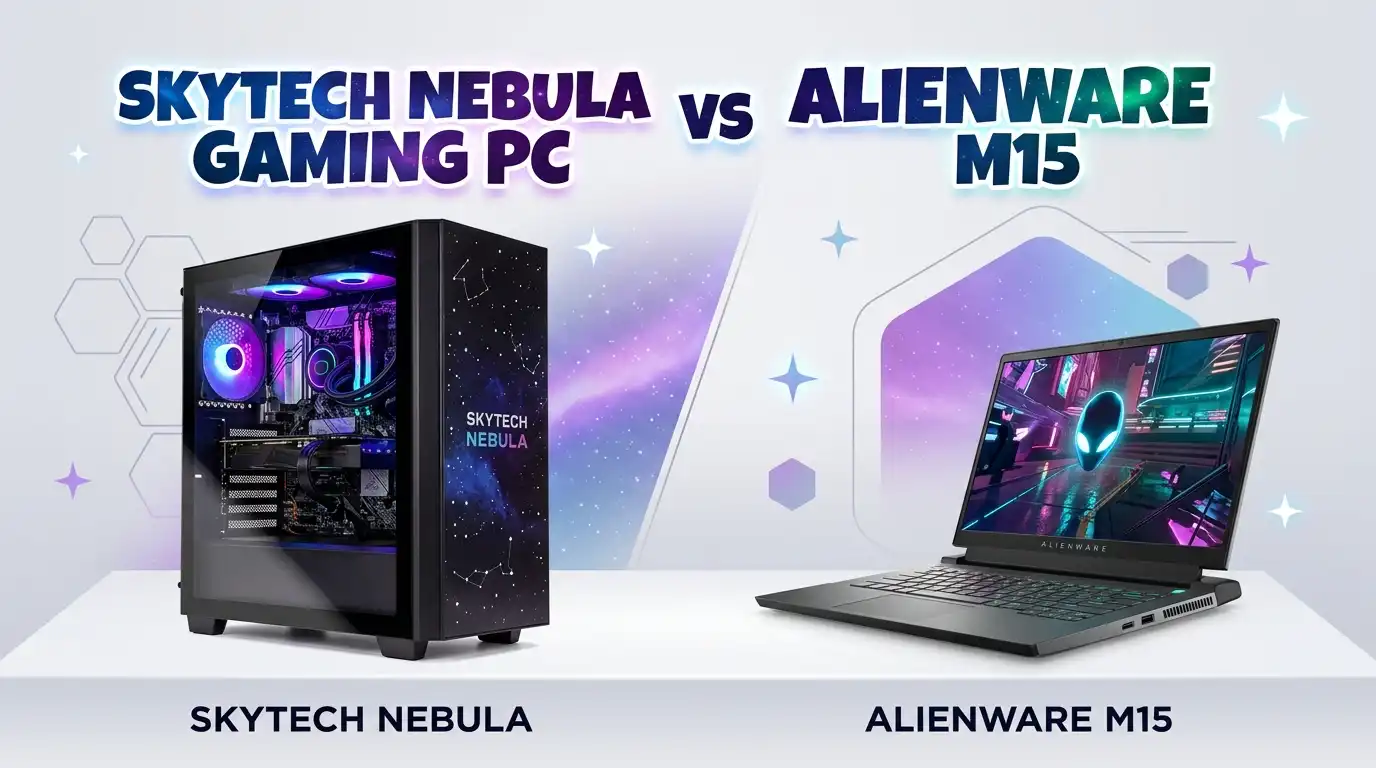
Skytech Nebula Gaming PC vs Alienware M15 in 2026
If you’re torn between buying a desktop gaming PC and a gaming laptop, you face a real decision. The Skytech Nebula gaming PC and Alienware M15 gaming laptop both deliver strong gaming performance. Yet each machine offers different advantages for different types of gamers.
This comparison guide will help you understand what makes each device special. You’ll learn about performance differences, pricing, and which option fits your gaming lifestyle. Whether you need a stationary powerhouse or a portable gaming machine, we’ll break down everything you need to know.
Both systems can handle modern games at high settings. The choice comes down to your priorities, budget, and how you play games. Let’s dive into the details.
Key Takeaways:
- Desktop Power vs Laptop Portability — The Skytech Nebula gives you maximum performance and expandability as a stationary gaming desktop, while the Alienware M15 offers portability and mobility for gamers who need to play anywhere, making it the better choice for students and travelers.
- Price and Value — Skytech Nebula gaming PCs typically cost less than comparable Alienware laptops with similar specs, offering superior value for budget-conscious gamers who want to get the most performance per dollar spent.
- Thermal Management and Cooling — Desktop PCs like the Nebula can use larger cooling solutions and maintain lower temperatures under load, while laptops experience thermal throttling under extended gaming sessions due to space constraints and heat dissipation challenges.
- Upgrade Path and Longevity — Skytech Nebula desktops allow you to upgrade individual components like RAM, storage, and graphics cards, while Alienware M15 laptops have limited upgrade options, making desktops a better long-term investment.
- Game Performance Consistency — Gaming desktops maintain stable frame rates throughout long gaming sessions, while gaming laptops may experience reduced performance after extended play due to thermal throttling and power management features.
Understanding the Skytech Nebula Gaming PC

Last update on 2026-10-11 / Affiliate links / Images from Amazon Product Advertising API Some of the links on this website are affiliate links, which means that at no additional cost to you, I earn a commission if you click through and make a purchase. I only recommend products and services that I believe will add value to my readers. Thank you for your support!
The Skytech Nebula represents a solid entry point into desktop gaming. This machine comes as a complete, ready-to-use gaming system. You simply unbox it, plug it in, and start playing. The Nebula includes an Intel Core i5-14400F processor paired with an NVIDIA RTX 5060 Ti graphics card in most configurations.
The desktop form factor provides several advantages. You get better cooling airflow, more expansion slots, and easier access to internal components. The Skytech Nebula ships with a full-size motherboard and case, giving you room to add more storage or upgrade components later. The power supply is typically 650 watts, which provides ample power for the included hardware.
Storage comes in the form of NVMe SSDs, which load games and applications faster than older drive types. The Nebula usually includes 16GB of DDR5 RAM, sufficient for gaming and light multitasking. Windows 11 Home comes pre-installed, so you can start gaming immediately without setup headaches.
The physical size of the Skytech Nebula makes it a dedicated gaming station. You’ll place this computer on or near your gaming desk. The desktop won’t move between locations easily, but this stationary nature allows for better cable management and optimal airflow design.
Pros and Cons of Skytech Nebula Gaming PC
Pros of Skytech Nebula:
The Skytech Nebula delivers exceptional value for the money when compared to gaming laptops with similar performance levels. You get more computing power per dollar spent, making it ideal for budget gamers. The desktop platform allows full upgrade potential for future improvements. You can swap out the graphics card, add more RAM, or install additional storage drives as your needs change.
Cooling performance stands as another major advantage. Larger fans and better air circulation keep components cooler. This means less thermal throttling and more consistent performance during extended gaming marathons. The system remains relatively quiet compared to gaming laptops, which use small fans at high RPMs.
The power delivery is superior. The desktop version of graphics cards performs better than laptop variants because they receive more power and cooling. Your gaming experience benefits from this extra muscle. You also get a full keyboard and mouse, plus the option to upgrade these peripherals easily.
Cons of Skytech Nebula:
The biggest drawback is lack of portability. You cannot take this desktop with you. It stays in one location permanently. Moving it between rooms requires careful handling to avoid damage.
Initial cooling out of the box may need optimization. Some users report that stock cooling configurations could be improved. Cable management requires attention to maintain proper airflow. The desktop occupies significant desk or floor space, which matters if you have limited room.
Electricity consumption is higher than laptops. The desktop draws more power during gaming, affecting your energy bills. The desktop also generates more noise under full gaming load, though still quieter than many gaming laptops.
Exploring the Alienware M15 Gaming Laptop

Last update on 2026-10-11 / Affiliate links / Images from Amazon Product Advertising API Some of the links on this website are affiliate links, which means that at no additional cost to you, I earn a commission if you click through and make a purchase. I only recommend products and services that I believe will add value to my readers. Thank you for your support!
The Alienware M15 R7 represents Dell’s flagship gaming laptop. This portable powerhouse combines Intel’s 12th generation processors with NVIDIA’s powerful graphics cards. The laptop features a 15.6-inch display with QHD resolution and a 240Hz refresh rate, delivering crisp visuals during intense gaming sessions.
The M15 R7 typically ships with an Intel Core i9-12900H processor and RTX 3080 graphics card, making it a true performance beast. The laptop includes 32GB of DDR5 RAM as standard, double what most base-model desktops offer. The 1TB SSD provides ample storage for your game library.
The display technology matters. The 240Hz refresh rate means smoother motion and faster response times when gaming at high frame rates. The Alienware M15 includes advanced cooling with dual vapor chambers and multiple fans working in concert.
This laptop is designed for gamers who move around. Whether traveling, attending LAN parties, or gaming at friends’ houses, the M15 goes with you. The 15.6-inch screen size represents the perfect balance between portability and screen real estate. It’s larger than ultrabooks but still carries in standard backpacks.
The Alienware design features distinctive aesthetics with RGB lighting, alien-inspired angular styling, and premium build quality. The keyboard includes mechanical switches for responsive gameplay. Connectivity options include Thunderbolt, USB-C, HDMI, and DisplayPort ports.
Pros and Cons of Alienware M15
Pros of Alienware M15:
The Alienware M15 offers outstanding portability. You take your gaming power anywhere. Travel, visit friends, or attend gaming events with your full gaming setup. The laptop requires no desk setup, just a power outlet and flat surface.
Performance is exceptional for a laptop. The RTX 3080 Ti and i9-12900H combination handles every modern game at high settings. The 240Hz display makes competitive gaming smooth and responsive. The dual vapor chamber cooling system keeps temperatures reasonable during extended play.
The display quality exceeds most gaming laptops. The QHD resolution provides sharp details, and the 240Hz refresh rate eliminates screen tearing. Color accuracy is decent, making it suitable for creative work beyond gaming. The Alienware brand carries premium positioning and excellent customer support from Dell.
The all-in-one nature means no assembly required. Everything is ready to use out of the box. Battery life provides enough runtime for light work away from a power outlet.
Cons of Alienware M15:
The price point stands significantly higher than desktop alternatives. You pay a premium for portability and compact engineering. A comparable desktop with similar specs costs hundreds less.
Upgrades are extremely limited. The RAM and storage might be user-upgradeable, but the graphics card and processor are soldered to the motherboard. You cannot improve performance through upgrades as easily as desktop systems.
Thermal throttling happens under sustained gaming loads. After 30 to 45 minutes of intense gaming, temperatures rise and performance reduces automatically to protect the hardware. The laptop cannot dissipate heat as effectively as a desktop design.
The keyboard and trackpad are permanent. You cannot swap them for better peripherals without external accessories. Weight and bulk make it harder to transport than ultrabooks, though easier than desktops. Battery life is modest, limiting unplugged gaming or work time.
Performance Comparison: Raw Gaming Power
The raw gaming performance differs between these machines. The Skytech Nebula with an RTX 5060 Ti delivers solid 1440p gaming at high settings. Frame rates in modern titles range from 80 to 120 FPS depending on game settings. The processor handles streaming and background tasks smoothly.
The Alienware M15 with RTX 3080 Ti achieves higher frame rates overall. In demanding titles, you’ll see 100 to 150 FPS at QHD settings. However, the performance gap narrows when both systems thermally throttle under sustained gaming.
The desktop advantage appears in sustained performance. After hours of gaming, the Skytech Nebula maintains consistent frame rates. The Alienware M15 experiences performance dips due to thermal throttling. Both systems can play any modern game, but the desktop keeps performing at peak capability longer.
The processor difference matters less for gaming. The i5-14400F in the Nebula keeps up with the i9-12900H in the Alienware. CPU performance becomes relevant in simulation games, streaming, and content creation. For pure gaming, both processors are sufficient.
Display and Visual Experience
The Alienware M15 R7 features a 15.6-inch QHD display with 240Hz refresh rate. This display is excellent for competitive gaming. The screen is integrated into the laptop, so you use it whenever you game.
The Skytech Nebula doesn’t include a monitor. You need to purchase one separately. This seems like a disadvantage initially, but it offers flexibility. You can buy the exact monitor you want, whether that’s high refresh rate for competitive gaming or high resolution for visual quality.
A quality gaming monitor for the Skytech Nebula might cost $200 to $400. Despite this extra expense, the total system cost remains lower than the Alienware M15. Monitor technology also improves faster than laptop displays, so you can upgrade your monitor independently as newer panels arrive.
The Alienware’s 240Hz display provides smoother motion in fast-paced games. You’ll notice reduced blur in shooters and fighting games. The QHD resolution balances sharpness and performance well on the 15.6-inch screen.
If you add a secondary monitor to the Alienware, it can output video externally. Many gamers place the M15 on a stand with an external keyboard and mouse at home. This setup provides a desktop-like experience while keeping the mobility option available.
Price Analysis and Value Proposition
The Skytech Nebula typically costs between $900 and $1,500 depending on specifications. A well-equipped model with RTX 5060 Ti and good processor runs around $1,200. Adding a quality gaming monitor costs an additional $200 to $400. Total system cost reaches approximately $1,500 to $1,700.
The Alienware M15 R7 starts around $1,800 and can exceed $2,500 for top configurations. The base RTX 3070 Ti model costs more than a fully equipped Skytech Nebula system. The RTX 3080 Ti version exceeds most desktop gaming PC prices.
Value calculation is straightforward. The Skytech Nebula delivers more performance per dollar. For the same budget as the Alienware M15, you get better gaming performance from a desktop setup. However, the Alienware M15 includes portability, which has real value for mobile gamers.
Consider your usage patterns. If you game at home exclusively, the desktop offers superior value. If you need gaming power away from home, the laptop’s premium is justified. Both offer good value in their respective categories.
Entry-level Skytech Nebula models with RTX 5060 start around $800 to $900. This price point creates a barrier for many gamers, but it remains less expensive than any comparable gaming laptop. The sweet spot for Nebula systems is $1,100 to $1,400, offering excellent mid-range gaming performance.
Cooling and Thermal Management
Thermal performance differentiates these systems significantly. The Skytech Nebula uses larger cooling solutions. The CPU cooler and case fans provide ample cooling surface area. Most Nebula systems keep GPUs under 75 degrees Celsius during gaming, and CPUs stay below 70 degrees Celsius under normal conditions.
The Alienware M15 uses dual vapor chamber technology, which is excellent for a laptop. However, space constraints limit cooling effectiveness. After 30 minutes of intense gaming, the M15 reaches 80 to 85 degrees Celsius on the GPU. When hitting 85 to 90 degrees, thermal throttling activates, reducing performance automatically.
Thermal throttling is the Alienware’s main performance limiter during extended gaming. The system reduces clock speeds to stay within safe temperature ranges. This protection prevents damage but reduces gaming performance. Gamers notice frame rate drops after playing for an hour straight.
The Skytech Nebula doesn’t need thermal throttling. The superior cooling keeps components in safe operating temperatures indefinitely. You can game for 8 hours straight without performance degradation from heat.
Some Skytech Nebula units could benefit from improved cable management or additional intake fans. The default configuration usually works fine, but optimization is possible. Case design and airflow patterns matter more than raw cooling capacity in desktops.
The Alienware M15 includes better-designed thermal solutions than most gaming laptops. The dual vapor chamber system is state-of-the-art for portable machines. However, the physics of laptop form factors limit what’s possible. Desktop cooling is inherently superior.
Portability and Lifestyle Fit
Portability is where these systems diverge completely. The Skytech Nebula is a stationary machine. It sits on your desk and stays there. Moving it between rooms is possible but cumbersome. Taking it to a LAN party or friend’s house isn’t practical without significant effort.
The Alienware M15 is designed for movement. At 5.5 pounds, it weighs more than an ultrabook but less than most gaming laptops. It fits in standard backpacks. You can take it to college, work, or gaming venues easily. Battery life isn’t great for gaming, but you get an hour or two of light use away from power.
If gaming happens exclusively at your desk, portability doesn’t matter. The Skytech Nebula serves you better. If you game in multiple locations, need to travel for work, or attend gaming events, the Alienware M15 becomes essential.
College students benefit from the Alienware M15. You can take it to your dorm, study areas, or friend’s houses. The portability enables a lifestyle that gaming desktops cannot match. Working professionals who game occasionally also appreciate the ability to pack a laptop.
Casual gamers who primarily game at home gain nothing from the Alienware’s portability. A desktop provides better performance and value. Consider your actual usage patterns honestly. The portability advantage only matters if you’ll actually use it.
Upgradability and Future-Proofing
The Skytech Nebula offers substantial upgrade potential. The motherboard has extra RAM slots. You can add more RAM years later if needed. The storage is user-replaceable NVMe SSD. Upgrading from 1TB to 2TB or faster drives is straightforward.
The graphics card is your biggest upgrade opportunity. The RTX 5060 Ti can be replaced with a better card when prices drop or new technology arrives. You might install an RTX 5070 or RTX 5080 in three to five years. This upgrade path extends the system’s lifespan significantly.
The CPU is more permanent. Replacing the processor requires changing the motherboard, which affects RAM compatibility and power supply requirements. However, the current CPU remains capable for gaming for many years.
The Alienware M15 offers almost no upgrade path. The graphics card is soldered to the motherboard. The processor is also integrated into the system. RAM might be user-upgradeable, but storage access requires disassembly.
This limitation means the Alienware M15 has a finite lifespan. When performance becomes insufficient, you cannot upgrade components. You must buy a new laptop. The Skytech Nebula can stay relevant longer through targeted upgrades.
For long-term value, the Skytech Nebula wins decisively. You might use it for five to seven years with component upgrades. The Alienware M15 likely needs replacement after three to five years.
Noise Levels During Gaming
Noise matters if you share space with others or prefer a quiet gaming environment. The Skytech Nebula runs relatively quietly during gaming. The case fans spin slower than laptop fans because they have more space for air movement. Most gamers report the desktop is quiet enough to maintain conversations while gaming.
The Alienware M15 generates noticeable noise during gaming. The compact design forces fans to spin faster to move adequate air. Gaming sessions produce fan noise that’s audible across a room. In quiet environments, the laptop fan noise is distracting.
The noise difference stems from physics. Small fans must spin faster to move the same air volume as larger fans. The laptop’s compact design doesn’t allow for larger cooling fans. This is an inherent limitation of gaming laptop design.
If you stream your gaming or record videos, the Skytech Nebula’s quieter operation is valuable. Microphones won’t pick up excessive fan noise. The Alienware M15 requires microphone positioning away from the fans or noise suppression software.
People sensitive to sound might find the Alienware M15’s noise bothersome during long sessions. The Skytech Nebula provides a more pleasant gaming environment. This factor doesn’t affect gameplay but improves overall experience.
Connectivity and Expansion Options
The Skytech Nebula provides standard desktop connectivity. You get USB ports on the rear and possibly front panels. HDMI and DisplayPort options allow connection to multiple monitors. Audio connectors include 3.5mm jacks for headphones and speakers.
Adding USB hubs, WiFi extenders, or capture cards is straightforward. The desktop case usually has empty expansion slots and USB headers for future additions. You can also add a second graphics card if the power supply and motherboard support it.
The Alienware M15 includes USB-C, USB-A, Thunderbolt, HDMI, and DisplayPort. The connectivity is comprehensive for a laptop. However, you’re limited to the ports included at purchase. Expansion requires external hubs and adapters.
The laptop excels at wireless connectivity. WiFi 6 and Bluetooth are excellent, which matters for portability. Desktop connectivity requires running cables, which is fine for a stationary setup. The Skytech Nebula might need longer cables if placed far from other equipment.
For gaming, both systems provide sufficient connectivity. For content creators or streamers, the Skytech Nebula’s expansion options offer flexibility that the Alienware M15 cannot match.
Power Consumption and Operating Costs
The Skytech Nebula draws more power than the Alienware M15. During gaming, the desktop consumes 400 to 500 watts. Running 40 hours per week for gaming costs approximately $30 to $40 monthly in electricity. Annual operating cost from gaming is around $360 to $480.
The Alienware M15 draws 150 to 200 watts during gaming. The same gaming schedule costs approximately $10 to $15 monthly. Annual operating cost is around $120 to $180. The laptop’s lower power consumption provides modest savings over time.
The difference isn’t enormous, but it adds up. Over five years, the Skytech Nebula costs $1,800 to $2,400 more in electricity. If you’re an extreme gamer playing 60+ hours weekly, costs increase accordingly. Casual gamers notice minimal impact on power bills.
Power consumption also affects your electricity bill’s environmental impact. The desktop uses more energy, but the performance advantage might justify the usage for some gamers. This is a personal value decision based on gaming frequency and environmental priorities.
Which System Suits Your Gaming Style
The Skytech Nebula is perfect for gamers who play at a dedicated desk. If your gaming chair and monitor occupy a permanent location, a desktop system is ideal. You gain maximum performance, upgrade potential, and value. The Nebula is the smart choice for budget-conscious PC gamers seeking serious performance.
The Alienware M15 suits gamers who move between locations regularly. Students, business travelers, and LAN party attendees benefit from the portability. You sacrifice upgrade potential and future-proofing, but you gain mobility. The M15 is the best choice for gamers who refuse to leave their gaming power at home.
Consider your actual gaming habits. Do you play at the same desk consistently, or do you game in multiple locations? Do you plan to keep your system for five+ years, or do you upgrade frequently? Do you value upgrade potential, or do you buy new systems when they’re outdated? Honest answers determine the best choice.
Casual gamers should consider the Skytech Nebula first. The performance-to-price ratio is unbeatable. The upgrade path extends system lifespan. Gaming casually doesn’t require portability, so the desktop advantage dominates. Competitive gamers might prefer the Alienware M15’s display quality if portability matters.
Final Verdict and Recommendation
The Skytech Nebula Gaming PC and Alienware M15 are both excellent systems. Neither is objectively superior. The choice depends entirely on your priorities.
The Skytech Nebula wins on value, performance consistency, upgradability, and cooling. Choose this system if you have a permanent gaming location, value money over portability, and plan to own the system for multiple years. The total cost of ownership is significantly lower.
The Alienware M15 wins on portability, build quality, and all-in-one convenience. Choose this laptop if you need to game away from home, travel frequently, or value the ability to pack your gaming setup anywhere. The premium price is justified by the mobility advantage.
Gaming laptops never match the performance-per-dollar ratio of desktops. Expect to pay more for less power when choosing portability. The Alienware M15 is the best gaming laptop, but a Skytech Nebula offers more gaming power for the same money.
Both systems deliver excellent gaming experiences. Either choice results in years of enjoyable gaming. The decision hinges on your lifestyle and priorities. Read the pros and cons of each carefully, consider your usage patterns, and choose the system that matches your actual gaming needs.
Frequently Asked Questions
Can I upgrade the Skytech Nebula components after purchasing it?
Yes, you can upgrade most Skytech Nebula components. You can add more RAM, install faster storage, or replace the graphics card with a newer model. The CPU requires motherboard replacement, which is less practical. Component upgrades extend the system’s lifespan significantly.
Does the Alienware M15 support external monitor connections?
Yes, the Alienware M15 includes HDMI and DisplayPort outputs. You can connect an external monitor, keyboard, and mouse to create a desktop-like setup. Many users dock their M15 at home while maintaining portability for travel.
Which system is better for content creation like video editing?
The Skytech Nebula is better for content creation. More RAM capacity, storage upgrade options, and consistent thermal performance make it superior. The Alienware M15 can handle editing but thermal throttling during rendering slows down work.
How long do these systems typically last before needing replacement?
The Skytech Nebula can remain useful for five to seven years with component upgrades. The Alienware M15 typically becomes outdated in three to five years due to limited upgrade options. Desktop systems have longer usable lifespans.
What’s the actual frame rate difference in gaming between these systems?
In competitive games, the Alienware M15 delivers 10 to 20 higher frames per second. In demanding AAA games, the difference narrows. Both systems handle modern games smoothly. The Skytech Nebula maintains consistent frame rates longer without thermal throttling.
Is the Alienware M15 suitable for gaming on battery power?
Gaming on battery provides only 30 to 45 minutes of gameplay before the battery depletes. You need a power outlet for extended gaming sessions. The Alienware M15 is designed to game plugged in, which eliminates the portability advantage in practice.

Hi, my name is Lily you can say i am a gadget hunter at this point. Welcome to Gadget Gallery The Gallery of Gadget Reviews