Roconia Projector vs Philips Projector: Ultimate Comparison
Buying a projector can feel like a guessing game. Two brands that keep coming up in online searches are Roconia and Philips. Both promise big screen entertainment at home, but they differ in price, features, and overall quality. So which one should you pick?
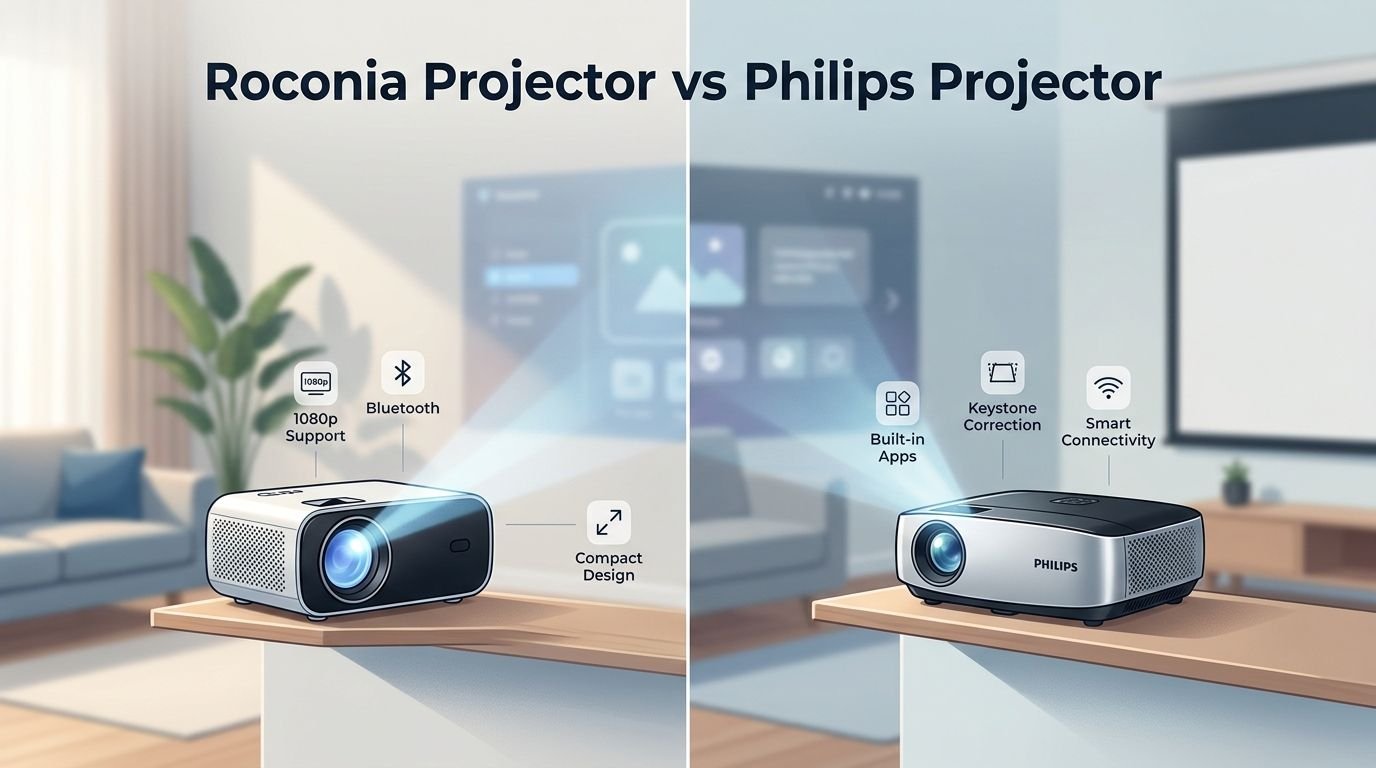
In this post, we put the Roconia 5G WiFi Bluetooth 1080P Projector head to head against the Philips NeoPix Prime 2 Smart Projector. We compare resolution, brightness, connectivity, audio, and value for money.
By the end, you will know exactly which projector fits your setup and budget. Whether you want a movie night powerhouse or a compact smart projector with built in apps, this guide breaks it all down. Let’s get started.
Key Takeaways:
- The Roconia projector offers native 1080P resolution and claims up to 18,000 lumens of brightness. It supports 4K content and projects up to a 300 inch screen. This makes it a strong pick for large rooms and outdoor movie nights.
- The Philips NeoPix Prime 2 runs a built in smart OS with preloaded apps like YouTube and Netflix. It supports 720P native resolution with 1080P input support. This makes it ideal for casual viewing in smaller rooms.
- Roconia wins on raw brightness and screen size. Its 10,000:1 contrast ratio and high lumen count deliver a vivid picture even in rooms with some ambient light. Philips relies more on a controlled, darker viewing environment.
- Philips wins on brand trust and smart features. The Philips name carries decades of electronics credibility. Its Android TV integration and Chromecast support let you stream content without any extra devices.
- Roconia is more affordable and often ships with a projector screen and carrying bag. Philips costs more upfront but offers a more polished software experience.
- Both projectors support Bluetooth and WiFi connectivity. However, Roconia uses 5G dual band WiFi and Bluetooth 5.1, while Philips offers dual band WiFi and Bluetooth for audio output. Your choice depends on whether you value raw performance or smart convenience.
Roconia 5G WiFi Bluetooth Native 1080P Projector Overview


Last update on 2026-10-13 / Affiliate links / Images from Amazon Product Advertising API Some of the links on this website are affiliate links, which means that at no additional cost to you, I earn a commission if you click through and make a purchase. I only recommend products and services that I believe will add value to my readers. Thank you for your support!
The Roconia projector has gained popularity as a budget friendly home theater option. It features a native 1920x1080P resolution and supports 4K content playback. The brand claims up to 18,000 lumens of brightness, though real world performance typically falls below that number.
This projector uses LCD technology and a 7 layer glass lens to produce clear images. It can project a screen size from 50 inches up to 300 inches. The throw distance ranges from about 5 to 20 feet.
It connects through HDMI, USB, AV, and 3.5mm audio ports. You also get 5G WiFi for wireless screen mirroring from iOS and Android devices. Bluetooth 5.1 lets you pair external speakers or headphones.
Pros:
- Native 1080P Full HD resolution with 4K support
- Very high brightness rating for a budget projector
- 300 inch maximum screen size
- 5G WiFi and Bluetooth 5.1 connectivity
- Comes with a projector screen and carrying bag
- Affordable price point under $200
Cons:
- Actual lumens may be lower than advertised
- Fan noise can be noticeable during quiet scenes
- No built in smart TV operating system
- Plastic build quality feels lightweight
- Color accuracy may shift at extreme screen sizes
Philips NeoPix Prime 2 Smart Projector Overview

Last update on 2026-10-11 / Affiliate links / Images from Amazon Product Advertising API Some of the links on this website are affiliate links, which means that at no additional cost to you, I earn a commission if you click through and make a purchase. I only recommend products and services that I believe will add value to my readers. Thank you for your support!
The Philips NeoPix Prime 2 takes a different approach. It focuses on smart features and brand reliability over raw specs. This projector has a native 720P HD resolution and supports 1080P input. It comes with a built in Philips OS loaded with streaming apps.
The display projects up to 80 inches in True HD. It weighs just 2.7 pounds, which makes it one of the most portable projectors in its class. Dual 5 watt speakers provide decent audio for a small to mid size room.
Connectivity options include two HDMI ports, USB, VGA, and a MicroSD slot. Dual band WiFi and Bluetooth round out the wireless options. The Philips OS gives you direct access to YouTube, Netflix, and other popular apps.
Pros:
- Built in Philips OS with preloaded streaming apps
- Extremely lightweight at just 2.7 pounds
- Dual HDMI ports for multiple devices
- Trusted Philips brand with proven track record
- Dual band WiFi and Bluetooth included
- Clean, modern design
Cons:
- Native resolution is only 720P
- Maximum screen size tops out at 80 inches
- Brightness rated at around 180 lumens (much dimmer)
- Higher price for lower raw specs
- Limited to smaller room setups
- No 4K support
Resolution and Picture Quality Comparison
Resolution matters a lot for picture clarity. The Roconia projector delivers native 1920x1080P resolution. This means every pixel on screen is a true Full HD pixel. It also accepts 4K input and downscales it. The result is a sharp and detailed image on screens up to 300 inches.
The Philips NeoPix Prime 2 runs at native 720P (1280×720). It can accept 1080P input signals, but it displays them at 720P. On an 80 inch screen, this still looks good. But it cannot match the Roconia’s detail on larger displays.
If picture sharpness is your top priority, the Roconia has a clear advantage here. The Full HD native resolution makes text crisper and details finer. Philips works well enough for casual movie watching, but it falls short for gaming or detailed presentations.
Brightness and Contrast Ratio
Brightness determines how well a projector performs in different lighting conditions. Roconia advertises up to 18,000 lumens with a 10,000:1 contrast ratio. These marketing numbers are likely inflated, but even at real world output, the Roconia produces a noticeably bright image.
The Philips NeoPix Prime 2 rates at roughly 180 lumens. This is a massive difference. You will need a very dark room to get the best picture from the Philips. Any ambient light will wash out the image quickly.
For daytime viewing or rooms with windows, the Roconia is the better choice. The Philips works best in a dedicated dark room setting. This is one of the biggest gaps between these two projectors and a key factor in your buying decision.
Connectivity and Wireless Features
Both projectors offer solid connectivity, but they serve different needs. The Roconia features 5G WiFi and Bluetooth 5.1. It supports wireless screen mirroring from iPhones, Android phones, and Windows laptops. Wired connections include HDMI, USB, AV, and a 3.5mm audio jack.
The Philips NeoPix Prime 2 includes dual band WiFi and Bluetooth along with two HDMI ports, USB, VGA, and a MicroSD card slot. The extra HDMI port is a nice bonus if you connect multiple devices like a gaming console and a streaming stick at the same time.
Roconia’s 5G WiFi offers faster wireless streaming with less lag. Philips has the edge with its built in smart OS, which removes the need for external streaming devices entirely. Your preference depends on whether you already own a Fire Stick or Roku, or you want everything built in.
Smart Features and Operating System
This is where the Philips projector pulls ahead. The NeoPix Prime 2 comes with a built in Philips OS preloaded with apps like YouTube and Netflix. You can browse, search, and stream directly from the projector. No extra device needed.
The Roconia projector does not include a built in smart TV system. You need to connect an external streaming device like a Fire TV Stick, Roku, or Chromecast. Some newer Roconia models support direct Netflix access, but the core model relies on external devices.
If you want a plug and play experience, Philips gives you that right out of the box. If you already own streaming devices and prefer a better picture, the Roconia still gets the job done with a bit more setup.
Audio Quality
Sound quality often gets overlooked in projector comparisons. The Roconia projector includes dual built in speakers. They provide basic audio that works for casual viewing. The sound is clear but lacks bass and depth. You will want external speakers for a true home theater experience.
The Philips NeoPix Prime 2 has two 5 watt speakers that deliver slightly better audio. The stereo separation is decent for a projector this compact. Philips has a long history of audio engineering, and it shows in the sound output here.
Both projectors support Bluetooth audio output. This means you can pair a soundbar or Bluetooth speaker with either one. For the best experience, investing in a separate sound system is the right move regardless of which projector you choose.
Portability and Design
The Philips NeoPix Prime 2 weighs just 2.7 pounds. It is compact, sleek, and easy to carry from room to room. The modern design looks good on a shelf or table. This projector fits easily into a backpack for travel.
The Roconia projector is larger and heavier due to its bigger lens and cooling system. It still qualifies as portable, but it is more of a semi permanent setup option. The included carrying bag helps with transport.
If you need a projector for travel, small gatherings, or bedroom use, the Philips wins on portability. If the projector stays in one room most of the time, the Roconia’s larger size is not a drawback. It also ships with a tripod screen, which adds value.
Price and Value for Money
The Roconia projector typically sells for under $150 on Amazon. It often comes bundled with a projector screen and carrying bag. For the price, you get Full HD resolution, high brightness, and wide connectivity. This is exceptional value in the budget projector market.
The Philips NeoPix Prime 2 usually costs between $150 and $250. You pay more for the Philips brand name, smart OS, and compact design. However, the lower resolution and brightness mean you get less raw performance per dollar.
If your budget is tight, the Roconia delivers more projector for less money. If you prefer a premium brand with smart features and do not need a huge screen, the Philips justifies its higher price for certain buyers.
Best Use Cases for Each Projector
The Roconia projector shines in specific setups. It works great for outdoor movie nights because of its high brightness and large screen support. It pairs well with gaming consoles thanks to its Full HD resolution and low input lag. Backyard parties and large living rooms are its sweet spot.
The Philips NeoPix Prime 2 fits different scenarios. It excels in bedrooms, small apartments, and office presentations. The smart OS makes it perfect for someone who wants a simple streaming setup without cables and extra devices.
Think about where and how you plan to use your projector. Big screen and bright rooms favor Roconia. Small screen and dark rooms favor Philips. Match the projector to your space for the best results.
Who Should Buy the Roconia Projector?
The Roconia is a great pick for budget conscious buyers who want big screen entertainment. If you host movie nights, watch sports, or game on a large display, this projector delivers solid performance. The 5G WiFi and Bluetooth 5.1 connectivity keep things wireless and simple.
It also suits people who already own a Fire TV Stick, Roku, or Apple TV. Since the Roconia lacks built in apps, pairing it with an existing streaming device gives you the best of both worlds. You get Full HD visuals on a massive screen at a fraction of the cost of a big TV.
First time projector buyers will appreciate the included screen and bag. You can set up your home theater right away without spending extra on accessories.
Who Should Buy the Philips Projector?
The Philips NeoPix Prime 2 is ideal for people who value convenience and brand quality. If you want to take a projector out of the box, connect to WiFi, and start streaming immediately, Philips delivers that experience. The built in apps remove extra steps from your setup.
It works best for travelers, students, and small space dwellers. The lightweight body and compact footprint fit anywhere. The dual HDMI ports also make it useful for quick office or classroom presentations.
Buyers who prioritize design and portability over screen size will love the Philips. It is a lifestyle projector that looks good and works smoothly in small to medium rooms.
Final Verdict: Roconia Projector vs Philips Projector
Both projectors serve different audiences. The Roconia projector wins on specs, brightness, screen size, and price. It is the better choice for large rooms, outdoor use, and budget buyers who want maximum performance per dollar.
The Philips NeoPix Prime 2 wins on smart features, portability, brand trust, and ease of use. It is the better choice for small rooms, travel, and buyers who want a self contained streaming experience without extra devices.
There is no single winner here. Your best projector depends on your room size, budget, and feature priorities. For raw value and performance, go Roconia. For smart convenience and portability, go Philips.
Frequently Asked Questions
Is the Roconia projector good for gaming?
Yes. The Roconia projector supports native 1080P resolution and 4K input. It connects through HDMI, which works with PS4, PS5, Xbox, and Nintendo Switch. The large screen size up to 300 inches creates an immersive gaming experience. Pair it with external speakers for the best setup.
Does the Philips NeoPix Prime 2 have Netflix built in?
The Philips NeoPix Prime 2 comes with a built in Philips OS that includes preloaded apps. YouTube is available directly. Netflix access may require a firmware update or may work through the integrated browser or Chromecast. Check the latest app availability on the Philips store.
Can I use the Roconia projector outdoors?
Absolutely. The Roconia projector’s high brightness makes it one of the better budget options for outdoor movie nights. It ships with a screen and carrying bag. Set it up in a backyard, patio, or campsite. Just make sure you have a power source nearby.
Which projector has better sound quality?
The Philips NeoPix Prime 2 has a slight edge in audio with its dual 5 watt speakers. Roconia has built in dual speakers too, but they are less refined. Both projectors support Bluetooth audio output, so pairing an external speaker is the best option for either model.
How long do the lamps last on these projectors?
Both projectors use LED light sources. The Roconia projector has a rated lamp life of approximately 50,000 hours. The Philips NeoPix Prime 2 offers a similar LED lifespan of around 30,000 hours. LED lamps last far longer than traditional bulbs and do not need frequent replacement.
Are these projectors worth buying in 2026?
Both remain solid choices in the budget projector category. The Roconia delivers impressive specs for its price. The Philips offers a polished user experience with smart features. If you want a home theater on a budget, either one can serve you well depending on your specific needs and room setup.

Hi, my name is Lily you can say i am a gadget hunter at this point. Welcome to Gadget Gallery The Gallery of Gadget Reviews