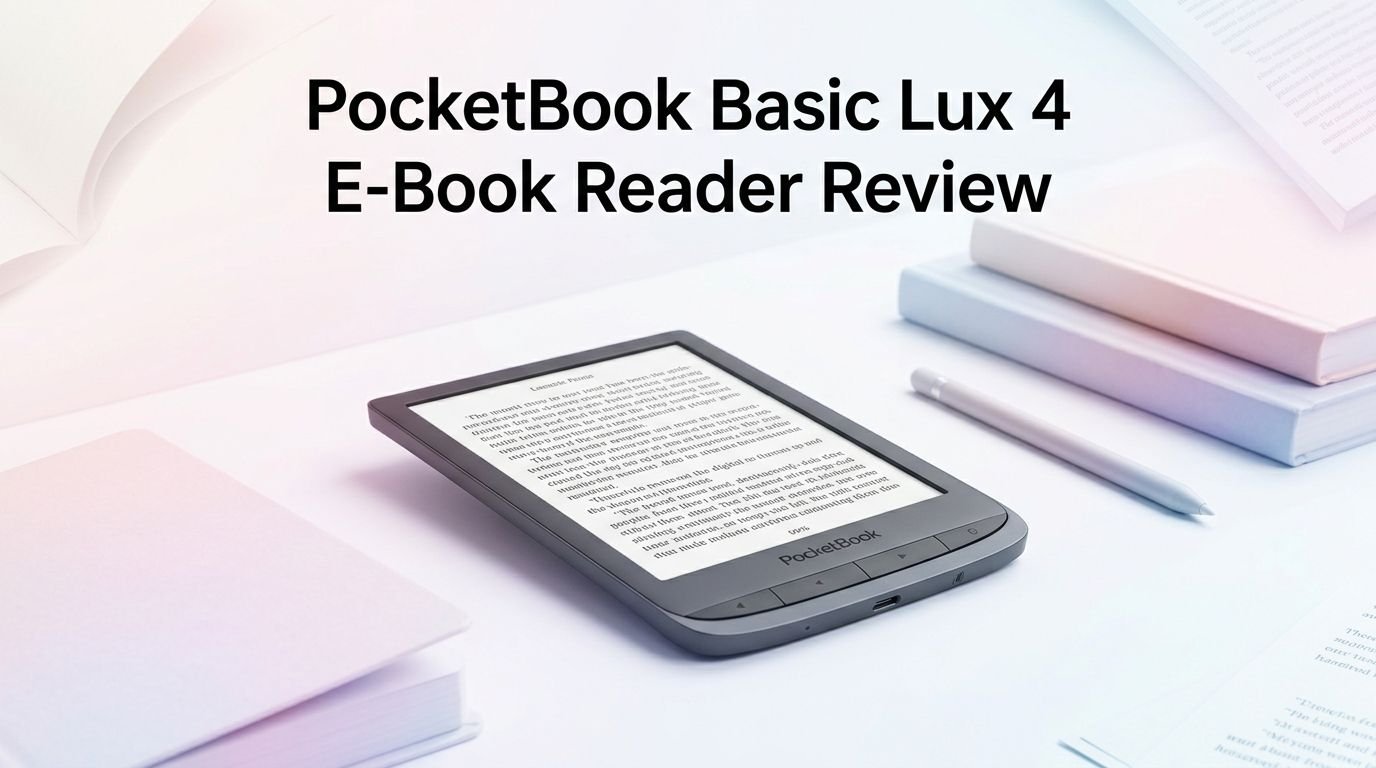
PocketBook Basic Lux 4 E-Book Reader Review 2026: Worth It?
Are you looking for a simple, affordable e-reader that just lets you read? The PocketBook Basic Lux 4 might be the device you have been searching for. In a market full of flashy screens, color displays, and app-loaded tablets, this little 6-inch reader takes a different path. It focuses on one thing: reading.
The PocketBook Basic Lux 4 has been around since 2023. Yet it continues to attract readers who want a lightweight, distraction-free experience.
It supports more file formats than almost any Kindle. It offers expandable storage through a microSD slot. And it costs less than most of its competitors.
Key Takeaways:
- The PocketBook Basic Lux 4 features a 6-inch E Ink Carta display with 212 PPI resolution. The screen is glare-free and comfortable for long reading sessions. It does not strain your eyes like a phone or tablet screen would.
- It runs on a Dual Core 1 GHz processor with 512 MB of RAM and 8 GB of internal storage. You can expand that storage up to 32 GB with a microSD card. This gives you room for thousands of books without worrying about space.
- File format support is outstanding. This reader handles EPUB, PDF, FB2, MOBI, DJVU, DOC, DOCX, TXT, RTF, HTML, CBR, CBZ, and more. You do not need to convert files before loading them. This is a huge advantage over Kindle devices.
- Battery life lasts up to one month on a single charge. The 1300 mAh battery keeps up with daily reading. It charges through a Micro-USB port, which is a bit dated but functional.
- The price sits well under $110, making it one of the most affordable dedicated e-readers available. It competes directly with the base model Kindle but offers more format flexibility and expandable storage.
- The device weighs just 155 grams. That makes it lighter than most smartphones. You can hold it in one hand for hours without fatigue.

Last update on 2026-08-29 / Affiliate links / Images from Amazon Product Advertising API Some of the links on this website are affiliate links, which means that at no additional cost to you, I earn a commission if you click through and make a purchase. I only recommend products and services that I believe will add value to my readers. Thank you for your support!
PocketBook Basic Lux 4 E-Book Reader: Full Overview
The PocketBook Basic Lux 4 is an entry-level e-reader made by PocketBook International. This company was founded in Ukraine in 2007 and now operates from Switzerland. PocketBook has earned a loyal following in Europe and is growing in popularity across North America.
This model launched in mid-2023 at a retail price of $109. It replaced the Basic Lux 3 and brought small but meaningful improvements. The upgrades include a faster processor, better frontlight, and a refreshed interface.
The Basic Lux 4 runs on a Linux-based operating system. It does not rely on any single bookstore ecosystem. You can buy books from almost any online store, download free public domain titles, or sideload your personal collection. This open approach sets PocketBook apart from Amazon and Kobo.
The device connects to Wi-Fi for downloading books from the PocketBook Cloud or a built-in browser. You can also transfer files via USB. The reading interface is clean and simple. You get adjustable fonts, margins, line spacing, and page orientation. Dictionary support comes built in with multiple languages.
PocketBook also includes its Send-to-PocketBook feature. This lets you email files directly to your device. It works much like Amazon’s Send-to-Kindle service.
Display Quality and E-Ink Technology
The PocketBook Basic Lux 4 uses a 6-inch E Ink Carta touchscreen display. The resolution sits at 758 x 1024 pixels, giving you a pixel density of 212 PPI. This is lower than the 300 PPI found on newer Kindles and Kobos.
Does the lower PPI matter in practice? For most readers, the difference is small. Text looks sharp and clear at standard font sizes. You may notice slightly less crispness on very small fonts. But for normal reading conditions, the display performs well.
The E Ink Carta technology provides a paper-like reading surface. There is no backlight glare, and the screen stays easy on your eyes. You can read outdoors in direct sunlight without any issues. The display does not emit blue light the way phone and tablet screens do.
The frontlight on this device lets you read in dark rooms. It offers adjustable brightness levels. However, it does not include warm light adjustment (color temperature control). This means you only get a cool white light. If warm-toned lighting matters to you, you may want to look at higher-end models.
Page refresh rates are reasonable. Ghost images appear occasionally during page turns. A full refresh clears them up. PocketBook lets you set how often full page refreshes happen, giving you control over the reading experience.
Top 3 Alternatives for PocketBook Basic Lux 4
1. Amazon Kindle (2024) 16GB


Last update on 2026-08-29 / Affiliate links / Images from Amazon Product Advertising API Some of the links on this website are affiliate links, which means that at no additional cost to you, I earn a commission if you click through and make a purchase. I only recommend products and services that I believe will add value to my readers. Thank you for your support!
2. Kobo Clara BW

Last update on 2026-08-29 / Affiliate links / Images from Amazon Product Advertising API Some of the links on this website are affiliate links, which means that at no additional cost to you, I earn a commission if you click through and make a purchase. I only recommend products and services that I believe will add value to my readers. Thank you for your support!
3. Amazon Kindle Paperwhite 16GB (2024)

Last update on 2026-08-29 / Affiliate links / Images from Amazon Product Advertising API Some of the links on this website are affiliate links, which means that at no additional cost to you, I earn a commission if you click through and make a purchase. I only recommend products and services that I believe will add value to my readers. Thank you for your support!
Build Quality and Design
The PocketBook Basic Lux 4 has a compact and lightweight design. It measures approximately 108 x 161 x 8 mm. It weighs only 155 grams. That makes it one of the lightest e-readers you can buy right now.
The body is made from plastic with a matte finish on the back. The matte texture gives you a secure grip and resists fingerprints. The front bezel has a slim border around the screen. It is not the thinnest bezel on the market, but it keeps the overall size small.
On the bottom edge, you will find the Micro-USB port, a microSD card slot, and the power button. The power button has a small LED indicator built into it. This LED tells you the charging and power status of the device.
Performance and Processing Power
Under the hood, the PocketBook Basic Lux 4 runs a Dual Core processor clocked at 2 x 1 GHz. It has 512 MB of RAM. This combination handles e-book rendering, page turns, and menu navigation with acceptable speed.
Page turns happen quickly for standard EPUB and FB2 files. PDF files take a bit longer to render, especially if they contain complex layouts or images. This is common across budget e-readers. Heavy PDF users may want a more powerful device.
The Linux-based operating system is lightweight and efficient. It boots up fast and uses minimal resources. You will not find apps, games, or a web browser that loads quickly. The built-in browser is basic and slow. It works in a pinch for downloading a book but not for casual browsing.
Menu navigation feels smooth. Swiping through your library, adjusting settings, and searching for books all happen without major delays. The device handles large libraries well. Even with hundreds of books loaded, scrolling through your collection stays responsive.
File Format Support
This is one area where the PocketBook Basic Lux 4 truly stands out. It supports an impressive range of file formats right out of the box. You do not need to convert anything before transferring files.
Supported book formats include EPUB, EPUB DRM, PDF, PDF DRM, FB2, FB2.ZIP, DJVU, DOC, DOCX, RTF, PRC, TXT, CHM, HTM, HTML, and MOBI. Image formats include JPEG, BMP, PNG, and TIFF. Audio is not supported on this model.
For comparison, the Amazon Kindle only reads AZW, MOBI, and a limited set of other formats natively. The PocketBook reads almost everything you throw at it. This makes it perfect for readers who get books from multiple sources.
The EPUB support is a major advantage. EPUB is the most common open e-book format used by libraries, independent publishers, and online stores. If you borrow books from a public library through services other than Kindle, EPUB compatibility is essential.
Storage and Expandability
The PocketBook Basic Lux 4 comes with 8 GB of internal storage. After the operating system and pre-loaded content take their share, you get roughly 6 GB of usable space. That is enough for several thousand standard e-books.
What sets this device apart is the microSD card slot. You can insert a microSD card up to 32 GB. This gives you a total of 40 GB of storage. Very few modern e-readers offer expandable storage anymore. Amazon dropped this feature years ago. Kobo also moved away from SD card slots.
The microSD slot sits on the bottom edge of the device. Inserting and removing a card is easy. The device recognizes the card instantly and adds books from it to your library.
This expandable storage option is ideal for readers with large collections. Comic book readers, in particular, benefit from extra space. CBR and CBZ files can be much larger than standard text-based e-books. Having 32 GB of additional room keeps you from deleting old books to make space.
File management is straightforward. You can organize books into folders on your computer and transfer them via USB. The PocketBook library interface also lets you sort by title, author, date, or format.
Battery Life and Charging
The PocketBook Basic Lux 4 packs a 1300 mAh lithium-ion polymer battery. PocketBook claims it can last up to one month on a single charge. Real-world results depend on your usage habits.
If you read for about 30 minutes to an hour each day with Wi-Fi turned off and the frontlight at a low setting, one month is realistic. Heavier use, higher brightness, and active Wi-Fi will reduce battery life. Most users report getting two to three weeks of regular use per charge.
The device charges through a Micro-USB port. This is one of the more disappointing aspects of the hardware. Most modern devices have switched to USB-C. Micro-USB is slower and less convenient. You may need to keep a separate cable around if all your other devices use USB-C.
Charging from empty to full takes about two to three hours. A quick top-up before a trip gives you days of reading time. The low power consumption of E Ink technology is a genuine advantage. You do not need to worry about charging this device every night like a smartphone.
The power button LED glows while charging and turns off when the battery is full. This small indicator is helpful for knowing when to unplug.
Software Features and User Interface
The PocketBook Basic Lux 4 runs on a proprietary Linux-based operating system. The interface is clean, simple, and focused on reading. There are no distracting apps, notifications, or social media integrations.
The home screen shows your recent books and gives quick access to your library, bookstore, settings, and applications. Navigation uses the touchscreen. Swiping left or right turns pages. Tapping the top of the screen brings up the menu bar.
Reading customization options are generous. You can change fonts, font sizes, margins, line spacing, text alignment, and page orientation. Multiple font choices are available, and you can add custom fonts through the device’s storage.
The built-in dictionary supports multiple languages. You can tap and hold any word to see its definition. A translation feature is also available for translating words between languages. This makes the PocketBook useful for language learners.
PocketBook Cloud syncs your reading position, bookmarks, and notes across devices. You can start reading on your PocketBook and continue on your phone using the PocketBook Reader app. The Send-to-PocketBook email feature lets you send documents directly to the device wirelessly.
Other built-in apps include a calculator, calendar, and a basic web browser. The browser works but is not meant for regular internet use. It loads pages slowly and renders them with limited accuracy.
Frontlight and Reading Comfort
Reading comfort is a strong point of the PocketBook Basic Lux 4. The E Ink Carta display mimics real paper and does not cause the eye fatigue associated with LCD and OLED screens.
The frontlight illuminates the screen from the edges. It provides even, consistent lighting across the display. You can adjust the brightness manually through a quick slider in the top menu. There is no automatic brightness sensor, so you need to adjust it yourself.
One limitation is the absence of adjustable color temperature. Many competing e-readers let you shift the light from cool white to warm amber. Warm light is easier on the eyes during nighttime reading. The PocketBook Basic Lux 4 only offers cool white light.
Despite this limitation, the frontlight performs well in most conditions. In a dimly lit room, a low brightness setting provides comfortable reading. In complete darkness, a medium setting works without causing eye strain.
During daytime and outdoor reading, you can turn the frontlight off entirely. The E Ink screen reflects ambient light just like paper. You get excellent readability in sunlight without any power consumption from the light.
The anti-glare surface of the screen also helps. Even under direct overhead lighting, reflections stay minimal. This contributes to a pleasant, distraction-free reading session.
Connectivity and Cloud Features
The PocketBook Basic Lux 4 connects to the internet through Wi-Fi (802.11 b/g/n). There is no Bluetooth on this model. This means you cannot connect wireless earphones or use audio features.
Wi-Fi serves a few important functions. First, it connects you to the PocketBook Cloud. This cloud service stores your purchased books, reading progress, bookmarks, and notes. Your data syncs across PocketBook devices and the PocketBook Reader app on smartphones and tablets.
Second, Wi-Fi enables the Send-to-PocketBook feature. Each device gets a unique email address. When you send a file to that address, it appears on your device automatically. This works with EPUB, PDF, and several other formats. It is a convenient way to load new books without a USB cable.
Third, the device has a built-in web browser. You can visit online bookstores, download free e-books, or access the PocketBook store. The browser is functional but slow. It is best used for quick downloads, not regular web browsing.
The PocketBook store offers a selection of e-books. However, the catalog is smaller than Amazon’s or Kobo’s. Most PocketBook users buy books from other stores or download free titles from sites like Project Gutenberg. The open file format support makes this easy and flexible.
There is no cellular connectivity. You need a Wi-Fi network for any online features.
PocketBook Basic Lux 4 vs. Amazon Kindle (2024)
Last update on 2026-08-29 / Affiliate links / Images from Amazon Product Advertising API Some of the links on this website are affiliate links, which means that at no additional cost to you, I earn a commission if you click through and make a purchase. I only recommend products and services that I believe will add value to my readers. Thank you for your support!
These two devices compete directly on price. The Amazon Kindle (2024) costs around $95 while the PocketBook Basic Lux 4 sits near $100 to $110. Both target budget-conscious readers, but they differ in several ways.
The Kindle offers a sharper 300 PPI display compared to the PocketBook’s 212 PPI. Text looks crisper on the Kindle, especially at smaller font sizes. The Kindle also uses USB-C for charging, which is more modern and convenient.
However, the PocketBook wins on file format support. The Kindle locks you into Amazon’s ecosystem. You need to buy books from Amazon or convert files to Kindle-compatible formats. The PocketBook reads EPUB, PDF, DJVU, FB2, and many more formats natively.
Storage expandability is another PocketBook advantage. The Kindle offers 16 GB with no expansion option. The PocketBook gives you 8 GB plus a microSD slot for up to 32 GB more.
The Kindle integrates with Amazon’s massive bookstore and Kindle Unlimited subscription service. It also supports Audible audiobooks via Bluetooth. The PocketBook has no audio support and a smaller bookstore.
Both devices lack waterproofing. Both weigh under 160 grams. The right choice depends on your priorities. Choose the Kindle for display quality and the Amazon ecosystem. Choose the PocketBook for format freedom and expandable storage.
Pros and Cons of the PocketBook Basic Lux 4
Every device has strengths and weaknesses. Here is an honest look at both sides of the PocketBook Basic Lux 4.
The strengths are clear. The file format support is the best in its price range. The microSD card slot adds flexibility that almost no competitor offers. The lightweight design makes it perfect for one-handed reading and travel. The battery lasts weeks on a single charge. The frontlight works well for indoor reading.
The weaknesses deserve attention too. The 212 PPI screen is noticeably behind the 300 PPI standard. The Micro-USB charging port feels outdated in 2026. The lack of warm light adjustment limits nighttime reading comfort. There is no water resistance for reading near pools, baths, or beaches. Bluetooth is absent, so audiobooks are not an option.
The Linux-based software is stable but limited. You will not find the app selection or ecosystem depth of Amazon or Kobo. The PocketBook bookstore has a smaller catalog than its bigger competitors.
PDF reading on the 6-inch screen can feel cramped. While the reflow feature helps, it does not work perfectly with every document. Readers who work with PDFs regularly may want a larger screen.
Overall, the pros outweigh the cons for readers who prioritize format compatibility and simplicity. It does what it promises: it lets you read your books, your way, without fuss.
Final Verdict: Is the PocketBook Basic Lux 4 Worth Buying in 2026?
The PocketBook Basic Lux 4 remains a solid choice for a specific audience. It does not try to be everything for everyone. Instead, it excels at being a simple, open, and affordable reading device.
In 2026, the competition has grown stronger. The Kindle (2024) offers a sharper screen and USB-C. The Kobo Clara BW adds waterproofing and a warm light. But neither matches the PocketBook’s file format range or expandable storage.
If you want freedom from any single bookstore ecosystem, this device delivers. You can load books from anywhere, in almost any format, without conversion hassles. That flexibility has real everyday value.
The price point remains attractive. At around $100, you get a capable e-reader that handles daily reading with ease. The month-long battery life, featherlight weight, and paper-like screen make reading a pleasure.
Is it perfect? No. The screen resolution, charging port, and lack of waterproofing show its age. But for what it costs, it offers remarkable value. The PocketBook Basic Lux 4 earns a recommendation for format-conscious readers who want an open and uncomplicated e-reading experience.
Frequently Asked Questions
Does the PocketBook Basic Lux 4 support Kindle books?
The PocketBook Basic Lux 4 supports MOBI files, which is a format used by older Kindle books. However, it does not support Amazon’s newer KFX or AZW3 DRM-protected formats. You can read DRM-free Kindle files on the PocketBook. For DRM-protected Amazon books, you would need a Kindle device.
Can I borrow library books on the PocketBook Basic Lux 4?
Yes, you can read library books in EPUB and PDF formats. Many library systems use Adobe DRM for lending. The PocketBook supports Adobe DRM-protected EPUB and PDF files. You can borrow books through compatible library services and load them onto the device.
Does the PocketBook Basic Lux 4 have a warm light?
No, this model does not include adjustable color temperature. The frontlight provides cool white illumination only. If you want warm light for nighttime reading, you should consider the PocketBook Verse or a Kindle Paperwhite instead.
Is the PocketBook Basic Lux 4 waterproof?
No, the PocketBook Basic Lux 4 does not have any water resistance rating. You should keep it away from water, including pools, bathtubs, and rain. The Kindle Paperwhite and Kobo Clara BW both offer IPX8 waterproofing if you need that feature.
How do I transfer books to the PocketBook Basic Lux 4?
You have several options. You can connect the device to your computer via Micro-USB and drag files into the device storage. You can use the Send-to-PocketBook email feature to send files wirelessly. You can also download books directly through the built-in Wi-Fi browser or PocketBook Cloud. Additionally, you can load books onto a microSD card and insert it into the device.
How long does the PocketBook Basic Lux 4 battery last?
PocketBook states the battery lasts up to one month. Real-world usage typically delivers two to three weeks of regular reading. Battery life depends on frontlight brightness, Wi-Fi usage, and daily reading time. Turning off Wi-Fi and lowering the frontlight extends battery life significantly.

Hi, my name is Lily you can say i am a gadget hunter at this point. Welcome to Gadget Gallery The Gallery of Gadget Reviews