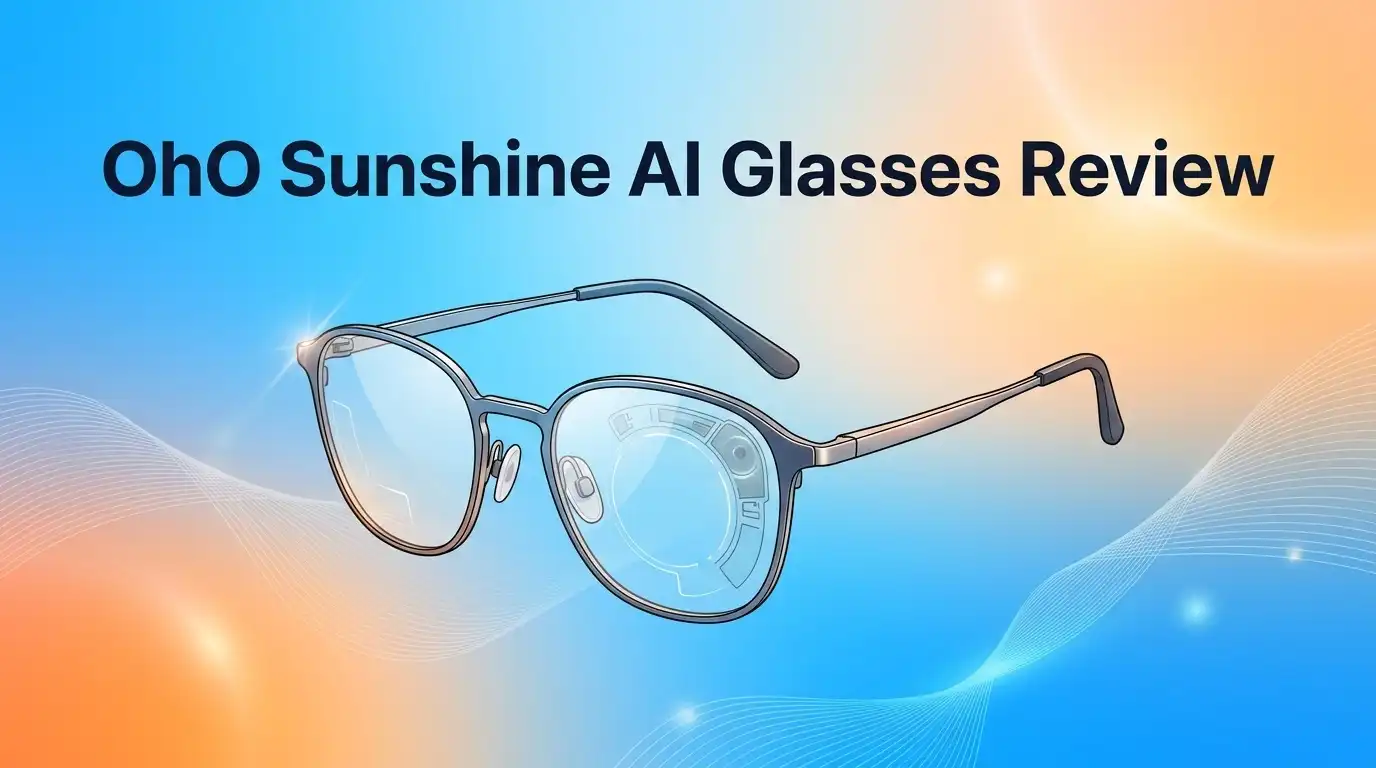
OhO Sunshsine AI Glasses Review 2026: Worth Buying?
Smart glasses used to cost a small fortune. In 2026 that has changed fast. The OhO sunshsine AI Glasses sit at the budget end of the market, yet they promise open ear audio, an onboard AI assistant, and live translation in over a hundred languages. That combination sounds almost too good for the price.
So I wore them for three weeks. I used them on morning walks, on video calls, at a busy coffee shop, and during one very windy bike ride. I also tried the translation feature on a Spanish speaking neighbour who was kind enough to play along.
This review covers what these glasses actually deliver, and where they fall short. No marketing fluff. Just honest observations from daily use, plus a few alternatives if these are not the right fit for your face or your budget.
In a Nutshell:
- The price is the headline feature. These glasses land far below Ray Ban Meta pricing. You get open ear speakers, a microphone, AI voice access, and translation for roughly the cost of a decent pair of wireless earbuds. That value gap is the single strongest reason to consider them.
- Audio quality is good, not great. The open ear drivers produce clear vocals and surprisingly usable volume indoors. Bass is thin and outdoor wind noise cuts through easily. They work well for podcasts and calls, less well for music you actually care about.
- Battery life holds up. OhO advertises 10 hours of playtime. I measured closer to eight hours at moderate volume with the microphone active. That still covers a full work day for most people.
- Translation works, but it is not instant. Expect a short delay between speech and output. It handles slow, clear conversation well. It struggles with fast talkers, slang, and background noise.
- There is no camera on this model. If you want photo and video capture, you need a different OhO product entirely. Many buyers miss this detail and end up disappointed.
- Build quality feels light and plasticky. The TR90 frame is comfortable and durable enough, but it does not feel premium in the hand. This is a budget product and it looks the part up close.
What Are the OhO Sunshsine AI Glasses?

Last update on 2026-10-13 / Affiliate links / Images from Amazon Product Advertising API Some of the links on this website are affiliate links, which means that at no additional cost to you, I earn a commission if you click through and make a purchase. I only recommend products and services that I believe will add value to my readers. Thank you for your support!
The OhO sunshsine AI Glasses are audio sunglasses with a voice assistant built in. OhO Sunshine is a Chinese eyewear brand that has sold Bluetooth glasses and camera glasses for several years. This AI model is one of their newer releases.
The frame houses two small speakers near your temples. These fire sound down at your ears without covering them. Your ears stay completely open, so you still hear traffic, conversation, and your surroundings.
A microphone array sits in the frame arms. It handles phone calls, voice commands, and the translation feature. You press a touch panel on the right arm to wake the assistant.
The AI side connects through a companion app on your phone. The glasses themselves do not run the model. They act as a microphone and speaker for a cloud service, which is exactly how most budget AI wearables work in 2026.
Translation supports well over a hundred languages according to OhO. The company quotes 164 languages on some listings. In practice, the common ones like Spanish, French, Mandarin, and Japanese perform best.
The lenses are polycarbonate with UV400 protection. Some variants ship with photochromic lenses that darken in sunlight. Others come with fixed tinted or clear lenses.
One important clarification: this model has no camera. OhO sells separate camera glasses under names like Brave, Vidsoul, and Edge Pro. If you came here looking for video recording, this is not that product.
Unboxing Experience and First Impressions
The box is small and plain. A matte cardboard sleeve slides off to reveal a hard shell zip case inside, which is a nice touch at this price. Plenty of competitors ship with a flimsy pouch.
Inside the case you get the glasses, a USB C charging cable, a microfibre cleaning cloth, and a folded paper manual. Mine also included a small cloth pouch for travel.
The manual is short and translated awkwardly in places. It tells you the basics and nothing more. I ended up on YouTube to figure out the double tap gestures, which is a small frustration on day one.
My first physical impression was weight. These are light. Noticeably lighter than I expected for a pair of glasses with electronics inside. The arms are thicker than normal sunglasses but not comically so.
The finish is a soft touch matte black. It feels pleasant, though it picks up fingerprints and skin oil quickly. A quick wipe with the cloth sorts it out.
Powering on takes a long press on the right arm. A voice prompt announces the power state and pairing mode. The voice prompt is loud. I recommend your first power on happens at home, not on a train.
Pairing took under ten seconds on both an iPhone and an Android phone. The app download was the slower part of the setup. Overall, from box to first song took me about four minutes.
Design, Build Quality, and Comfort
The frame uses TR90 material, a flexible nylon composite common in sports eyewear. It bends without snapping and shrugs off being tossed in a bag.
The shape is a wide rectangular style. It suits medium and larger faces well. Smaller faces may find them oversized, and the arms sit wide at the temples because of the speaker housings.
Comfort over long sessions was genuinely good. I wore them for a four hour stretch and forgot they were on for most of it. The nose bridge is fixed rather than adjustable, which is a minor limitation.
Weight sits around 40 grams depending on lens choice. That is heavier than standard sunglasses but lighter than most camera equipped smart glasses on the market.
Here is a real drawback. These do not work over prescription glasses. If you wear glasses daily, you either need contacts or you need to source prescription lenses separately. OhO does support lens replacement, but that adds cost and hassle.
The hinges click into place with a satisfying stop. After three weeks they showed no looseness. The touch panel on the right arm is responsive, though it registers accidental taps when you push the glasses up your nose.
Build quality overall is fine for the money. It is not premium. The plastic sounds hollow if you tap it. These feel like a tool, not a fashion statement.
Top 3 Alternative for OhO Sunshsine AI Glasses


Last update on 2026-10-13 / Affiliate links / Images from Amazon Product Advertising API Some of the links on this website are affiliate links, which means that at no additional cost to you, I earn a commission if you click through and make a purchase. I only recommend products and services that I believe will add value to my readers. Thank you for your support!
Ray Ban Meta Gen 2 Wayfarer Smart AI Glasses

Last update on 2026-10-13 / Affiliate links / Images from Amazon Product Advertising API Some of the links on this website are affiliate links, which means that at no additional cost to you, I earn a commission if you click through and make a purchase. I only recommend products and services that I believe will add value to my readers. Thank you for your support!
Lucyd Lyte Eclipse Smart Audio Glasses

Last update on 2026-10-13 / Affiliate links / Images from Amazon Product Advertising API Some of the links on this website are affiliate links, which means that at no additional cost to you, I earn a commission if you click through and make a purchase. I only recommend products and services that I believe will add value to my readers. Thank you for your support!
SOLOS AI Smart Glasses AirGo A5 5th Gen
Audio Performance and Call Quality
Open ear audio always involves compromise. Sound travels through air to reach your ear rather than sealing inside it. You trade bass and isolation for awareness.
The OhO glasses handle midrange well. Podcasts, audiobooks, and spoken content sound clear and natural. Voices come through crisply even at moderate volume.
Music is a different story. Bass is thin and rolls off early. Kick drums sound like taps rather than thuds. Acoustic tracks and vocal led songs fare best. Electronic music and hip hop lose their foundation entirely.
Maximum volume is decent indoors. Outdoors it becomes a problem. On a windy walk I pushed volume to full and still lost detail. On a bike, forget it.
Sound leakage exists but stays modest. At normal volume, someone sitting a metre away hears a faint whisper. At full volume they hear your podcast clearly. Do not use these in a quiet library.
Call quality impressed me more than music did. The microphone picks up your voice well in quiet spaces. Callers described me as clear with a slight room echo.
In noisy environments the microphone struggles. A busy café made me hard to understand. The noise reduction does something, but it does not match the multi microphone arrays in premium wearables.
Latency for video is acceptable. I noticed a small lip sync gap on YouTube that most people would ignore. Gaming would be frustrating.
AI Assistant and Translation Features Tested
The AI side is the reason these carry the AI Glasses name. A long press summons the assistant through the paired app.
You ask a question out loud. The audio uploads, a response comes back, and the glasses speak it to you. Response time in my testing ranged from two to five seconds on good WiFi.
Answer quality depends entirely on the connection. On strong WiFi it felt smooth. On patchy mobile data it stalled or timed out. This is a connected experience, not an onboard one.
The assistant handles general knowledge, quick calculations, unit conversions, and short summaries well. It does not control smart home devices or deeply integrate with your phone apps.
Translation is the standout feature. You select two languages in the app, speak, and the glasses output the translated audio. There is also a listening mode for translating what someone says to you.
I tested Spanish to English extensively. Simple sentences translated accurately and quickly. Complex sentences with idioms produced awkward results. Fast conversational speech often got cut off mid sentence.
The delay averaged around three seconds. That works for asking directions or ordering food. It does not work for natural back and forth conversation.
Accents matter. A clear speaker gets good results. Regional accents and rapid speech reduced accuracy noticeably.
For a traveller, this is a useful safety net. For a business meeting, it is not reliable enough. Set your expectations accordingly.
Battery Life and Charging Reality
OhO advertises 10 hours of playtime. Marketing battery numbers usually assume ideal conditions, so I tested this properly.
At around 50 percent volume playing podcasts continuously, I got roughly eight hours and twenty minutes. That is a respectable result and close enough to the claim to be fair.
Mixed use drains faster. A day with two hours of music, several phone calls, and a handful of AI queries left me at about 30 percent after seven hours. The AI and translation features are the biggest drains.
Standby drain is low. Left idle overnight, the glasses lost around four percent. You can charge them every second or third day with light use.
Charging happens through USB C on the right arm. A full charge took just under two hours from empty. There is no wireless charging and no charging case.
The lack of a charging case is a real gap. Competitors like Ray Ban Meta top up in their case throughout the day. With the OhO glasses you plug them into a wall and stop wearing them.
The charging port cover is a small rubber flap. It feels like the first part that will fail after a year of daily opening and closing.
Battery health over three weeks stayed consistent. Long term degradation is unknown, and the battery is not user replaceable. That effectively sets a lifespan ceiling on the product.
Water Resistance and Outdoor Use
OhO rates these as water resistant rather than waterproof. The listings mention IPX4 level protection on several models in the range.
IPX4 means splashes from any direction. Sweat during a workout is fine. Light rain is fine. Swimming, showering, and heavy downpours are not.
I wore them through a light drizzle twice with no issues. I also wore them on a hot run and sweat caused no problems. The touch panel did become less responsive when wet.
The polarised lens option cuts glare well on bright days. Driving with them was comfortable and the tint felt neutral rather than colour shifting.
Photochromic variants transition in about thirty seconds outdoors. They clear more slowly indoors, taking a minute or two. This is normal behaviour for photochromic lenses at this price.
Wind is the main outdoor enemy. Above a light breeze, both audio quality and microphone pickup deteriorate sharply. Cycling above walking pace made calls impossible.
Grip during activity was good. The arms held firm during a jog with no slipping. There are no rubber grips, so a very sweaty session might change that.
For casual outdoor use they perform well. For serious sport, a sports specific model with better sealing and grip serves you better.
What These Glasses Do Not Do Well
Honest reviews name the weak spots plainly. Here are the ones that matter.
There is no camera. This is the most common source of buyer disappointment. The product name suggests capability it does not have.
There is no display. Nothing appears in your field of view. All output is audio only. If you expected augmented reality overlays, look at a completely different category.
The app experience is rough. It works, but the interface feels unpolished and translations inside the app are inconsistent. Updates arrive irregularly.
Music quality disappoints audiophiles. Thin bass and limited volume ceiling make these unsuitable as a primary music device.
Wind and noise ruin the microphone. Outdoor calls in anything above a gentle breeze are unpleasant for the person on the other end.
Prescription wearers are excluded. No fit over design and no simple prescription pathway. This shuts out a large group of potential buyers.
Customer service reports are mixed. Some users report smooth warranty handling. Others describe slow email responses. Buying through Amazon gives you a clearer returns path.
Finally, the brand does not have the software longevity of a major manufacturer. Cloud dependent AI features rely on OhO keeping servers running. That is a genuine long term risk with any small brand AI product.
Pros and Cons
Pros
- Excellent price relative to every major smart glasses competitor on the market
- Genuinely comfortable for long wear thanks to the light TR90 frame
- Clear midrange audio that suits podcasts, audiobooks, and calls
- Battery life close to the advertised figure at roughly eight hours of real use
- Translation across a very large language list, useful for travel basics
- Open ear design keeps you aware of traffic and surroundings
- Hard shell case included in the box, which is rare at this price
- UV400 lens protection with polarised and photochromic options available
- Fast and stable Bluetooth pairing on both iOS and Android
- Water resistant enough for sweat and light rain
Cons
- No camera despite the smart glasses positioning
- No display or augmented reality capability whatsoever
- Weak bass and limited maximum volume for music
- Microphone performance collapses in wind or crowd noise
- AI features require a strong internet connection to work properly
- Translation delay of around three seconds breaks conversational flow
- Companion app feels unpolished with awkward translated text
- No charging case, so you must plug them in to top up
- Not compatible with prescription glasses and no easy prescription option
- Build materials feel budget when examined closely
- Battery is not replaceable, limiting long term lifespan
OhO Sunshsine AI Glasses vs Ray Ban Meta Gen 2
This comparison comes up constantly, so let us handle it directly.
Ray Ban Meta Gen 2 costs several times more. For that money you get a 12 megapixel camera, 3K video recording, a polished app, Meta AI integration, and a charging case.
The Ray Bans win on almost every technical measure. Audio is fuller. Microphones are better. Software updates arrive regularly from a company with enormous resources.
The OhO glasses win on one measure that matters to many buyers. Price. You could buy four pairs of OhO glasses for the cost of one pair of Ray Bans.
The two products serve different buyers. Ray Ban Meta suits someone who wants a camera on their face and a polished ecosystem. OhO suits someone who wants audio and basic AI without spending much.
Style is subjective. The Ray Ban Wayfarer silhouette is iconic and passes as normal eyewear. The OhO frame looks like tech eyewear from a metre away.
Privacy differs too. Ray Ban Meta includes a recording indicator light because it has a camera. OhO has nothing to record with, which some people consider a privacy advantage.
Battery life is roughly comparable in raw hours. The Ray Ban charging case extends real world usage significantly though.
My honest take is this. If your budget stretches to Ray Ban Meta, buy Ray Ban Meta. If it does not, the OhO glasses deliver a surprising amount of the experience for a fraction of the outlay.
Price and Value for Money
Last update on 2026-10-13 / Affiliate links / Images from Amazon Product Advertising API Some of the links on this website are affiliate links, which means that at no additional cost to you, I earn a commission if you click through and make a purchase. I only recommend products and services that I believe will add value to my readers. Thank you for your support!
Pricing on the OhO AI Glasses fluctuates. I have seen the AI model listed between forty and one hundred dollars depending on the variant and current promotion.
At the lower end of that range, the value proposition is strong. You are paying earbud money for glasses that also handle sun protection, calls, and translation.
At the higher end of the range, the maths gets tighter. Once you approach one hundred dollars, other audio glasses with better sound enter the conversation.
The lens variant affects price. Photochromic lenses cost more than fixed tint. Polarised versions sit in the middle. Decide which you actually need before comparing listings.
Watch for the camera confusion when comparing prices. OhO camera models cost considerably more and appear in the same search results. Check the specification list carefully before you buy.
Warranty terms vary by seller. Amazon purchases give you the standard returns window, which I recommend using for a proper fit test in the first week.
Value depends on your use case. As a podcast and call device with occasional translation, these justify their price easily. As a music device or a camera replacement, they do not.
Who Should Buy These Glasses
These suit specific people very well and other people not at all.
Buy them if you walk or commute frequently and want audio without blocking your ears. The awareness benefit is real and the comfort supports long wear.
Buy them if you travel occasionally and want a translation safety net for menus, directions, and simple exchanges. It works well enough for that job.
Buy them if you take a lot of calls in quiet indoor environments and want your hands free without wearing earbuds all day.
Skip them if you want a camera. Buy an OhO camera model or Ray Ban Meta instead.
Skip them if music quality matters to you. Open ear at this price cannot compete with proper headphones.
Skip them if you wear prescription glasses and do not use contacts. The fit problem has no clean solution.
Skip them if you need reliable translation for work. The delay and accuracy limits make them unsuitable for professional settings.
For everyone else, they are a low risk purchase. The price means the downside is small even if they do not click for you.
Final Verdict
The OhO sunshsine AI Glasses are a good budget product that oversells itself slightly with its name. Strip away the AI branding and you have comfortable open ear audio sunglasses with a useful translation trick attached.
Audio is clear for speech and weak for music. Battery life holds up honestly. Comfort is genuinely excellent. The AI works when your connection cooperates.
The gaps are real and worth repeating. No camera. No display. Poor wind performance. Rough app. Budget materials.
I would recommend these to a friend on a tight budget who wants to try smart eyewear without committing serious money. I would not recommend them to someone expecting a Ray Ban Meta experience at a discount.
Rated against their price, they earn a solid score. Rated against the best smart glasses of 2026, they sit firmly in the entry tier. Both statements are true at the same time.
Frequently Asked Questions
Do the OhO sunshsine AI Glasses have a camera?
No. This model has no camera and cannot take photos or record video. OhO sells separate camera glasses under different product names if you need capture capability.
How long does the battery actually last?
OhO claims 10 hours of playtime. In my testing at moderate volume, real world battery life came in around eight hours. Heavy use of AI and translation reduces that figure further.
Can I use these glasses with a prescription?
Not directly. The frame does not fit over existing glasses. Replacement lenses exist, but fitting prescription lenses requires an optician and adds cost.
Are they waterproof?
They are water resistant, not waterproof. Sweat and light rain are fine. Do not swim in them or wear them in the shower.
Does the translation feature work offline?
No. Translation and AI features require an internet connection through your paired phone. Without data, those functions stop working.
Do they leak sound to people nearby?
At normal volume, leakage is minimal. At high volume, people close to you will hear your audio clearly. Avoid maximum volume in quiet shared spaces.
Are they compatible with both iPhone and Android?
Yes. Bluetooth pairing worked smoothly on both platforms during testing. The companion app is available for both operating systems.
How do they compare to regular earbuds for calls?
Indoor call quality is comparable to mid range earbuds. Outdoor call quality is noticeably worse because of wind noise reaching the microphone.
Can I replace the battery when it degrades?
No. The battery is sealed inside the frame and is not user replaceable. This limits the practical lifespan of the product to a few years.
Is the AI assistant the same as ChatGPT?
The glasses connect to a cloud AI service through the OhO app. Feature sets and underlying models can change with app updates, so check the current listing for specifics before buying.

Hi, my name is Lily you can say i am a gadget hunter at this point. Welcome to Gadget Gallery The Gallery of Gadget Reviews