Mingtawn AI Smart Glasses Review 2026: Worth Buying?
Smart glasses used to cost a small fortune. In 2026, that changed fast. Budget brands now sell camera glasses for the price of a decent pair of headphones. The Mingtawn AI Smart Glasses sit right in that new price band, and they promise a lot for the money.
I wore these glasses for three weeks. I took them grocery shopping, on a short road trip, on two video calls, and on a very windy morning walk. I recorded clips, asked the assistant questions, and tried the translation feature on a Spanish menu.
This review covers what impressed me, what annoyed me, and what the marketing copy leaves out. No hype. No pretending a $100 product beats a $400 one. If you want a straight answer about whether these belong on your face, keep reading.
In a Nutshell:
- The price is the main story. These glasses usually sell between $100 and $210 depending on the model and sale. That is a fraction of what Meta charges, and the feature list looks surprisingly close on paper.
- The camera is decent, not amazing. Mingtawn advertises an 8MP (800W) sensor with 4K output and anti shake. Real footage looks good in daylight and soft in low light. The 4K label refers to upscaled output, so treat it as a strong 1080p to 2K camera.
- Audio quality genuinely surprised me. Open ear speakers get loud enough for podcasts and calls. Dual microphones pick up your voice clearly indoors. Wind ruins outdoor calls.
- Battery life is short for video. Expect roughly one hour of heavy recording, and far longer for music only playback. The 270mAh to 290mAh cell is small by design.
- The AI and translation features work, but slowly. Object recognition and multi language translation both function through the phone app. Responses take a few seconds and need a stable connection.
- The app is the weak link. Setup takes patience, the interface feels rough, and the manual explains almost nothing. Budget hardware, budget software.
What Are the Mingtawn AI Smart Glasses?

Last update on 2026-10-06 / Affiliate links / Images from Amazon Product Advertising API Some of the links on this website are affiliate links, which means that at no additional cost to you, I earn a commission if you click through and make a purchase. I only recommend products and services that I believe will add value to my readers. Thank you for your support!
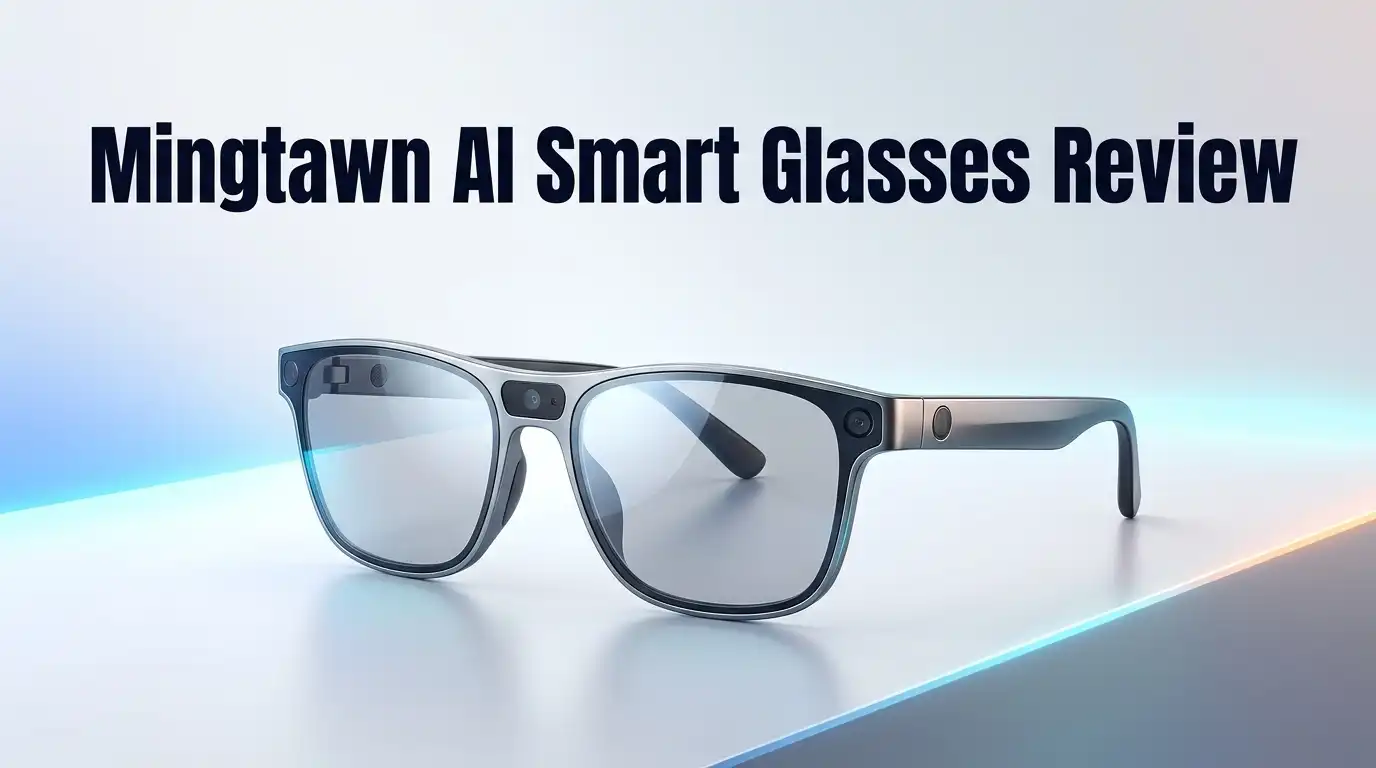
The Mingtawn AI Smart Glasses are camera glasses with a built in voice assistant. They look like normal sunglasses. They hide a camera in the left hinge area, speakers in both arms, and two microphones along the frame.
The core feature set covers four jobs. You record photos and video hands free. You listen to audio without earbuds. You take Bluetooth calls. You ask an AI assistant questions about what you see.
Mingtawn sells several variations under similar names. Some models list a 270mAh battery, others list 290mAh. Lens options include blue light filtering, polarized UV400, photochromic, and clear. The W630 is the version most reviewers on YouTube tested.
Storage sits at 4GB built in on the newer black model, with support for expansion up to 32GB. That holds a healthy number of clips before you need to offload files.
The glasses pair with a companion app on iOS and Android. The app handles transfers, translation summaries, and assistant queries. Without the app, you get a camera and a Bluetooth headset, nothing more.
Weight lands in the normal sunglasses range. They do not feel like a gadget strapped to your head, which matters more than the spec sheet suggests.
Mingtawn positions this product as a direct answer to Ray-Ban Meta. That comparison sets a high bar. The glasses clear some of it and trip over the rest. The rest of this review explains exactly where each outcome happens.
Unboxing Experience and First Impressions
The box arrives small and plain. Black cardboard, silver lettering, a product photo on the front. Nothing about it screams premium, and that feels honest for the price.
Inside, the glasses sit in a semi hard zip case. The case feels sturdy enough to survive a backpack. That single inclusion saves you buying an accessory later.
The rest of the contents are simple. You get a USB C charging cable, a microfiber cleaning cloth, and a folded paper manual.
The manual is the first disappointment. It runs a few pages and explains almost nothing useful. Button functions get a diagram. App setup gets one sentence and a QR code.
I had to search YouTube to understand the gesture controls. Several other reviewers reported the same experience. This is a recurring complaint across budget smart glasses, and Mingtawn does not fix it.
Pulling the glasses out, the first impression is better. The frame feels solid. Hinges move with resistance instead of flopping. The lenses sit flush and the arms have a matte finish that hides fingerprints.
Charging happens through a magnetic connection on one arm. The cable snaps on cleanly. My unit arrived at roughly half charge, so I got about twenty minutes of testing before topping up.
First pairing took me around six minutes. Bluetooth connected quickly. The app took longer and asked for camera, microphone, location, and photo permissions in sequence. Grant all of them or half the features stay locked.
Design, Build Quality, and Comfort
Mingtawn went with a classic shape. The frames look like standard wayfarer style sunglasses with slightly thicker arms. From two feet away, most people will not notice the camera.
The arms hide the electronics well. They measure thicker than normal glasses arms but stay under the point where they look strange. A friend asked about them only after I mentioned the camera.
Comfort held up over long sessions. I wore them for a three hour stretch with mild pressure behind my ears. Nothing painful, but I noticed them by hour two.
Weight distribution sits slightly rear heavy. The battery lives in the arms, so the glasses press on your ears more than your nose. People with smaller heads may find them loose.
Build quality punches above the price. The plastic feels dense rather than hollow. Flexing the arms produces no creaking. IP66 rating on the newer model means dust and water spray resistance.
Do not swim in them. IP66 covers rain and sweat, not submersion.
Lens quality depends on the version you buy. The polarized UV400 option cut glare well during driving. The blue light version looked slightly yellow indoors, which some people dislike.
Nose pads are fixed rather than adjustable. That is a real limitation. If the fit is wrong for your face, you cannot correct it.
Prescription support exists through third party lens replacement, but Mingtawn provides no official service. Glasses wearers should factor in that extra cost and hassle before buying.
Top 3 Alternative for Mingtawn AI Smart Glasses


Last update on 2026-10-06 / Affiliate links / Images from Amazon Product Advertising API Some of the links on this website are affiliate links, which means that at no additional cost to you, I earn a commission if you click through and make a purchase. I only recommend products and services that I believe will add value to my readers. Thank you for your support!
Meta Ray-Ban (Gen 2) Wayfarer Smart AI Glasses

Last update on 2026-10-06 / Affiliate links / Images from Amazon Product Advertising API Some of the links on this website are affiliate links, which means that at no additional cost to you, I earn a commission if you click through and make a purchase. I only recommend products and services that I believe will add value to my readers. Thank you for your support!
SOLOS Smart Glasses AirGo 3 Argon 6S

Last update on 2026-10-06 / Affiliate links / Images from Amazon Product Advertising API Some of the links on this website are affiliate links, which means that at no additional cost to you, I earn a commission if you click through and make a purchase. I only recommend products and services that I believe will add value to my readers. Thank you for your support!
RayNeo Air 2 AR Glasses
Camera Quality: 4K Claims Versus Real Results
The camera is the headline feature, so it deserves the most scrutiny. Mingtawn lists an 8MP sensor, often written as 800W in the product title, with 4K HD output and anti shake stabilization.
Here is the plain truth. The native sensor captures roughly 2K stills and 1080p video, and software upscales the result. Marketing calls that 4K. Photographers will call it something less flattering.
That said, daylight footage looks genuinely good. Colors run slightly warm. Detail holds up on a phone screen and on a laptop. Faces stay recognizable at conversational distance.
Low light is where the camera falls apart. Indoor evening clips turn grainy and soft. Streetlight scenes show heavy noise and smearing during movement.
Stabilization helps more than I expected. Walking clips stay watchable. Running clips do not. The system smooths gentle head movement and gives up on sharp turns.
Field of view sits wide enough to capture what you look at without dramatic fisheye distortion. Edges soften noticeably.
Single recording length caps around three minutes per clip on the 270mAh model. You press the button again to start a new clip. That limit protects the battery but interrupts longer moments.
Photos capture faster than video starts. There is a delay of roughly two seconds between the button press and the recording start. I missed several moments learning that timing.
Transferring files to your phone happens over the app. Speeds are slow. A three minute clip took close to two minutes to move across.
Compare this to a phone camera and the phone wins easily. Compare it to a phone you cannot reach because your hands are full, and the glasses win every time. That is the actual use case.
Audio Performance and Call Quality
Open ear speakers sit above each ear. They fire sound downward into your ear canal without blocking it. You hear the glasses and the world at the same time.
Volume gets louder than I expected. At seventy percent indoors, podcasts came through clearly. At full volume, sound leaks enough that a person sitting beside you hears your music.
Bass is thin. That is physics, not a design flaw. Every open ear speaker in this category shares the same limitation.
Speech content sounds excellent. Podcasts, audiobooks, and navigation prompts all come through clean and intelligible. These are speech first speakers, and they do speech very well.
Music sounds acceptable for background listening. Vocals and mids hold up. Kick drums basically disappear.
Wind noise is the biggest enemy. On my windy walk test, the speakers lost the fight completely above roughly fifteen miles per hour of breeze.
Call quality impressed me indoors. The dual microphone array picked up my voice clearly. Two people on the other end said I sounded like a normal phone call.
Outdoor calls were a different story. Callers reported wind rumble and occasional dropouts. The noise cancellation cannot handle moving air.
Latency is low enough for video calls. I used them on a Zoom meeting with no lip sync complaints.
There is no active noise cancellation, and there should not be. The whole point is staying aware of your surroundings. For cycling, walking, and office work, that awareness is a feature rather than a compromise.
AI Assistant and Object Recognition
Mingtawn advertises GPT powered object identification. The feature works through the companion app rather than on the glasses themselves.
You trigger it with a tap or a voice command. The glasses capture an image, send it to your phone, and the phone sends it to a cloud service. A spoken answer comes back through the speakers.
Response time averaged five to eight seconds in my testing. That pause feels long when you are standing in a store aisle waiting for an answer.
Accuracy was better than I predicted. It identified a houseplant, a car model, a book cover, and a bottle of sauce correctly. It confused two similar looking kitchen spices.
Text reading works reasonably well. I pointed it at a nutrition label and got a mostly accurate readout. Small print produced errors.
The assistant depends completely on your phone connection. No signal means no AI. In a parking garage or on a plane, the smart features simply stop existing.
Conversational follow up questions work inconsistently. Sometimes the assistant remembered context. Sometimes it treated each question as new.
The voice sounds synthetic but clear. You can adjust speaking speed in the app settings.
Compared to Meta AI on Ray-Ban glasses, Mingtawn feels a generation behind in polish and speed. The answers land in a similar quality range. The waiting and the occasional failed request are what separate them.
For casual curiosity, this is a fun feature. For anything you depend on, it is not reliable enough yet.
Real Time Translation Feature Tested
Translation is the feature Mingtawn markets hardest, and the one buyers ask about most. The glasses support multi language real time translation through the app.
Here is how it actually works. The microphones capture speech. The app processes it. Translated audio plays back through the speakers a few seconds later.
I tested Spanish and Mandarin. Spanish performed well with clear, slow speech. Fast conversational Spanish produced gaps and dropped phrases.
Mandarin results were more mixed. Simple sentences translated correctly. Longer sentences lost meaning by the end.
The delay is the core issue. You hear the translation three to six seconds after the person speaks. Natural back and forth conversation becomes impossible at that pace.
Where it does help is one direction listening. Menus read aloud, announcements, a tour guide speaking continuously, all of these work acceptably.
The app generates written summaries of your translated sessions. I found this genuinely useful. You can review a conversation afterward instead of trying to remember it.
Text translation through the camera also exists on some models. Point at a sign, get a readout. Accuracy depends heavily on lighting and font size.
Background noise destroys performance. In a busy restaurant, the microphones picked up three conversations at once and translated a blend of all of them.
Do not buy these expecting a universal translator. Buy them expecting a travel aid that helps you understand menus and signs. Set that expectation and you will not feel cheated.
Battery Life and Charging
Battery capacity sits at 270mAh on most models and 290mAh on the newer black version. Those are small cells, and the numbers show in daily use.
Mingtawn quotes up to 18 hours of continuous music playback. That figure comes from ideal lab conditions at low volume. My real result was closer to seven hours of mixed listening.
Video recording drains the battery fast. I measured roughly 55 to 65 minutes of total recording time from full charge. That matches the manufacturer claim of about one hour.
Mixed use gave me most of a day. A morning of podcasts, a handful of photos, two short calls, and a few AI queries left me around twenty percent by evening.
Standby drain is modest. Left overnight, the glasses lost around eight percent.
Charging takes roughly ninety minutes from empty using the magnetic USB C cable. There is no charging case, which is a notable gap versus more expensive competitors.
The lack of a charging case matters more than the raw battery number. Ray-Ban Meta glasses recharge inside their case throughout the day. Mingtawn glasses need a wall outlet.
There is no fast charge feature worth mentioning. A ten minute top up bought me around fifteen minutes of recording.
Battery percentage shows in the app and gets announced when you power on. The announcement is helpful because there is no display or indicator you can see while wearing them.
Plan around the battery rather than fighting it. Treat these as an event recording tool, not an all day camera.
The Companion App and Daily Setup
The app is where budget hardware shows its budget software. Mingtawn’s companion app functions, but it does not feel finished.
Initial setup involves scanning a QR code from the manual, downloading the app, creating an account, and pairing over Bluetooth. The account requirement annoyed me. There is no guest mode.
The interface uses translated English that sometimes reads awkwardly. Menu labels like “Photo Album Sync” sit next to phrases that make less sense.
Once configured, daily use is simpler. Open the app, connect, and the glasses appear with battery level and storage remaining.
File transfer is the most used function and the slowest. The app copies clips over a direct connection. Expect to wait, and expect the occasional failed transfer that requires a retry.
Settings let you adjust video resolution, photo quality, voice prompt language, and gesture behavior. The options are reasonable in number.
Firmware updates arrive through the app. I received one during my test period. It installed in about four minutes and fixed a bug where the assistant sometimes ignored the first command.
That update matters because it shows Mingtawn is still supporting the product. Many budget brands ship and disappear.
Background behavior on iOS caused problems. The app disconnected when I left it running behind other apps for long periods. Android performance was steadier.
Privacy settings exist but stay basic. There is no detailed control over what gets uploaded during AI queries.
If you want polished software, this is not the product. The app works well enough to use, and not one step better than that.
Pros and Cons
Every product involves trade offs. Here are the ones that shaped my three weeks with these glasses.
Pros
- Excellent price to feature ratio. You get a camera, speakers, microphones, AI queries, and translation for well under half the cost of premium competitors.
- Comfortable, normal looking design. The frames pass as ordinary sunglasses and stay wearable for hours without pain.
- Strong open ear audio for speech. Podcasts, audiobooks, calls, and navigation all sound clear and loud enough for real environments.
- Good daylight camera performance. Outdoor photos and videos look sharp enough for social media, and the stabilization handles walking well.
- Solid build with IP66 rating. The frames feel dense and survive rain, sweat, and dust without concern.
- Generous storage. 4GB built in with expansion to 32GB means you rarely run out of room mid outing.
- Ongoing firmware support. The update I received during testing fixed a real bug, which suggests active development.
Cons
- The 4K claim is misleading. Output is upscaled rather than native, and honest labeling would say 2K.
- Battery life for video is roughly one hour. No charging case makes that limitation harder to work around.
- Low light footage looks poor. Grain and softness appear as soon as the sun goes down.
- AI and translation both lag. Five to eight second delays break the flow of real conversation.
- The app feels unfinished. Awkward translations, slow transfers, and iOS disconnection issues all appear regularly.
- The manual is nearly useless. You will learn the controls from YouTube instead of the included paper.
- No official prescription lens support. Glasses wearers need a third party service and extra spending.
What the Mingtawn Glasses Do Not Do Well
Reviews that only list positives help nobody. Here is a focused look at the weak points, stated plainly.
Night and indoor video is the biggest failure. Any scene without strong light produces mushy, noisy footage. If you plan to record concerts, restaurants, or evening events, these glasses will disappoint you.
The camera also has no viewfinder. You cannot see what you are framing. I threw away roughly a third of my early clips because I aimed my head wrong.
Audio leakage limits private listening. In a quiet office or a library, people nearby hear your content. You will keep the volume low in those spaces.
Wind handling is poor across every function. Calls, translation, and voice commands all degrade outdoors in a breeze.
The AI assistant lacks the smooth conversational quality of Meta AI. It answers questions. It does not feel like talking to something intelligent.
Fit adjustability is absent. Fixed nose pads and fixed arm width mean the glasses either suit your face or they do not.
Customer support responses were slow when I asked a question about storage expansion. I received a reply in four days.
Privacy deserves mention. There is a small recording indicator, but it is subtle. Recording people without their knowledge is easier than it should be, and that carries legal weight in some places.
Finally, the naming is confusing. Mingtawn sells multiple similar models with different battery sizes and lens types under nearly identical titles. Read the listing carefully before ordering, because you may receive a different specification than you expected.
Who Should Buy the Mingtawn AI Smart Glasses?
These glasses fit certain people extremely well and frustrate others. Sorting yourself into the right group saves money.
Buy them if you are curious about smart glasses and unwilling to spend $400. This is the cheapest honest entry into the category. You learn whether you actually want camera glasses in your life.
Content creators who need casual point of view footage will find value. Cooking clips, workshop demos, and hobby videos all work well in good light.
Parents recording kids at outdoor events benefit from hands free capture. You watch the moment instead of watching a phone screen.
Cyclists and runners get useful open ear audio with awareness of traffic. The IP66 rating handles sweat without worry.
Travelers gain a helpful translation aid for menus and signs. Set expectations correctly and it earns its place in a bag.
Skip them if you need reliable low light video. Skip them if you want a fast, natural AI assistant. Skip them if you wear prescription lenses and do not want a third party lens project.
Professional videographers should not consider these at all. The output quality does not meet any professional standard.
People who make many outdoor phone calls will find the wind noise unacceptable.
If you already own Ray-Ban Meta glasses, there is nothing here to upgrade to. These are a cheaper alternative, not a better product.
The honest summary is simple. These are very good glasses for the money and average glasses in absolute terms. Both statements are true at once.
Price and Value in 2026

Last update on 2026-10-06 / Affiliate links / Images from Amazon Product Advertising API Some of the links on this website are affiliate links, which means that at no additional cost to you, I earn a commission if you click through and make a purchase. I only recommend products and services that I believe will add value to my readers. Thank you for your support!
Pricing moves around a lot on this product. I have seen listings between roughly $100 and $210 across different models and sale periods.
At the low end, around $100, these represent strong value. You get functional camera glasses with working audio for the price of mid range earbuds.
At $200, the calculation gets harder. That price starts approaching territory where more polished options exist.
Compare against Meta Ray-Ban Gen 2 glasses at roughly $379 and up. Meta gives you better cameras, a faster assistant, a charging case, and proper prescription support. You pay roughly triple for that polish.
Compare against Solos AirGo 3 at around $199 to $299. Solos offers cleaner software and ChatGPT integration, but many models skip the camera entirely.
Amazon Echo Frames at $269 offer Alexa and better audio but no camera at all.
Against that field, Mingtawn’s argument is straightforward. It includes a camera at a price where most competitors do not.
Watch for sales. The product appears in deal listings regularly, and I have seen discounts of thirty percent or more.
Resale value will be poor. Budget electronics rarely hold worth, so treat this as money spent rather than money invested.
Check the specific listing before ordering. Battery capacity, lens type, and storage vary between models with almost identical names.
My value verdict is positive with a condition. Buy at or below $130 and you will feel satisfied. Pay more than $180 and you should look at other options first.
Final Verdict
After three weeks, I keep reaching for these glasses more than I expected. That says something the spec sheet does not.
The Mingtawn AI Smart Glasses succeed at the basics. They look normal. They feel comfortable. They record usable daylight video and play clear audio.
They fail at the ambitious parts. The AI feels slow. Translation lags behind conversation. Low light video looks bad.
The gap between marketing language and real performance is the main frustration. Calling upscaled output 4K sets buyers up for disappointment they did not need to feel.
Judged on price, the product earns a recommendation. Judged as a Ray-Ban Meta competitor, it does not.
My rating sits at 3.7 out of 5. That reflects strong hardware value held back by rough software and honest physical limits.
Buy them as an inexpensive experiment. Buy them for daylight point of view clips and open ear audio. Buy them if the alternative is spending nothing and staying curious.
Do not buy them expecting the flagship experience for a fifth of the flagship price. That product does not exist yet in 2026.
Smart glasses at this price are improving quickly. A year from now, this same budget will likely buy something noticeably better.
For today, Mingtawn delivers a functional, comfortable, genuinely useful pair of camera glasses. That was not possible at this price two years ago, and that progress deserves credit.
Frequently Asked Questions
Do the Mingtawn AI Smart Glasses really record in 4K?
Not natively. The sensor is 8MP and captures roughly 2K stills with 1080p video. Software upscales the output to a 4K file size. Real detail matches a good 1080p camera rather than a true 4K one.
How long does the battery last during video recording?
Around 55 to 65 minutes of continuous recording from a full charge. Music only playback lasts far longer, in the seven hour range at moderate volume. Charging takes about ninety minutes.
Can I use prescription lenses with these glasses?
Mingtawn does not offer an official prescription service. Third party lens replacement shops can usually swap the lenses, but you take on the cost and the risk yourself. Confirm with the shop before ordering.
Does the AI assistant work without a phone connection?
No. Object recognition, translation, and voice queries all route through the companion app and a cloud service. Without an internet connection, you keep only the camera, speakers, and Bluetooth calling.
Are these glasses waterproof?
The newer model carries an IP66 rating, which covers dust and strong water spray. Rain and sweat are fine. Swimming and submersion are not, and water damage will likely void the warranty.
How much storage do they have?
The current black model includes 4GB of internal storage with support for expansion up to 32GB. That holds a substantial number of clips before transfers become necessary.
Do people know when you are recording them?
There is a small recording indicator, but it is subtle and easy to miss. Recording laws vary by location, so check local rules and ask permission before filming people in private settings.
Are they better than Ray-Ban Meta glasses?
No. Meta glasses beat them on camera quality, assistant speed, software polish, and charging convenience. Mingtawn wins only on price, costing roughly a third as much.

Hi, my name is Lily you can say i am a gadget hunter at this point. Welcome to Gadget Gallery The Gallery of Gadget Reviews