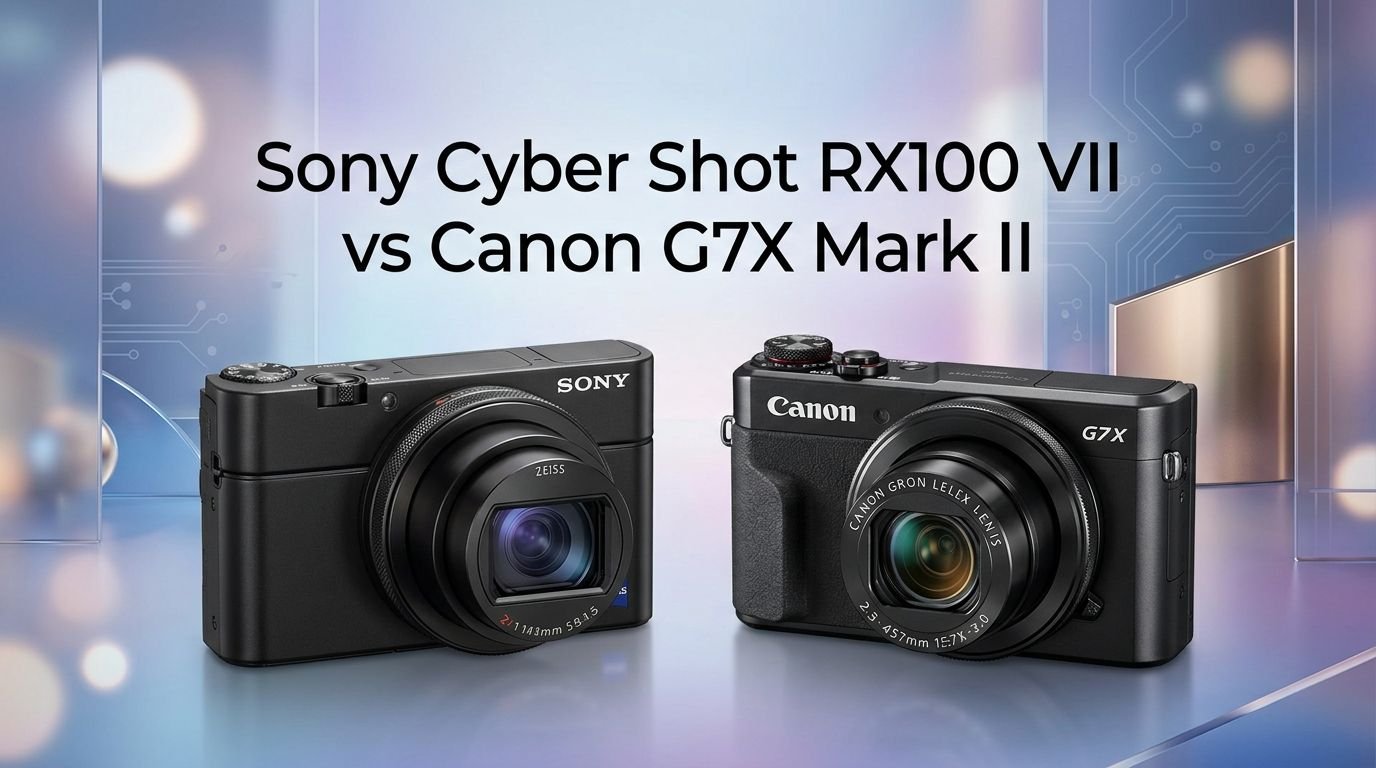
Sony Cyber Shot RX100 VII vs Canon G7X Mark II
You want a pocket camera that takes stunning photos. You have two popular options sitting at the top of every recommendation list.
The Sony Cyber Shot RX100 VII and the Canon G7X Mark II are both premium compact cameras with 1 inch sensors and loyal fan bases. But they serve very different types of shooters.
One costs nearly twice as much as the other. One has a longer zoom. One has a brighter lens. The specs look similar on paper, but the real world differences between these two cameras are significant.
Key Takeaways
- The Sony RX100 VII offers a 24 to 200mm zoom range, which is almost double the Canon’s 24 to 100mm range. This makes the Sony far more flexible for travel and wildlife photography.
- The Canon G7X Mark II has a brighter f/1.8 to f/2.8 lens, compared to the Sony’s f/2.8 to f/4.5. The Canon performs better in low light at the wide end and creates smoother background blur.
- Sony’s autofocus system dominates with 357 phase detection AF points, while the Canon uses only 31 contrast detect AF points. The Sony tracks moving subjects with far greater accuracy.
- The Canon G7X Mark II costs significantly less than the Sony RX100 VII. The Canon sells for around $700 to $800, while the Sony sits near $1,498 to $1,500. Budget conscious buyers will find the Canon hard to beat.
- The Sony shoots 4K video at 30fps with S Log3 support, making it ideal for content creators who want professional color grading options. The Canon maxes out at 1080p Full HD.
- Both cameras weigh about 300 grams and fit in a jacket pocket. Size and portability are nearly identical between the two models.
Sony Cyber Shot RX100 VII Overview

Last update on 2026-08-29 / Affiliate links / Images from Amazon Product Advertising API Some of the links on this website are affiliate links, which means that at no additional cost to you, I earn a commission if you click through and make a purchase. I only recommend products and services that I believe will add value to my readers. Thank you for your support!
The Sony RX100 VII launched in 2019 as the seventh generation of Sony’s beloved RX100 line. It packs a 20.1 megapixel 1 inch stacked Exmor RS CMOS sensor with a BIONZ X image processor. The camera uses a Zeiss Vario Sonnar T 24 to 200mm f/2.8 to f/4.5 lens*.
Sony built this camera for speed. It shoots at up to 20 frames per second with no viewfinder blackout. The autofocus system calculates focus and exposure up to 60 times per second. This gives you a level of subject tracking that rivals many mirrorless cameras.
The RX100 VII also features a pop up electronic viewfinder, a tilting 3 inch LCD touchscreen, and built in Wi Fi and Bluetooth. Video shooters get 4K recording at 30fps, 1080p at 120fps for slow motion, and S Log3 for flexible color grading. Sony positioned this camera as an “alpha camera in your pocket”, and many professional photographers use it as a backup body.
Pros:
- Exceptional 357 point phase detection autofocus
- 24 to 200mm zoom range covers wide angle to telephoto
- 4K video recording with S Log3 and HLG support
- 20fps burst shooting with zero blackout
- Built in electronic viewfinder
- Real time eye AF for humans and animals
Cons:
- Very high price point around $1,498
- Lens aperture narrows quickly as you zoom in
- Battery life is limited to about 260 shots per charge
- Small grip makes extended shooting uncomfortable
- Menu system can feel overwhelming for beginners
Canon G7X Mark II Overview

Last update on 2026-08-29 / Affiliate links / Images from Amazon Product Advertising API Some of the links on this website are affiliate links, which means that at no additional cost to you, I earn a commission if you click through and make a purchase. I only recommend products and services that I believe will add value to my readers. Thank you for your support!
The Canon G7X Mark II arrived in 2016 and quickly became one of the most popular compact cameras ever made. It uses a 20.1 megapixel 1 inch CMOS sensor paired with Canon’s DIGIC 7 image processor. The lens is a 24 to 100mm f/1.8 to f/2.8 zoom with optical image stabilization.
Canon designed this camera for simplicity and great image quality. The f/1.8 maximum aperture lets in a lot of light, which helps in dim conditions and creates pleasing background blur. The touchscreen tilts up 180 degrees, making it a favorite among vloggers and selfie photographers.
This camera earned a massive following on YouTube and social media. Its natural color science produces warm, flattering skin tones straight out of the camera. The user interface is clean and easy to learn, even for first time camera owners.
Pros:
- Bright f/1.8 to f/2.8 lens excels in low light
- Excellent Canon color science with beautiful skin tones
- 180 degree tilting touchscreen for vlogging
- Lower price makes it accessible to more buyers
- Simple and intuitive menu system
- Compact and lightweight at 319 grams
Cons:
- No 4K video recording, maxes out at 1080p 60fps
- Only 31 contrast detect autofocus points
- No electronic viewfinder
- Slower burst rate at 8 frames per second
- Autofocus struggles with fast moving subjects
- Aging design with no Bluetooth connectivity
Sensor and Image Quality
Both cameras use a 1 inch 20.1 megapixel CMOS sensor. This sensor size is much larger than what you find in a smartphone. It captures more light and produces cleaner images with less noise.
The Sony RX100 VII uses a stacked CMOS sensor design with DRAM. This architecture allows faster readout speeds and reduces rolling shutter in video. The Canon G7X Mark II uses a standard 1 inch CMOS sensor without the stacked design.
In good light, both cameras produce sharp, detailed images with accurate colors. The differences become more visible in challenging conditions. The Canon’s brighter lens gives it an edge in very dim environments at the wide end. The Sony’s newer sensor technology provides slightly better dynamic range and less noise at higher ISO settings.
Raw files from both cameras offer good flexibility in post processing. Canon’s JPEG output tends to produce warmer, more saturated colors. Sony’s JPEGs lean toward a cooler, more neutral tone. Many photographers prefer Canon’s out of camera look for portraits and casual shooting.
Lens Comparison
The lens is where these two cameras differ the most. The Sony RX100 VII has a Zeiss Vario Sonnar T* lens that covers 24 to 200mm at f/2.8 to f/4.5. The Canon G7X Mark II has a Canon lens that covers 24 to 100mm at f/1.8 to f/2.8.
Sony gives you an 8.3x zoom range. Canon gives you a 4.2x zoom range. That extra reach on the Sony is huge for travel photography, wildlife, and street photography. You can fill the frame with distant subjects without moving closer.
The Canon fights back with its much brighter aperture. At the wide end, f/1.8 lets in roughly four times more light than the Sony’s f/2.8. At the telephoto end, f/2.8 still beats the Sony’s f/4.5. This brightness advantage helps the Canon shoot at lower ISO values in dim light. It also gives the Canon better background separation for portrait style shots.
If you need versatility and zoom range, the Sony wins. If you need low light performance and shallow depth of field, the Canon wins.
Autofocus Performance
The autofocus gap between these two cameras is massive. The Sony RX100 VII uses 357 focal plane phase detection AF points that cover 68 percent of the frame. It also has 425 contrast detection points. The camera calculates focus and exposure up to 60 times per second.
The Canon G7X Mark II relies on 31 contrast detection AF points only. It has no phase detection capability. Contrast detection works well for still subjects, but it struggles with fast moving targets like kids, pets, and sports.
Sony’s real time tracking AF and real time eye AF work for both humans and animals. The camera locks onto a subject’s eye and holds focus as they move through the frame. This feature alone makes the Sony a better choice for anyone who photographs moving subjects.
The Canon focuses accurately in good light with static scenes. It handles basic video autofocus reasonably well. But it cannot match the Sony’s speed or precision. If autofocus performance is a top priority, the Sony RX100 VII wins by a wide margin.
Video Capabilities
Video is another area where the Sony pulls ahead. The RX100 VII records 4K UHD video at 30fps with full pixel readout. It also captures 1080p at 120fps for smooth slow motion playback. S Log3 and HLG gamma profiles give videographers professional color grading options.
The Canon G7X Mark II records 1080p Full HD at up to 60fps. It does not support 4K recording. There are no log profiles or advanced video features. The Canon records clean, usable footage, but it cannot compete with the Sony’s video specifications.
Both cameras have built in stereo microphones. Neither has a 3.5mm external microphone jack, which limits audio quality for serious vlog work. The Sony does offer a microphone accessory through its Multi Interface Shoe.
For YouTube creators, TikTok videos, and professional video work, the Sony RX100 VII is the clear winner. The Canon G7X Mark II still records decent 1080p footage for casual use. Many popular YouTubers built their early channels using the Canon’s simple and reliable video mode.
Viewfinder and Display
The Sony RX100 VII has a pop up electronic viewfinder (EVF) with 2.36 million dots. This EVF retracts into the camera body when not in use. It helps you compose shots in bright sunlight when the rear screen is hard to see.
The Canon G7X Mark II does not have a viewfinder. You compose every shot using the rear LCD screen. This is a notable disadvantage for outdoor shooting in direct sunlight.
Both cameras have a 3 inch tilting LCD touchscreen. The Canon’s screen tilts up 180 degrees, making it ideal for selfies and front facing vlogging. The Sony’s screen tilts up about 180 degrees and down about 90 degrees.
The Canon’s touchscreen interface feels smooth and responsive. Sony’s touch controls work well for selecting focus points and navigating menus. Both screens display sharp, accurate previews of your shot.
Build Quality and Design
The Sony RX100 VII measures 102 x 58 x 43mm and weighs 302 grams with battery and memory card. The Canon G7X Mark II measures 106 x 61 x 42mm and weighs 319 grams. Both cameras fit easily in a pants pocket or small bag.
The Sony has an all metal body that feels premium and solid. The Canon also has a sturdy build with a metal chassis. Neither camera has weather sealing or water resistance.
The Canon has a slightly textured front grip that provides a more secure hold. The Sony’s body is smooth and slippery. Many Sony owners add a third party grip or case for better handling. Sony sells an optional shooting grip that helps with video shooting.
Both cameras look sleek and professional. The Canon feels slightly more comfortable during extended handheld use. The Sony feels more compact and streamlined in the pocket.
Battery Life and Connectivity
Battery life is similar between both cameras. The Canon G7X Mark II lasts about 265 shots per charge using its NB 13L battery. The Sony RX100 VII gets about 260 shots per charge using its NP BX1 battery. Both cameras fall short of the 300 plus shot counts you might expect.
The Sony offers Wi Fi, Bluetooth, and NFC for wireless image transfer and remote control. The Canon provides Wi Fi and NFC but lacks Bluetooth. Sony’s Imaging Edge Mobile app allows remote shooting and easy file sharing to your phone.
Both cameras charge through USB, which is convenient for travel. You can top off the battery using a portable power bank. Carrying a spare battery is recommended for both models, especially during full day shooting sessions.
Price and Value Comparison
The price gap between these two cameras is significant. The Sony RX100 VII currently sells for around $1,498 on Amazon. The Canon G7X Mark II typically sells between $700 and $800 depending on the retailer and bundle.
That means the Sony costs roughly twice as much as the Canon. The question is whether the extra features justify the higher price. Sony gives you 4K video, a longer zoom, faster autofocus, and a built in viewfinder. These are real, measurable advantages.
The Canon offers outstanding value at its price point. Its image quality, color science, and ease of use compete with cameras that cost much more. Budget conscious photographers often find the Canon delivers 90 percent of the experience at half the cost.
If money is not a concern, the Sony is the better camera. If you want the best bang for your buck, the Canon G7X Mark II is tough to beat. Your budget will likely be the deciding factor for many buyers.
Who Should Buy the Sony RX100 VII?
Last update on 2026-08-29 / Affiliate links / Images from Amazon Product Advertising API Some of the links on this website are affiliate links, which means that at no additional cost to you, I earn a commission if you click through and make a purchase. I only recommend products and services that I believe will add value to my readers. Thank you for your support!
The Sony RX100 VII is best for serious photographers and videographers who want a compact backup camera. It suits travel photographers who need a wide zoom range without carrying a heavy kit. Sports and wildlife enthusiasts benefit from the fast autofocus and 20fps burst mode.
Content creators who shoot 4K video will appreciate the professional video features. The S Log3 profile and 120fps slow motion give you creative options that the Canon simply cannot match. Photographers who already own Sony Alpha cameras will enjoy a familiar menu system.
This camera is also a great choice for anyone who photographs fast moving subjects. The real time tracking and eye AF keep sharp focus on kids, pets, and athletes. If you demand top tier performance in the smallest possible body, the RX100 VII delivers.
Who Should Buy the Canon G7X Mark II?
Last update on 2026-08-29 / Affiliate links / Images from Amazon Product Advertising API Some of the links on this website are affiliate links, which means that at no additional cost to you, I earn a commission if you click through and make a purchase. I only recommend products and services that I believe will add value to my readers. Thank you for your support!
The Canon G7X Mark II is ideal for casual photographers, new vloggers, and social media creators. It produces beautiful images with minimal effort. The 180 degree flip screen and simple interface make it perfect for selfies and front facing video.
Budget minded buyers will love the Canon’s lower price tag. Students, hobbyists, and first time camera owners get premium 1 inch sensor quality without spending $1,500. The Canon also works well as an everyday carry camera for documenting daily life.
If you shoot mostly in 1080p and do not need 4K, the Canon handles video with ease. Its warm color reproduction looks great on YouTube and Instagram without heavy editing. Many successful content creators started with this exact camera and never felt limited by its capabilities.
Final Verdict: Sony RX100 VII vs Canon G7X Mark II
The Sony Cyber Shot RX100 VII is the more capable camera by almost every technical measure. It has better autofocus, longer zoom, 4K video, and a built in viewfinder. These advantages matter most for experienced photographers and dedicated video creators.
The Canon G7X Mark II offers excellent image quality, superior low light performance at the wide end, and a much friendlier price. It remains one of the best compact cameras for casual use, vlogging, and everyday photography.
Choose the Sony if you need maximum performance, 4K video, and a long zoom range. Choose the Canon if you want great photos and video at a lower price with a simpler shooting experience. Both cameras are excellent. Your choice depends on your priorities and your budget.
Frequently Asked Questions
Is the Sony RX100 VII worth the extra money over the Canon G7X Mark II?
It depends on your needs. The Sony offers 4K video, 357 autofocus points, 20fps burst shooting, and a 24 to 200mm zoom range. If you use these features regularly, the extra cost is justified. If you mainly shoot casual photos and 1080p video, the Canon gives you similar image quality for much less money.
Which camera is better for vlogging?
The Canon G7X Mark II has been the go to vlogging camera for years. Its 180 degree flip screen, bright lens, and warm skin tones make it excellent for talking head videos. The Sony RX100 VII offers 4K vlogging with better autofocus tracking. If you need 4K and fast AF, pick the Sony. If you want simplicity and great colors at a lower price, pick the Canon.
Can the Canon G7X Mark II shoot 4K video?
No. The Canon G7X Mark II records video at a maximum resolution of 1080p Full HD at 60fps. It does not have 4K recording capability. If 4K video is a requirement, the Sony RX100 VII or the newer Canon G7X Mark III are better options.
Which camera has better low light performance?
The Canon G7X Mark II has the advantage at the wide angle end thanks to its f/1.8 maximum aperture. This brighter lens lets in more light and allows lower ISO settings. The Sony RX100 VII has a newer sensor with slightly better noise handling at high ISO values. Overall, the Canon performs better in low light at wide angle, while the Sony holds up better when zoomed in.
How long does the battery last on each camera?
The Canon G7X Mark II gets approximately 265 shots per charge. The Sony RX100 VII gets approximately 260 shots per charge. Battery life is very similar between the two. Both cameras benefit from carrying a spare battery for extended shooting days.
Are these cameras still worth buying in 2026?
Yes. Both cameras remain highly capable in 2026. The Sony RX100 VII still has one of the best autofocus systems in any compact camera. The Canon G7X Mark II continues to deliver excellent image quality at a competitive price. Neither camera has a direct replacement that makes it obsolete for most users.

Hi, my name is Lily you can say i am a gadget hunter at this point. Welcome to Gadget Gallery The Gallery of Gadget Reviews