Steam Deck OLED Review 2026: Still Worth It?
The Steam Deck OLED came out in late 2023, so it is about three years old now. In 2026 it also costs a lot more than it did at launch. Is it still a good buy, or should you pick something else?
I spent a lot of time with this handheld for this review. I played big AAA games, small indie games, and old favorites. I tested the screen, the battery, and the controls. I also looked hard at the new price.
This review covers the good, the bad, and the parts that annoy me. By the end, you will know if this handheld fits your budget and the way you play.
Key Takeaways
- The OLED screen is still the best reason to buy it. The 7.4 inch HDR panel shows deep blacks and bright colors. It reaches up to 1,000 nits in HDR and runs at up to 90Hz. Games look far better than they did on the old LCD model.
- The battery holds up well. The 50Wh battery lasts about 3 to 12 hours, depending on the game. Light indie games can run all day. Heavy AAA games still drain it in about three hours.
- Performance has not changed since 2022. The custom AMD chip is now three years old. It runs most games at 800p with medium settings. Newer games often need low settings and FSR upscaling to stay playable.
- The price went up a lot in 2026. Valve raised the price in May 2026. The 512GB model went from $549 to $789, and the 1TB model went from $649 to $949. Valve also stopped making the cheaper LCD model, so there is no budget Deck left.
- SteamOS is still the easiest handheld software to use. It boots quickly and handles sleep and resume very well. Your Steam library is ready right away. Windows handhelds still feel clunky next to it.
- Steam Deck 2 has no release date. Valve says it is working on the next model but has not set a date. If you want a SteamOS handheld right now, this is still the main option.
Steam Deck OLED

Last update on 2026-11-06 / Affiliate links / Images from Amazon Product Advertising API Some of the links on this website are affiliate links, which means that at no additional cost to you, I earn a commission if you click through and make a purchase. I only recommend products and services that I believe will add value to my readers. Thank you for your support!
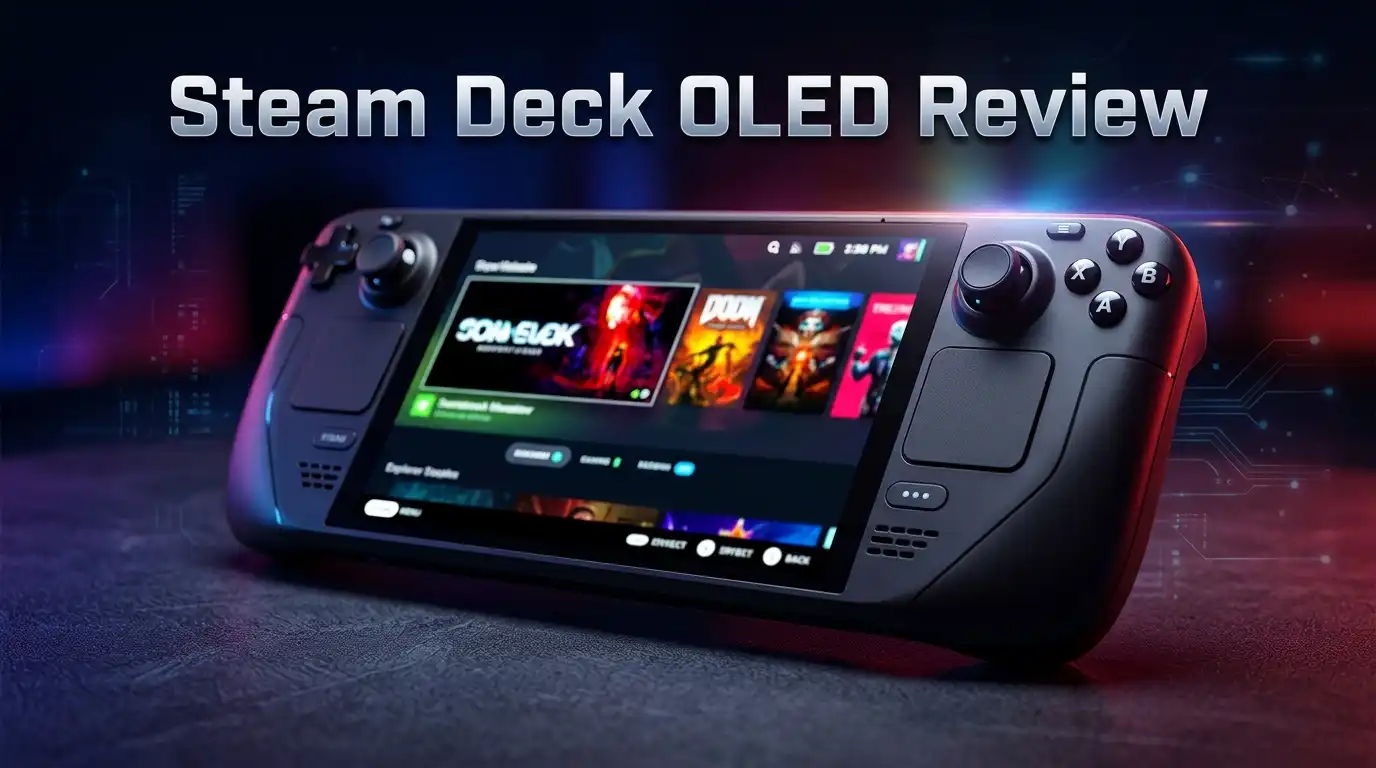
The Steam Deck OLED is Valve’s handheld gaming PC. It runs SteamOS, a gaming system built on Linux. You can play your Steam library anywhere, on the couch, in bed, or on a train.
It uses a custom AMD APU with four Zen 2 CPU cores and eight RDNA 2 graphics units. It has 16GB of LPDDR5 memory running at 6400 MT/s. You can choose 512GB or 1TB of NVMe storage.
The screen is a 7.4 inch HDR OLED panel at 1280 x 800 resolution. It supports up to 90Hz. The battery is 50Wh. It weighs about 640 grams, which makes it a little lighter than the original LCD Deck.
For wireless, it has WiFi 6E and Bluetooth 5.3. The 1TB version also has etched glass that cuts down glare.
Unboxing the Steam Deck OLED
The box looks plain, and I mean that as a compliment. Valve uses brown cardboard with simple printing. Opening it feels calm and well thought out.
The carrying case sits on top. The 512GB model comes with a standard case. The 1TB model comes with a premium case that has a removable liner. The Deck sits snugly inside the case.
Under the case, you find the 45W USB C power adapter. Valve made the cable longer for the OLED model, at about 2.5 meters. That is great for playing from bed.
You also get a small cleaning cloth and a quick start card. There is no screen protector and no microSD card. Setup takes about ten minutes. You log in to Steam, connect to WiFi, and download updates.
Design and Build Quality
The Steam Deck OLED looks almost the same as the original model. It is still large. It measures about 298mm wide and 117mm tall. It does not fit in a jacket pocket.
The back is a matte black plastic that feels solid. It does not squeak or flex. The thumbsticks feel smooth and have better tension than the first model. Valve also improved the trackpads and the haptics.
It weighs about 640 grams. That is lighter than the LCD Deck, but it still feels heavy after an hour or two. I often rest it on a pillow during long sessions.
The fan runs quieter now, and the hum has a softer pitch. Overall, the build feels premium and durable. This is a well made device, even though the size will not suit everyone.
Top 3 Alternative for Steam Deck OLED
ASUS ROG Xbox Ally X

Last update on 2026-11-20 / Affiliate links / Images from Amazon Product Advertising API Some of the links on this website are affiliate links, which means that at no additional cost to you, I earn a commission if you click through and make a purchase. I only recommend products and services that I believe will add value to my readers. Thank you for your support!
Lenovo Legion Go S (SteamOS Edition)

Last update on 2026-11-20 / Affiliate links / Images from Amazon Product Advertising API Some of the links on this website are affiliate links, which means that at no additional cost to you, I earn a commission if you click through and make a purchase. I only recommend products and services that I believe will add value to my readers. Thank you for your support!
ASUS ROG Xbox Ally

Last update on 2026-10-29 / Affiliate links / Images from Amazon Product Advertising API Some of the links on this website are affiliate links, which means that at no additional cost to you, I earn a commission if you click through and make a purchase. I only recommend products and services that I believe will add value to my readers. Thank you for your support!
The OLED Display Is the Star
The screen is the main reason to choose this model. The OLED panel shows perfect blacks because each pixel turns off on its own. Dark games like Hollow Knight and Alan Wake look amazing.
Colors are rich and accurate. HDR games pop, with peak brightness up to 1,000 nits. SDR brightness reaches about 600 nits, so it is easy to see outside in the shade.
The 90Hz refresh rate helps a lot. Menus feel smooth, and light games feel snappier. You can also lock games to 45fps or 30fps to save battery.
The resolution is still 1280 x 800. Text looks a little soft next to newer 1080p handhelds. Still, at this screen size, most people will not mind. Once you play on this screen, LCD handhelds look washed out.
Performance in 2026 Games
This is where age starts to show. The chip is the same one from 2022, built on a smaller 6nm process. It runs cooler, but it is not faster.
Older and lighter games run great. Hades II, Stardew Valley, Balatro, and Elden Ring all play well. Many Steam Verified games hold a steady 40 to 60fps.
New AAA games are harder. Big 2025 and 2026 releases often need low settings and FSR upscaling. Some new games only reach 30fps. A few do not reach that at all.
Rival handhelds with newer AMD Z2 chips are clearly faster. If you mainly play the latest blockbusters, you will feel the limits. If you mostly play indie games and older titles, it still feels great.
Battery Life
The 50Wh battery is a big step up from the original Deck’s 40Wh. Valve rates it at 3 to 12 hours. My testing matched that range.
Light games last a long time. Stardew Valley ran for close to eight hours with a lower frame rate cap. Streaming games from my PC lasted about seven hours.
Heavy games drain it faster. Cyberpunk 2077 lasted about two and a half to three hours. Lowering the TDP and capping the frame rate helps a lot.
Charging is fast with the included 45W adapter. Charging from 20 to 80 percent takes about 45 minutes. The battery still beats many Windows handhelds in real use because SteamOS manages power so well.
SteamOS and Software
SteamOS is the secret weapon here. It feels like a console. You press the power button, and the game resumes right where you left off. Sleep and resume work perfectly.
The Quick Access menu lets you change TDP, frame rate, and refresh rate in seconds. You can see performance stats on screen. Steam Cloud syncs your saves with your PC.
Proton runs most Windows games without trouble. Thousands of games are Steam Verified or Playable. Desktop Mode lets you install emulators, other launchers, and apps.
There are limits. Some multiplayer games with strict anti cheat do not run at all. Games from the Epic Games Store and Game Pass need extra setup. Windows handhelds handle those better. SteamOS is simple, but it is not perfect for every library.
Controls and Comfort
The controls are excellent. You get full size thumbsticks with capacitive touch. The face buttons and D pad feel responsive and clicky.
The two square trackpads are unique. They make mouse based games like strategy titles playable. The four back buttons are great for remapping controls.
Gyro aiming works very well in shooters. Steam Input lets you change any control layout. You can also download layouts made by the community.
Comfort is mixed. The grips are deep and fit large hands well. But the weight adds strain over time. People with small hands may find the reach a bit wide. I recommend a stand or a pillow for long sessions.
Connectivity, Storage, and Thermals
WiFi 6E makes downloads and game streaming fast. Bluetooth 5.3 connects headphones and controllers easily. There is one USB C port and a headphone jack.
Storage options are 512GB or 1TB. Many 2026 games take up 100GB or more. You can add a microSD card for extra space, and fast cards work well for most games.
Only one USB C port is a downside. You need a dock to charge and connect accessories together.
Thermals improved with the 6nm chip. The device stays warm but comfortable in the hands. The fan is quieter than the original. Docked play on a TV works, but 800p games look soft on a big 4K screen.
The 2026 Price Problem
This is the hardest part of the review. Valve raised prices on May 27, 2026, citing rising memory and storage costs. The 512GB model now costs $789. The 1TB model now costs $949.
That is about a 43 to 46 percent jump. You now pay much more for the same three year old chip. Valve also stopped selling the LCD model, so the old $399 entry point is gone.
Buyers noticed. Estimates suggest weekly Deck sales dropped by around 80 percent after the hike. Rival handhelds now often cost less.
The value equation has changed. At $549, the Deck was an easy pick. At $789, you need to love SteamOS and the OLED screen to justify it. Watch for holiday sales and certified refurbished deals.
What the Steam Deck OLED Does Not Do Well
An honest review should cover the weak spots, so here they are.
It struggles with new AAA games. Many 2026 releases run at low settings or below 30fps. The chip is simply aging.
The resolution is low. At 800p, text in some games looks tiny and blurry. Docked play on a large TV looks soft.
It does not run games with strict kernel anti cheat. Some popular online shooters will not work.
It is big and heavy. Long sessions tire your wrists. It will not fit in a small bag.
It has only one USB C port. It does not support Game Pass natively without workarounds. And the 2026 price makes it poor value next to faster rivals.
Pros and Cons
Pros
- The HDR OLED screen has perfect blacks, rich colors, and a smooth 90Hz refresh rate.
- The 50Wh battery lasts much longer than the original model in most games.
- SteamOS offers instant sleep and resume and a console like experience.
- The controls are excellent, with trackpads, back buttons, and accurate gyro aiming.
- The build feels solid, and the fan runs quietly.
- WiFi 6E makes downloads and PC streaming fast.
Cons
- The 2026 price of $789 to $949 is very high for this hardware.
- The 2022 era chip struggles with new AAA games.
- The 800p resolution looks soft next to newer handhelds.
- It is heavy and bulky for long play sessions.
- Some anti cheat games do not run at all.
- It has only one USB C port.
Who Should Buy the Steam Deck OLED
This handheld suits a specific type of player. Buy it if you have a large Steam library and want the simplest handheld experience. SteamOS just works.
It is great for indie fans and retro gamers. Indie games and emulators look stunning on the OLED panel. It also suits people who stream games from a gaming PC around the house.
Skip it if you mostly play brand new AAA games. A Z2 based handheld will run them better. Skip it if you rely on Game Pass or competitive online shooters.
Budget buyers should also wait. A sale or a refurbished unit makes much more sense at the 2026 price. Value matters more than ever this year.
Final Verdict
The Steam Deck OLED is still one of the most enjoyable handhelds you can buy. The screen is gorgeous. The battery is reliable. SteamOS is smooth and friendly.
But 2026 changed the math. The price hike hurts, and the chip is showing its age. Faster rivals now cost about the same or less.
My advice is simple. If you love SteamOS and value a great screen over raw power, buy it, ideally on sale. If you chase the newest games, look at the alternatives.
I rate it 4 out of 5. It is still a wonderful device. It is just no longer the obvious bargain it used to be.
FAQs
Is the Steam Deck OLED worth it in 2026?
Yes, for SteamOS fans and players who mostly enjoy indie games. The screen and battery are excellent. However, the $789 starting price makes it less of a bargain. Look for sales or refurbished units.
How much does the Steam Deck OLED cost now?
Valve raised prices in May 2026. The 512GB model costs $789, and the 1TB model costs $949 in the US. Prices may change during sales.
Is the Steam Deck LCD still available?
No. Valve stopped making the LCD model, so the OLED versions are the only new Decks sold now. Refurbished LCD units sometimes appear.
When will Steam Deck 2 come out?
Valve says it is working on Steam Deck 2. However, it has not announced a release date. Valve wants a real generational jump in performance before it launches.
Can the Steam Deck OLED run new AAA games?
Many new games run, but often at low settings with FSR upscaling. Some only reach 30fps. Very demanding games may not run well.
How long does the battery last?
It lasts about 3 to 12 hours. Heavy AAA games last around three hours. Light indie games and streaming can last six to ten hours.
Should I get the 512GB or 1TB model?
The 512GB model is the better value for most people. You can add a microSD card for more space. The 1TB model adds anti glare glass and a premium case.

Hi, my name is Lily you can say i am a gadget hunter at this point. Welcome to Gadget Gallery The Gallery of Gadget Reviews