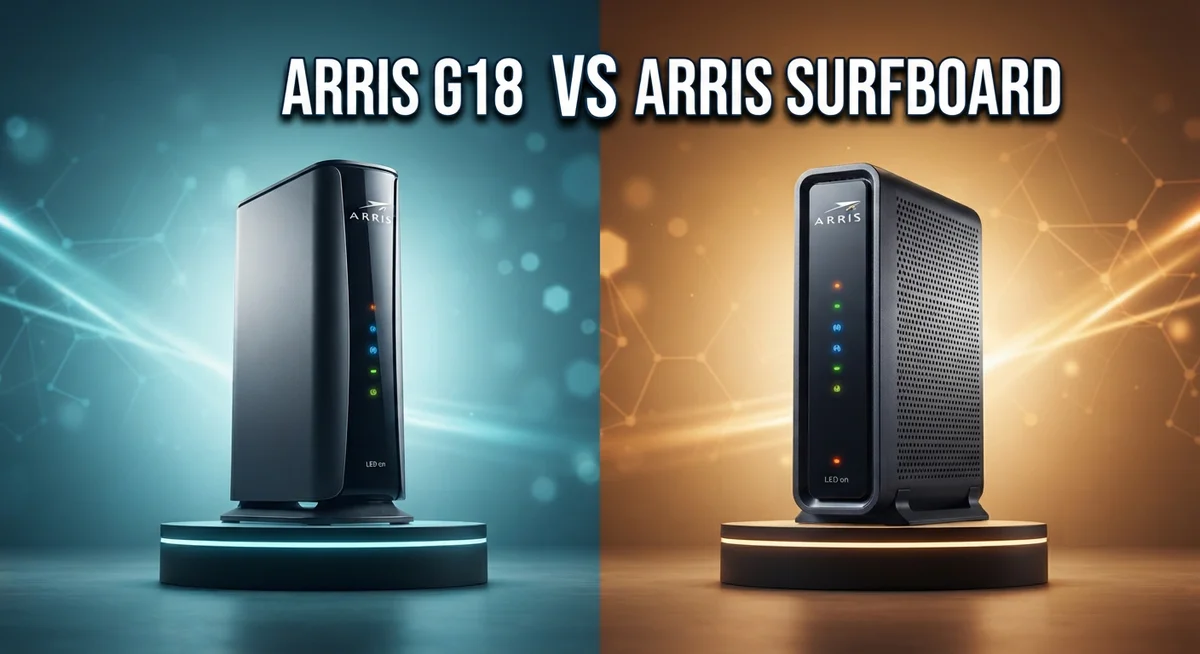
Arris G18 vs Arris Surfboard: Which One Is Better?
Picking a new modem router combo feels tricky. Two names often pop up in this search: the Arris G18 and the Arris Surfboard.
Both brands promise fast internet and steady connections. But they take very different paths to get there.
The Arris G18 packs a modem and router into one sleek tower. It brings Wi-Fi 6 and DOCSIS 3.1 into a single, space-saving unit.
The Arris Surfboard line takes a modular approach. It keeps your modem and router as separate devices, offering more flexibility and cooler performance over time.
Quick Comparison: Arris G18 vs Arris Surfboard
| Feature | Arris G18 | Arris Surfboard |
|---|---|---|
| DOCSIS Version | DOCSIS 3.1 | Varies by model |
| Wi-Fi Standard | Wi-Fi 6 (AX1800) | Varies (up to tri-band) |
| Architecture | All-in-one modem/router | Separate modem/router |
| Max Speed | Up to 1 Gbps | ~800 Mbps (varies by model) |
| Ethernet Ports | Two 1 Gbps ports | Varies by model |
| Thermal Performance | Limited (integrated design) | Better (separate units) |
| Upgrade Flexibility | Low (single device) | High (modular design) |
| Best For | Small spaces, simplicity | Long-term modularity, upgrades |
Arris G18 Review

Last update on 2026-10-11 / Affiliate links / Images from Amazon Product Advertising API Some of the links on this website are affiliate links, which means that at no additional cost to you, I earn a commission if you click through and make a purchase. I only recommend products and services that I believe will add value to my readers. Thank you for your support!
The Arris G18 is a single-device modem-router combo that merges both functions into one vertical tower. It suits people who live in small spaces and want simplicity without managing two separate boxes.
This unit runs on DOCSIS 3.1, the latest modem standard, and includes Wi-Fi 6 for faster wireless speeds. You get dual-band coverage and two 1 Gbps Ethernet ports for rock-solid wired connections.
The G18 delivers speeds up to 1 Gbps and maintains stable wired performance for devices plugged in directly. Its sleek tower design sits neatly on shelves or desks without taking up much room.
One trade-off: Wi-Fi 6 sits underutilized in this combo setup, and the single integrated device can face thermal stress over time. Upgrading means replacing the entire unit rather than swapping just the modem or router.
Pros
- All-in-one design saves space and simplifies setup
- DOCSIS 3.1 technology delivers modern speeds and future-ready performance
- Excellent wired Ethernet stability with two 1 Gbps ports
- Clean vertical tower form factor looks unobtrusive
Cons
- Wi-Fi 6 capabilities not fully utilized in a combo device
- Single unit means thermal and upgrade limitations down the road
Arris Surfboard Review

Last update on 2026-10-13 / Affiliate links / Images from Amazon Product Advertising API Some of the links on this website are affiliate links, which means that at no additional cost to you, I earn a commission if you click through and make a purchase. I only recommend products and services that I believe will add value to my readers. Thank you for your support!
The Arris Surfboard line takes a modular approach to home connectivity. Instead of cramming everything into one device, Surfboard separates the modem and router, giving you flexibility and better long-term performance.
This separation means cooler operation and easier upgrades down the road. You swap out individual components without replacing the entire unit when technology advances.
Surfboard models vary—the SBR-AC1750 handles around 800 Mbps, while the Max Pro steps up to tri-band performance. Build quality remains solid across the range, with reliable connectivity that handles streaming, gaming, and work-from-home demands.
Real-world performance stays consistent because each device focuses on its job. Your modem handles internet delivery while your router manages Wi-Fi distribution, reducing thermal stress and bottlenecks.
Pros
- Modular design lets you upgrade modem or router independently without replacing both
- Separate devices run cooler and more stable over time
- Solid build quality with dependable performance for everyday use
- Flexible setup works well in homes with separate device placement
Cons
- Requires space and outlets for two devices instead of one
- Max Pro model has a large footprint with limited Wi-Fi range
- Some models lack built-in security software
Head to Head: Key Differences
The G18 prioritizes compactness while the Surfboard prioritizes flexibility. The G18 squeezes modem and router into one tower, making it ideal for apartments or desks with limited space.
The Surfboard line keeps modem and router separate, giving you room to place each device where it works best.
Speed delivery differs between the two. The G18 reaches up to 1 Gbps using DOCSIS 3.1, which is newer technology.
Surfboard models vary by version, with the SBR-AC1750 hitting around 800 Mbps and the Max Pro offering tri-band options.
Thermal performance favors the Surfboard. When you combine modem and router into one box, heat builds up inside the G18 over long sessions.
Separate Surfboard devices run cooler because each handles its own workload independently.
Upgrade paths matter for long-term use. With the G18, you replace the entire unit if either the modem or router fails or becomes outdated.
Surfboard’s modular setup lets you swap just the modem or just the router without touching the other device.
Wired connections stay rock solid on both. The G18 offers two 1 Gbps Ethernet ports for devices that need direct cable connections.
Surfboard maintains reliable wired performance across its lineup, making both options trustworthy for gaming consoles or workstations.
Wireless capability shows a gap. The G18 includes Wi-Fi 6 but doesn’t fully use it in the combo format.
Surfboard models deliver steady Wi-Fi without the same cutting-edge label, focusing on consistent real-world performance instead.
Choose the G18 for single-device simplicity and small spaces. Choose Surfboard for cooler operation, independent upgrades, and flexible placement around your home.
Which One Should You Buy
The Arris G18 stands out as the overall winner in this comparison. It combines DOCSIS 3.1 and Wi-Fi 6 in one simple device.
You get strong wired performance and the latest tech without juggling separate boxes.
The Arris Surfboard still shines for specific needs. It offers more flexibility and runs cooler over time.
Best for each buyer – Arris G18: Best for users with limited space who want a simple, all-in-one modem and router with strong wired stability and the newest DOCSIS standard. – Arris Surfboard: Best for users who value long-term flexibility, modular setup, and cooler operation, and who have room for separate modem and router devices.
Frequently Asked Questions
Which device wins if I have a small apartment?
The Arris G18 is your best choice here. It combines modem and router into one compact unit, so you skip the clutter of two separate boxes.
The vertical tower design fits neatly on a shelf or desk. You get strong wired connections with two 1 Gbps Ethernet ports, plus Wi-Fi 6 coverage for the whole space.
The Surfboard line needs two devices, which takes up more room. If your apartment is tight, the G18 solves that problem instantly.
Can I upgrade just one part later, or do I need to replace everything?
Surfboard wins here. Its modular design lets you swap the modem or router independently. Your internet slows down?
Upgrade just the modem. Wi-Fi coverage drops?
Replace only the router.
The G18 is one integrated device. If either part fails or you want better performance, you replace the whole unit.
No partial upgrades available.
Which stays cooler during heavy use?
Surfboard devices run cooler. When modem and router sit in separate boxes, each handles its own workload. Heat dissipates better.
Over months and years, this matters for reliability.
The G18 packs both functions into one chassis. Heat builds up inside.
Thermal stress can affect long-term performance, though it handles everyday use just fine.
Does the G18 really need Wi-Fi 6 if I mainly use wired connections?
Not really. The G18 has Wi-Fi 6, but many users don’t fully tap that speed.
If you plug devices into those two Ethernet ports and rarely use wireless, Wi-Fi 6 sits mostly unused.
Your money goes toward a feature you won’t maximize. However, if you have some wireless devices, Wi-Fi 6 future-proofs your setup.

Hi, my name is Lily you can say i am a gadget hunter at this point. Welcome to Gadget Gallery The Gallery of Gadget Reviews