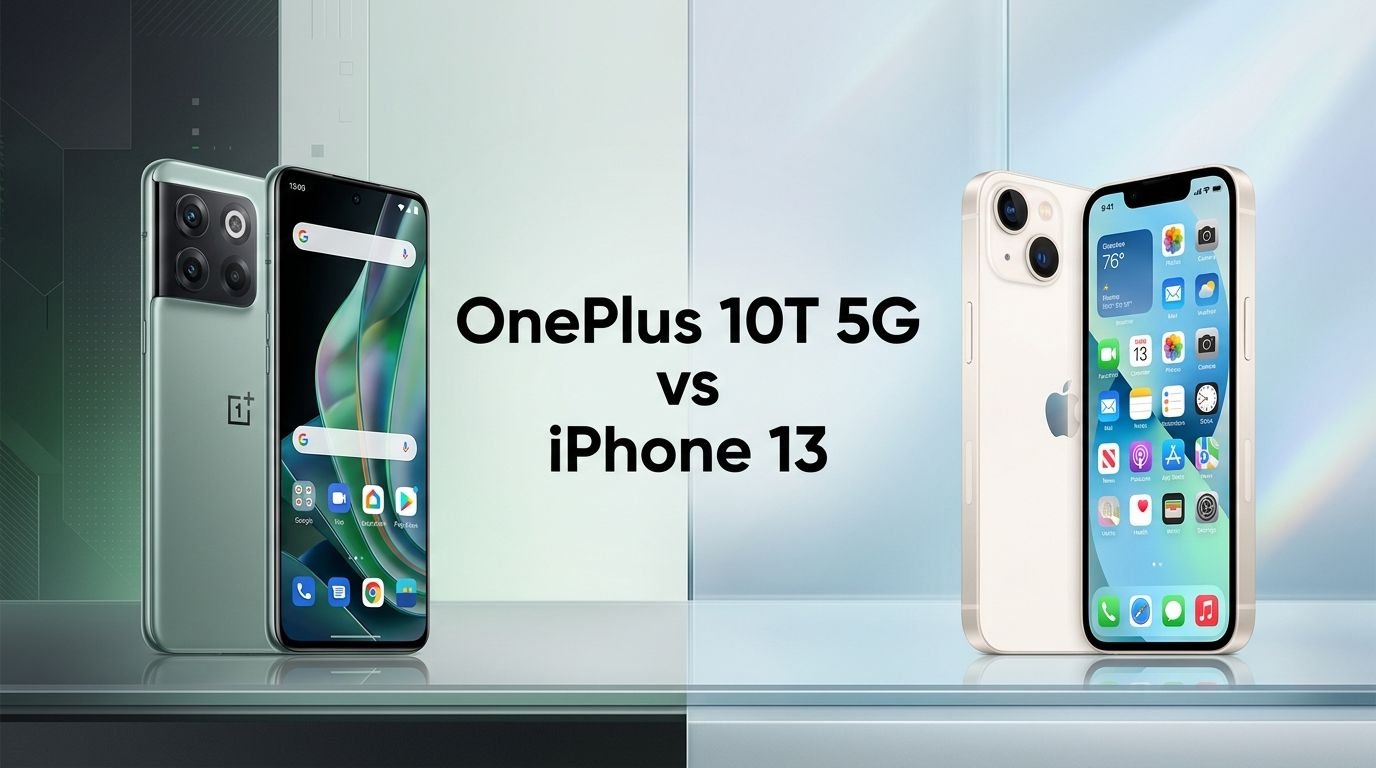
OnePlus 10T 5G vs iPhone 13: Battle of the Best
Are you stuck between the OnePlus 10T 5G and the iPhone 13? You are not alone. These two phones sit in a similar price range and offer strong performance, solid cameras, and 5G connectivity. But they take very different approaches to deliver the smartphone experience.
The OnePlus 10T 5G brings blazing fast 125W charging, a huge 6.7 inch AMOLED display, and up to 16GB of RAM.
The iPhone 13 fights back with Apple’s A15 Bionic chip, an IP68 water resistance rating, and the seamless iOS ecosystem. Both phones have loyal fans, and both phones have clear strengths.
Key Takeaways:
- The OnePlus 10T 5G charges from 0% to 100% in about 20 minutes with its 125W SuperVOOC technology. The iPhone 13 maxes out at 20W wired charging and takes over an hour to fully charge. If charging speed matters to you, the OnePlus 10T wins by a huge margin.
- The iPhone 13 has a better water resistance rating (IP68) and supports wireless charging. The OnePlus 10T 5G lacks both an official IP rating and wireless charging support. This makes the iPhone 13 a safer pick for accident prone users.
- The OnePlus 10T 5G packs a larger 4,800mAh battery compared to the iPhone 13’s 3,240mAh cell. However, both phones deliver a full day of use on a single charge thanks to software optimization on each platform.
- Camera quality leans in Apple’s favor despite the OnePlus 10T’s higher megapixel count of 50MP. The iPhone 13’s dual 12MP system produces more consistent colors, better video stabilization, and superior low light results.
- For raw multitasking power, the OnePlus 10T 5G leads with up to 16GB of RAM and the Snapdragon 8+ Gen 1 chipset. The iPhone 13 uses 4GB of RAM but compensates with Apple’s efficient A15 Bionic processor.
- The iPhone 13 gets longer software support from Apple with up to six years of iOS updates. The OnePlus 10T receives three major OxygenOS updates and four years of security patches.
OnePlus 10T 5G: Overview and First Impressions

Last update on 2026-10-11 / Affiliate links / Images from Amazon Product Advertising API Some of the links on this website are affiliate links, which means that at no additional cost to you, I earn a commission if you click through and make a purchase. I only recommend products and services that I believe will add value to my readers. Thank you for your support!
The OnePlus 10T 5G arrived in August 2022 as a performance focused flagship. It runs on the Qualcomm Snapdragon 8+ Gen 1 processor paired with up to 16GB of LPDDR5 RAM. This combination makes the phone a powerhouse for gaming, multitasking, and heavy app usage.
The design uses a glass back with Gorilla Glass 5 protection and a plastic frame. It weighs 204 grams and measures 163 x 75.4 x 8.8mm. The phone feels solid in the hand, though the plastic frame is a step down from the aluminum frames found on pricier flagships.
OnePlus shipped this phone with OxygenOS 12.1 based on Android 12. The software is clean and fast, with minimal bloatware. OnePlus promised three major Android updates and four years of security patches for this device.
The phone is available in Moonstone Black and Jade Green color options. Both finishes look premium and resist fingerprints reasonably well. The triple camera system on the back sits in a rectangular module that blends into the rear panel.
Pros:
- Snapdragon 8+ Gen 1 delivers flagship level speed
- 125W SuperVOOC charging fills the battery in about 20 minutes
- 120Hz AMOLED display is smooth and vibrant
- Up to 16GB of RAM handles heavy multitasking
- Clean OxygenOS software with minimal bloatware
Cons:
- No wireless charging support
- No official IP rating for water or dust resistance
- Plastic frame feels less premium than aluminum
- No alert slider (removed from this model)
- Camera quality falls short of top tier flagships
iPhone 13: Overview and First Impressions

Last update on 2026-10-11 / Affiliate links / Images from Amazon Product Advertising API Some of the links on this website are affiliate links, which means that at no additional cost to you, I earn a commission if you click through and make a purchase. I only recommend products and services that I believe will add value to my readers. Thank you for your support!
Apple released the iPhone 13 in September 2021 with the A15 Bionic chip. This processor remains one of the most powerful mobile chips ever made. It handles everything from casual browsing to 4K video editing without breaking a sweat.
The design is classic Apple. You get an aluminum frame, a Ceramic Shield front, and a glass back. The phone weighs 174 grams and measures 146.7 x 71.5 x 7.7mm. It is lighter, thinner, and more compact than the OnePlus 10T 5G.
The iPhone 13 ships with IP68 water and dust resistance. This means it can survive submersion in up to 6 meters of water for 30 minutes. This rating gives peace of mind for everyday accidents like spills and rain.
Apple’s iOS ecosystem is a major selling point. You get seamless integration with AirPods, Apple Watch, MacBooks, and iPads. iMessage, FaceTime, and AirDrop make communication smooth within the Apple ecosystem.
The phone is available in six colors: Starlight, Midnight, Blue, Pink, Green, and (PRODUCT)RED. All colors look refined and tasteful.
Pros:
- A15 Bionic chip delivers top tier performance and efficiency
- IP68 water and dust resistance
- Wireless charging support (MagSafe up to 15W)
- Excellent camera consistency and video recording
- Long software support with up to six years of iOS updates
Cons:
- 60Hz display feels outdated compared to 120Hz competitors
- 20W maximum wired charging is slow by 2026 standards
- Smaller 3,240mAh battery than most Android rivals
- No USB Type C (uses Lightning connector)
- Base model starts at 128GB with no expandable storage
Display Quality Comparison
The OnePlus 10T 5G features a 6.7 inch Fluid AMOLED display with a resolution of 2412 x 1080 pixels. It supports a 120Hz refresh rate and a 240Hz touch sampling rate. Colors pop, animations feel smooth, and scrolling is buttery.
The iPhone 13 has a 6.1 inch Super Retina XDR OLED display with a resolution of 2532 x 1170 pixels. This gives it a higher pixel density of 460 PPI compared to the OnePlus 10T’s 394 PPI. Images and text look slightly sharper on the iPhone’s screen.
However, the iPhone 13 is limited to a 60Hz refresh rate. This is its biggest display weakness. Once you experience 120Hz scrolling on the OnePlus 10T, going back to 60Hz feels slow and choppy. This alone is a deal breaker for many users.
Both screens deliver excellent brightness. The iPhone 13 reaches 800 nits typical and 1200 nits peak for HDR content. The OnePlus 10T can also get bright enough for comfortable outdoor use.
If you value screen size and smoothness, the OnePlus 10T 5G wins this round. If you prefer sharpness and a compact form factor, the iPhone 13 holds its own.
Performance and Processing Power
The OnePlus 10T 5G uses the Qualcomm Snapdragon 8+ Gen 1 processor. This chip is built on a 4nm process and clocks up to 3.2 GHz. It pairs with up to 16GB of LPDDR5 RAM and up to 256GB of UFS 3.1 storage. App launches are instant, and multitasking between heavy apps is seamless.
The iPhone 13 runs on the Apple A15 Bionic chip with a 6 core CPU and 4 core GPU. Despite having only 4GB of RAM, iOS manages memory so well that the iPhone rarely stutters. The A15 Bionic actually scores higher in the AnTuTu benchmark with about 1,230,618 points compared to the OnePlus 10T’s 1,016,955 points.
For gaming, both phones handle top titles at high settings. The OnePlus 10T has a HyperBoost Gaming Engine that optimizes frame rates and reduces lag. The iPhone 13 benefits from Apple’s GPU and Metal API for smooth gaming performance.
In real world use, both phones feel extremely fast. The OnePlus 10T handles more apps in memory simultaneously thanks to its extra RAM. The iPhone 13 delivers a more consistent and stable experience over time.
The performance battle is close. The iPhone 13 wins on raw benchmarks. The OnePlus 10T wins on multitasking headroom.
Camera Systems: A Detailed Look
The OnePlus 10T 5G has a triple camera setup: a 50MP main sensor (Sony IMX766, f/1.8), an 8MP ultrawide lens (f/2.2), and a 2MP macro lens (f/2.4). The front camera is a 16MP shooter. The main sensor captures sharp images in good light, and the Nightscape 2.0 mode improves low light results.
The iPhone 13 uses a dual camera system: a 12MP wide lens (f/1.6) and a 12MP ultrawide lens (f/2.4). The front camera is a 12MP TrueDepth sensor. Apple’s computational photography makes a big difference here. Colors are accurate, dynamic range is wide, and skin tones look natural.
In daylight conditions, both phones take great photos. The OnePlus 10T captures more detail in its 50MP mode. The iPhone 13 produces warmer tones and better color science.
In low light, the iPhone 13 pulls ahead. Its larger f/1.6 aperture gathers more light, and Apple’s Night mode produces cleaner results with less noise. The OnePlus 10T’s Nightscape mode works well but produces slightly softer images.
For video recording, the iPhone 13 is the clear winner. It supports Cinematic Mode at 1080p and Dolby Vision HDR recording up to 4K at 60fps. Video stabilization is superb. The OnePlus 10T records 4K at 60fps but lacks the same level of video polish.
Battery Life and Charging Speed
The OnePlus 10T 5G packs a 4,800mAh battery. This large cell comfortably powers the phone through a full day of use. Most users report around 5 to 7 hours of screen on time depending on usage patterns. The 120Hz display does consume more power than a 60Hz screen, but OxygenOS optimizes background tasks well.
The iPhone 13 has a smaller 3,240mAh battery. Despite the smaller capacity, the iPhone 13 delivers comparable battery life. Apple’s tight integration of hardware and software means the A15 Bionic chip is extremely power efficient. Most users also get a full day of use from the iPhone 13.
Here is where the OnePlus 10T 5G truly shines. It supports 125W SuperVOOC charging. This fills the battery from 0% to 100% in about 20 minutes. That is mind blowing. You can plug in for just 10 minutes and get enough juice for half a day.
The iPhone 13 supports a maximum of 20W wired charging. A full charge takes over 90 minutes. It also supports MagSafe wireless charging at 15W and Qi wireless charging at 7.5W. Wireless charging is convenient, but the speeds are still slow.
If you are always on the go and need quick top ups, the OnePlus 10T 5G is the better choice. If you prefer the convenience of wireless charging, the iPhone 13 has that advantage.
Software Experience: OxygenOS vs iOS
The OnePlus 10T 5G ships with OxygenOS 12.1 based on Android 12. OnePlus has since updated the phone to newer versions of OxygenOS. The software is clean, customizable, and fast. You can change icon packs, fonts, accent colors, and layout styles. The notification system on Android is also more flexible than iOS.
The iPhone 13 runs iOS, Apple’s mobile operating system. iOS is known for its smooth animations, consistent design, and strong privacy features. Features like Focus modes, App Tracking Transparency, and Mail Privacy Protection give users more control over their digital lives.
App quality tends to be slightly better on iOS. Developers often optimize apps for iPhone first. Social media apps like Instagram and Snapchat capture better photos and videos on iPhone because developers use the phone’s camera API directly.
Customization is where Android and OxygenOS win. You can set default apps, use widgets more freely, and arrange your home screen however you want. iOS has added widgets and home screen customization in recent updates, but it still feels more locked down.
For software longevity, the iPhone 13 gets the edge. Apple typically supports iPhones with major updates for five to six years. OnePlus commits to three major OS updates and four years of security patches for the 10T.
Build Quality and Design
The OnePlus 10T 5G has a glass front and back with a plastic frame. The phone is large at 6.7 inches and weighs 204 grams. The Gorilla Glass 5 on the front offers decent scratch protection. The overall build is solid, but the plastic frame feels less premium than metal.
The iPhone 13 features an aluminum frame with a Ceramic Shield front and glass back. It weighs just 174 grams and is 7.7mm thin. The Ceramic Shield is tougher than standard glass and resists drops better. The phone feels compact and easy to use with one hand.
Water resistance is a big differentiator. The iPhone 13 carries an IP68 rating, which means full protection against dust and water submersion up to 6 meters for 30 minutes. The OnePlus 10T 5G has no official IP rating, so you need to keep it away from water.
The OnePlus 10T removed the iconic alert slider that OnePlus fans loved. This was a silent, vibrate, and ring switch on the side of the phone. Its absence disappointed many long time OnePlus users.
Both phones have an in display fingerprint sensor (OnePlus 10T) and Face ID (iPhone 13) for biometric security. Both methods are fast and reliable.
5G Connectivity and Network Support
Both the OnePlus 10T 5G and iPhone 13 support 5G connectivity. They work on both sub 6GHz and mmWave 5G bands (depending on the model and region). This means you get access to faster download speeds and lower latency on supported networks.
The OnePlus 10T 5G supports Wi-Fi 6 and Bluetooth 5.2. It also includes NFC for contactless payments through Google Pay. The phone has a USB Type C port for data transfer and charging.
The iPhone 13 also supports Wi-Fi 6 and Bluetooth 5.0. It uses NFC for Apple Pay, which works at most contactless payment terminals. The phone uses a Lightning port instead of USB Type C. This is a drawback since most accessories and chargers now use USB Type C.
Both phones support dual SIM functionality. The OnePlus 10T uses two nano SIM cards. The iPhone 13 supports one nano SIM and one eSIM, or dual eSIM in some regions.
For call quality and signal reception, both phones perform well on major carriers. The 5G experience will depend more on your carrier’s coverage in your area than on the phone itself.
Storage Options and Value for Money
The OnePlus 10T 5G comes in two storage configurations: 8GB RAM + 128GB storage and 16GB RAM + 256GB storage. Neither option supports expandable storage through a microSD card. The 128GB variant is enough for most users, but heavy photo and video users should go for the 256GB version.
The iPhone 13 is available in 128GB, 256GB, and 512GB storage options. All variants come with 4GB of RAM. There is no microSD card slot here either. The 512GB option gives power users plenty of space, but it comes at a higher price.
In terms of value for money, the OnePlus 10T 5G originally launched at a lower price than the iPhone 13. In 2026, both phones are available at significantly reduced prices as pre owned or renewed devices. The OnePlus 10T offers more RAM and a bigger screen for less money.
The iPhone 13 holds its resale value much better than the OnePlus 10T. iPhones tend to retain value over time due to strong demand and long software support. If you plan to sell your phone later, the iPhone 13 is the safer investment.
Both phones eliminate the headphone jack. Neither phone includes a charger in the box (in most regions). You will need to budget for a charger if you do not already own a compatible one.
Gaming Performance Comparison
The OnePlus 10T 5G is built for gaming. Its Snapdragon 8+ Gen 1 processor and up to 16GB of RAM handle demanding games like Genshin Impact and Call of Duty Mobile at high settings. The HyperBoost Gaming Engine optimizes frame rates and touch response in real time.
The 6.7 inch 120Hz display makes gaming on the OnePlus 10T a visual treat. Games look smoother, animations flow better, and the larger screen provides more immersion. The 240Hz touch sampling rate also helps with competitive multiplayer games where quick reactions matter.
The iPhone 13 uses the A15 Bionic GPU which handles mobile games with ease. Despite running at 60Hz, the iPhone delivers stable frame rates and excellent graphics quality. Apple’s Metal API gives game developers powerful tools to optimize titles for iPhone hardware.
Thermal management is important during long gaming sessions. The OnePlus 10T uses a large vapor chamber cooling system to keep temperatures under control. The Snapdragon 8+ Gen 1 runs cooler than its predecessor (Snapdragon 8 Gen 1), which helps during extended play.
The iPhone 13 also manages heat well. Apple’s chip design is efficient, so the phone does not get uncomfortably hot during gaming.
If gaming is a priority, the OnePlus 10T 5G offers a better experience thanks to its 120Hz display, higher RAM, and dedicated gaming optimizations. The iPhone 13 delivers a smooth but less immersive gaming experience at 60Hz.
Audio and Media Experience
Both phones have stereo speakers that deliver clear and loud audio. The iPhone 13 uses a speaker at the bottom and the earpiece as a second speaker. The sound is balanced and rich for a smartphone. The OnePlus 10T also features stereo speakers that sound good but lack the same warmth as the iPhone’s output.
Neither phone has a 3.5mm headphone jack. You will need wireless earbuds or a USB Type C adapter (for the OnePlus) or a Lightning adapter (for the iPhone). The OnePlus 10T supports aptX and aptX HD codecs for high quality Bluetooth audio. The iPhone 13 supports AAC codec over Bluetooth, which works well with AirPods.
For media consumption, the OnePlus 10T’s 6.7 inch 120Hz AMOLED screen is fantastic. Watching movies and YouTube videos feels immersive on the large display. The HDR10+ support adds depth to compatible content.
The iPhone 13’s 6.1 inch OLED screen is smaller but still delivers excellent color accuracy and contrast. It supports Dolby Vision HDR, which is a premium HDR format available on streaming platforms like Netflix and Apple TV+.
Haptic feedback is another area where the iPhone 13 excels. Apple’s Taptic Engine provides precise and satisfying vibrations that enhance the overall user experience. The OnePlus 10T’s haptic motor is decent but does not match Apple’s quality.
Which Phone Should You Buy?
The answer depends on what you prioritize in a smartphone.
Choose the OnePlus 10T 5G if you want a bigger screen, faster charging, a higher refresh rate, and more RAM for multitasking. It is the better choice for gamers, power users, and people who hate waiting for their phone to charge. The phone delivers strong performance at a lower price point.
Choose the iPhone 13 if you value camera consistency, water resistance, wireless charging, long software support, and Apple ecosystem integration. It is the better choice for users who already own Apple products and want a reliable, polished experience.
Both phones are excellent options for daily use. They handle calls, texts, social media, navigation, and streaming without any issues. The differences matter more if you have specific needs like gaming, photography, or ecosystem preferences.
In 2026, both phones are available as renewed or pre owned devices at very attractive prices. You can get flagship level performance without spending flagship level money. Either phone will serve you well for another year or two of use.
Frequently Asked Questions
Is the OnePlus 10T 5G better than the iPhone 13 for gaming?
Yes, the OnePlus 10T 5G offers a better gaming experience. Its 120Hz AMOLED display, Snapdragon 8+ Gen 1 processor, and up to 16GB of RAM give it an edge over the iPhone 13’s 60Hz screen and 4GB of RAM. The HyperBoost Gaming Engine on the OnePlus also optimizes game performance in real time.
Does the iPhone 13 have a better camera than the OnePlus 10T 5G?
The iPhone 13 produces more consistent photos and significantly better video. Apple’s computational photography, Cinematic Mode, and Dolby Vision HDR recording give it a clear lead in the camera department. The OnePlus 10T captures more detail in its 50MP mode but lacks the same color science and video quality.
Can the OnePlus 10T 5G charge wirelessly?
No, the OnePlus 10T 5G does not support wireless charging. It relies on its 125W SuperVOOC wired charging, which fills the battery in about 20 minutes. The iPhone 13 supports both MagSafe wireless charging at 15W and Qi wireless charging at 7.5W.
Which phone has better water resistance?
The iPhone 13 is far better in this area. It has an IP68 rating and can survive submersion in up to 6 meters of water for 30 minutes. The OnePlus 10T 5G does not have an official IP rating, so it has no guaranteed water resistance.
How long will these phones receive software updates?
The iPhone 13 receives approximately five to six years of major iOS updates from Apple. The OnePlus 10T 5G gets three major Android updates and four years of security patches. The iPhone 13 has a clear advantage in long term software support.
Which phone offers better value for money in 2026?
Both phones are available at reduced prices as renewed devices in 2026. The OnePlus 10T 5G offers more hardware features (bigger screen, more RAM, faster charging) for a lower price. The iPhone 13 holds better resale value and receives longer software updates, which adds long term value.

Hi, my name is Lily you can say i am a gadget hunter at this point. Welcome to Gadget Gallery The Gallery of Gadget Reviews