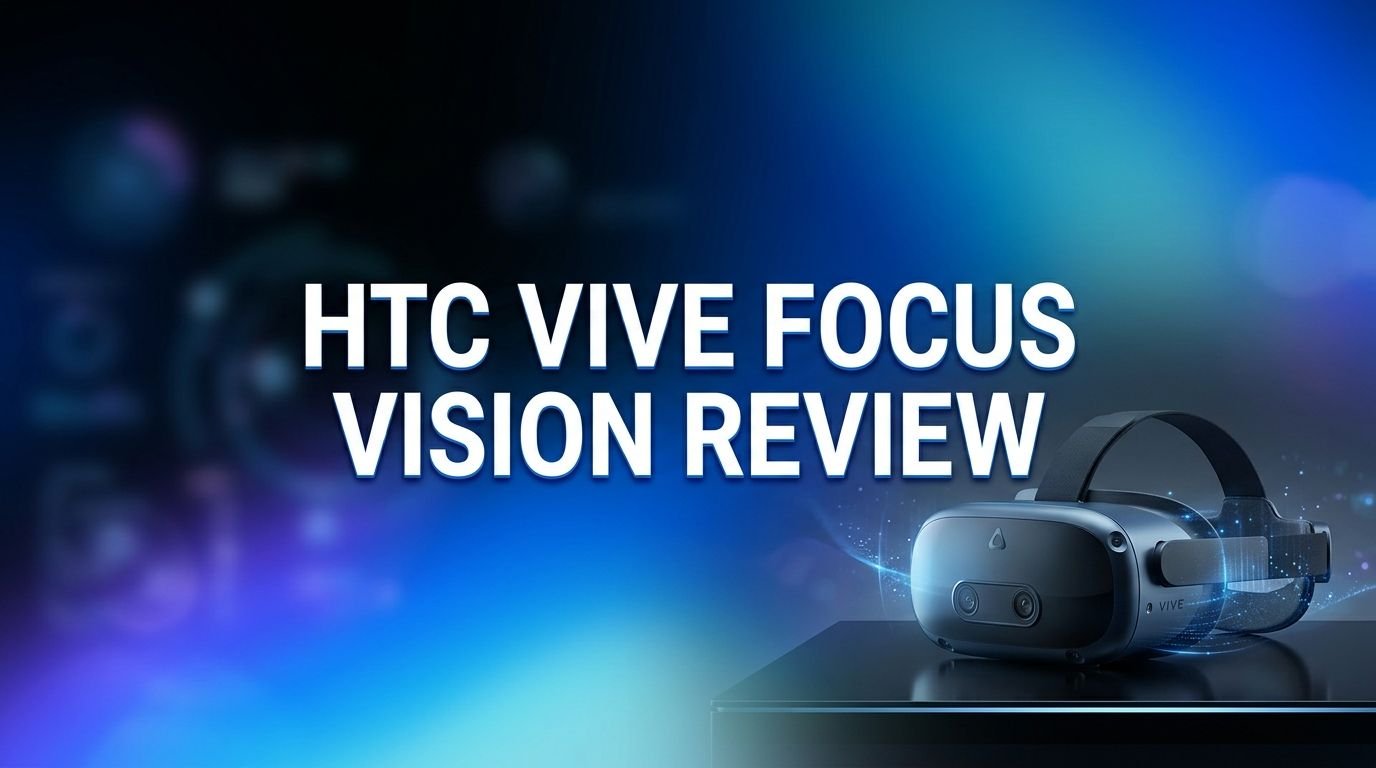
HTC Vive Focus Vision Review 2026: Worth Your Money?
So you are thinking about buying the HTC Vive Focus Vision. You want a premium standalone VR headset that also works as a PC VR device.
You have read the bold claims from HTC about 5K resolution, eye tracking, and mixed reality. But is this headset a smart buy in 2026, or does it fall short of its $999 price tag?
This review covers everything you need to know. We break down the display quality, processor performance, comfort, software library, and real world experience.
Key Takeaways:
- The HTC Vive Focus Vision costs $999 and offers total 5K resolution with 2448 x 2448 pixels per eye. The display is sharp, and the 120 degree field of view creates a strong sense of presence. However, the headset still uses older Fresnel lenses instead of modern pancake optics, which can produce light artifacts.
- The Snapdragon XR2 processor is a major concern. This chip launched in 2020 and powers the much older Meta Quest 2. The $300 Meta Quest 3S runs a chip that is 2.5 times faster, which makes the Focus Vision feel underpowered for its price.
- Hot swappable battery is a standout feature. The removable rear battery lasts about 2 hours. A built in reserve battery gives you up to 20 minutes of standby while you swap cells. This is a feature you will not find on any Meta Quest headset.
- Eye tracking and mixed reality come built in. The headset includes two eye tracking cameras and two 16MP color passthrough cameras. However, the software library for these features remains very limited in 2026.
- DisplayPort PC VR streaming is a strong selling point for PC gamers, but the required streaming kit costs an extra $149. Once connected, you get uncompressed visuals from your desktop GPU.
- Build quality and comfort are excellent. The halo style head strap, flip up visor, and balanced weight distribution make this one of the most comfortable VR headsets available today.


Last update on 2026-10-13 / Affiliate links / Images from Amazon Product Advertising API Some of the links on this website are affiliate links, which means that at no additional cost to you, I earn a commission if you click through and make a purchase. I only recommend products and services that I believe will add value to my readers. Thank you for your support!
HTC Vive Focus Vision Overview
The HTC Vive Focus Vision launched in late 2024 as an upgrade to the HTC Vive Focus 3. It sits in a unique space. This headset targets both enterprise users and enthusiast PC VR gamers who want premium features.
HTC priced the Focus Vision at $999. That puts it well above the Meta Quest 3 at $500 and the Quest 3S at $300. The higher price gets you features like built in eye tracking, automatic IPD adjustment, a hot swappable battery, and a DisplayPort connection option for lossless PC VR.
The headset runs on the Qualcomm Snapdragon XR2 processor with 12GB of LPDDR5 RAM and 128GB of storage. You can expand that storage with a MicroSD card up to 2TB. The dual LCD panels deliver 2448 x 2448 pixels per eye for a combined resolution of nearly 12 million pixels.
HTC designed this headset for people who want a single device that works standalone, supports mixed reality, and connects to a PC for high fidelity VR experiences. It is a bold vision, but the execution has some clear weak spots.
Display and Visual Quality
The display is one of the strongest parts of the HTC Vive Focus Vision. Each eye gets a 2448 x 2448 pixel LCD panel. The combined resolution of 4896 x 2448 pixels delivers a total of about 12 million pixels. That is noticeably sharper than the Meta Quest 3, which offers 2064 x 2208 pixels per eye.
Colors look vibrant and punchy on the Focus Vision. Black levels are better than expected for LCD panels. The 120 degree field of view is wider than the 110 degrees you get on the Quest 3. This extra width adds to the feeling of presence in VR.
The refresh rate supports up to 120Hz in DisplayPort mode (currently in beta). In standalone mode, the headset runs at 90Hz. Both rates deliver smooth motion for gaming and productivity.
The biggest visual downside is the Fresnel lens design. HTC stuck with older optics instead of using pancake lenses. Fresnel lenses can cause god rays and light bleeding around high contrast edges. This is a surprising choice for a $999 headset in 2026, especially when cheaper competitors already use sharper pancake lenses.
Top 3 Alternatives for HTC Vive Focus Vision
1. Meta Quest 3 512GB

Last update on 2026-10-11 / Affiliate links / Images from Amazon Product Advertising API Some of the links on this website are affiliate links, which means that at no additional cost to you, I earn a commission if you click through and make a purchase. I only recommend products and services that I believe will add value to my readers. Thank you for your support!
2. Meta Quest 3S 128GB

Last update on 2026-10-11 / Affiliate links / Images from Amazon Product Advertising API Some of the links on this website are affiliate links, which means that at no additional cost to you, I earn a commission if you click through and make a purchase. I only recommend products and services that I believe will add value to my readers. Thank you for your support!
3. PICO 4 Ultra 256GB

Last update on 2026-09-27 / Affiliate links / Images from Amazon Product Advertising API Some of the links on this website are affiliate links, which means that at no additional cost to you, I earn a commission if you click through and make a purchase. I only recommend products and services that I believe will add value to my readers. Thank you for your support!
Processor and Performance
The HTC Vive Focus Vision runs on the Qualcomm Snapdragon XR2 chip. This processor first arrived in 2020. It is the same silicon found in the HTC Vive Focus 3 and the older Meta Quest 2. For a headset that costs $999, this is hard to accept.
The Meta Quest 3S, priced at just $300, runs the Snapdragon XR2 Gen 2. That chip is 2.5 times faster for general processing. It also delivers up to 8 times faster AI processing. The Quest 3 uses the same Gen 2 chip. Both outperform the Focus Vision in raw standalone power.
In daily use, the older processor shows its age. Loading times are longer. Standalone games run with fewer visual effects. Complex mixed reality apps can feel sluggish. The 12GB of RAM helps with multitasking and memory heavy apps, but it cannot fix a slow CPU.
If you plan to use the Focus Vision mainly as a PC VR headset, the processor matters less. Your desktop GPU handles the heavy lifting over DisplayPort. But for standalone use, the Focus Vision feels like a 2020 headset wrapped in a 2024 shell. HTC missed an opportunity by not including at least the XR2 Gen 2 chip.
Design and Build Quality
The HTC Vive Focus Vision looks and feels premium. The build quality is excellent. Despite using plastic construction similar to the Quest 3, the Focus Vision has a sturdier feel. Every surface, hinge, and button feels well made.
The headset uses a halo style head strap with an adjustment dial at the back. This strap distributes weight evenly across your forehead and the back of your skull. You can flip the visor upward to check your surroundings without removing the headset.
The magnetically attached face cushion uses PU leather trim. It is easy to remove and clean. The facial interface measures 150mm wide, which means it fits comfortably over most eyeglasses. This is a big plus for glasses wearers who struggle with the Quest 3’s tighter fit.
The controller design carries over from the Focus 3. Both controllers feature ergonomic grips, analog triggers, and Hall sensors. They feel solid in your hands. The rechargeable batteries inside each controller last up to 15 hours. You charge them with USB C cables.
Overall, the Focus Vision looks and feels like a $999 device. The design choices reflect years of refinement from HTC’s enterprise VR experience.
Comfort and Fit
Comfort is a major strength of the HTC Vive Focus Vision. The balanced weight distribution puts the heavy battery pack at the back of the head strap. This counterweights the front mounted display and cameras.
Long VR sessions feel manageable. The ample cushioning on the forehead pad and rear cradle prevents pressure points. The PU leather trim stays comfortable even during sweaty gaming sessions. It wipes clean quickly between uses.
The automatic IPD adjustment is a standout feature. The headset scans your eyes and physically moves the lenses to match your interpupillary distance. Supported IPD ranges from 57mm to 72mm. This works well for sharing the headset between multiple users.
However, the auto IPD system is not always accurate. Some users report the system landing on an incorrect IPD value, which causes blurry visuals. In those cases, manual adjustment gives better results. This inconsistency is frustrating for a feature that should just work at this price point.
The flip up visor design deserves praise. You can check your phone or talk to someone without pulling the entire headset off your head. This small detail makes a big difference during long work sessions.
Eye Tracking and Mixed Reality
The HTC Vive Focus Vision includes built in eye tracking with two dedicated cameras. The system outputs gaze data at 120Hz. It supports a 5 point calibration process and handles automatic IPD adjustment.
Eye tracking sounds exciting on paper. It can enable foveated rendering, which sharpens the area you look at while reducing detail in your peripheral vision. This boosts performance without lowering visual quality. It can also add new gameplay mechanics where characters react to your gaze.
The reality is less exciting right now. Very few apps and games support eye tracking on the Focus Vision. The Vive store offers a handful of titles with eye tracking integration, like Capsule Critters and Mare. The feature feels more useful for developers building custom experiences than for consumers.
Mixed reality uses two 16MP full color passthrough cameras. The view of the real world is functional but noticeably fuzzy. It falls in line with what the Meta Quest 3 and 3S deliver. It is nowhere close to the clarity of the Apple Vision Pro’s passthrough.
A small number of mixed reality apps exist on the Vive store. The library is thin. Apps like Figmin XR and Yuki offer mixed reality modes, but the selection cannot compete with Meta’s growing ecosystem. This is a real weakness for anyone who prioritizes mixed reality content.
DisplayPort PC VR Streaming
The DisplayPort streaming mode is one of the strongest selling points of the HTC Vive Focus Vision. With the optional $149 Wired PC Streaming Kit, you connect the headset directly to your GPU’s DisplayPort output.
This connection delivers uncompressed video from your PC. Standard wireless and USB based PC VR solutions compress the image before sending it to your headset. That compression creates visual artifacts, color banding, and a slight loss of detail. The Focus Vision’s DisplayPort mode skips that step.
The result is noticeably cleaner visuals for PC VR games. Titles like Half Life: Alyx look stunning through the Focus Vision’s 5K displays. The 120Hz refresh rate in DisplayPort mode (beta) adds extra smoothness. Colors and fine details come through without the usual wireless compression haze.
The downside is the extra cost and the cable tether. The $149 streaming kit pushes the total investment past $1,100. You also lose the freedom of wireless VR while connected. For dedicated PC VR users who already have a powerful desktop, this tradeoff might be worthwhile.
If lossless PC VR matters to you, the Focus Vision offers something unique in the standalone headset market. No other standalone device matches this level of wired PC VR quality without base stations.
Battery Life and Hot Swap Feature
The HTC Vive Focus Vision packs a 7000 mAh removable battery in the rear of the head strap. HTC rates it for about 2 hours of active use. Real world testing shows closer to 1 hour and 45 minutes with typical standalone usage.
That battery life is shorter than the Meta Quest 3 and Quest 3S. However, the Focus Vision has a trick that no Meta headset can match. The battery is hot swappable. You can pull out the drained battery and pop in a fresh one without leaving VR.
A small built in reserve battery keeps the headset running for up to 20 minutes during the swap process. This means you never lose your VR session. For enterprise users running training simulations or demo events, this feature is incredibly valuable.
The included 30W charger gets the battery to 50% in about 30 minutes. A full charge takes roughly 1.5 hours. Extra batteries are available from HTC but add to the total cost.
For home users, the 2 hour battery life may feel limiting. But the hot swap system means you can theoretically run the headset all day with enough spare batteries. This is a genuine advantage over every consumer VR headset on the market right now.
Software Library and App Ecosystem
The software library is a clear weakness of the HTC Vive Focus Vision. The Vive app store has grown since the Focus 3 days, but it still cannot match the Meta Quest store.
Meta offers hundreds of titles across gaming, fitness, productivity, and social VR. Exclusive titles like the Vader Immortal series and Batman: Arkham Shadow draw players to the Quest platform. The Vive store has a fraction of these options.
Popular social VR apps like VR Chat work on the Focus Vision. Some cross platform titles are available. But many popular Quest games simply do not exist on the Vive platform. This limits the standalone experience.
The PC VR side of things is much better. Through SteamVR, you access the full Steam library of VR titles. This includes Half Life: Alyx, Boneworks, Pavlov VR, and thousands of other games. The DisplayPort connection makes this experience particularly smooth.
For enterprise users, HTC offers VIVE Business solutions with device management, custom app deployment, and kiosk mode. The business ecosystem is strong. If you are buying this for your company, the software situation is much more favorable than for individual consumers.
HTC Vive Focus Vision vs Meta Quest 3
This comparison comes up often. The Meta Quest 3 costs $499 and the Focus Vision costs $999. That is a $500 gap. What do you get for the extra money?
The Focus Vision wins on resolution. Its 2448 x 2448 per eye beats the Quest 3’s 2064 x 2208 per eye. The Focus Vision also has a wider 120 degree field of view compared to the Quest 3’s 110 degrees. Built in eye tracking and the hot swappable battery are exclusive Focus Vision features.
The Quest 3 wins on processing power. Its Snapdragon XR2 Gen 2 chip is 2.5 times faster. The Quest 3 uses pancake lenses for sharper optics with fewer artifacts. Meta’s app store offers a far larger selection of games and experiences.
For most consumers, the Meta Quest 3 delivers a better overall package at half the price. The Focus Vision makes more sense for enterprise buyers, VR Chat enthusiasts who want eye and face tracking, and PC VR purists who value DisplayPort streaming.
The Focus Vision is the more specialized tool. The Quest 3 is the better all rounder. Your use case should guide this decision.
Who Should Buy the HTC Vive Focus Vision?
The HTC Vive Focus Vision is not for everyone. At $999, it needs to serve a specific purpose to justify its cost. Here is who benefits most from this headset.
Enterprise and business users are the primary audience. The hot swappable battery, device management tools, and durable build make it ideal for training, simulation, and product demos. Companies that need reliable VR hardware for multiple employees will appreciate the Focus Vision’s design.
PC VR enthusiasts who want lossless streaming should consider this headset. The DisplayPort mode delivers uncompressed visuals that wireless solutions cannot match. If you already own a powerful gaming PC and want a clean, cable connected VR experience without base stations, the Focus Vision fills that niche well.
VR Chat users and social VR fans benefit from the built in eye tracking and optional face tracking accessory. These features add expressive communication to virtual avatars. The VR Chat community values eye and face tracking, and the Focus Vision delivers both.
Casual VR gamers should look elsewhere. The Quest 3 or Quest 3S offers more games, better standalone performance, and a much lower price. The Focus Vision’s aging processor and small app library make it a tough sell for someone who just wants to play VR games.
Pros and Cons of the HTC Vive Focus Vision
Let’s summarize the strengths and weaknesses of this headset to help you make a quick decision.
The positives stand out in several areas. The 5K resolution display is sharp and vibrant. The 120 degree field of view adds strong immersion. The build quality feels premium. The hot swappable battery is a unique and practical feature. DisplayPort PC VR streaming delivers the best wired VR quality in a standalone headset.
Eye tracking and automatic IPD adjustment add convenience and future proofing. The halo head strap and balanced weight make this one of the most comfortable headsets for extended sessions. The 150mm wide facial interface works well with glasses.
The negatives are hard to ignore. The Snapdragon XR2 processor is outdated. Fresnel lenses produce visual artifacts that pancake lenses avoid. The software library is thin compared to Meta’s platform. The $999 price feels steep for what the standalone experience delivers.
Battery life of about 2 hours is below average. The auto IPD feature is inconsistent. Mixed reality passthrough cameras produce a fuzzy image. The DisplayPort streaming kit adds another $149 to the cost. Face tracking requires a separate $119 accessory purchase.
Final Verdict: Is the HTC Vive Focus Vision Worth It in 2026?
Last update on 2026-10-13 / Affiliate links / Images from Amazon Product Advertising API Some of the links on this website are affiliate links, which means that at no additional cost to you, I earn a commission if you click through and make a purchase. I only recommend products and services that I believe will add value to my readers. Thank you for your support!
The HTC Vive Focus Vision is a mixed bag. It offers some genuinely impressive features. The 5K display, hot swappable battery, eye tracking, and DisplayPort streaming are real advantages. The build quality is among the best in VR.
But the outdated processor, Fresnel lenses, and thin app library hold it back. In 2026, you can get faster standalone performance from headsets that cost a third of the price. The Focus Vision feels like a premium shell around aging hardware.
For enterprise users, this headset remains a solid choice. The business features, swappable battery, and device management tools serve professional environments well. For PC VR purists who want uncompressed visuals, the DisplayPort option is compelling.
For most consumers, the Meta Quest 3 or Quest 3S is still the smarter buy. You get faster performance, a larger game library, and modern optics at a fraction of the cost. The Focus Vision’s premium features do not outweigh its drawbacks for everyday VR gaming.
The HTC Vive Focus Vision earns a recommendation for niche use cases only. If your needs line up with its strengths, it delivers. If they do not, your money goes further elsewhere.
Frequently Asked Questions
Is the HTC Vive Focus Vision good for gaming?
The Focus Vision handles standalone VR gaming with decent quality. However, the older Snapdragon XR2 chip limits performance. You get better standalone gaming from the cheaper Meta Quest 3 or Quest 3S. For PC VR gaming via DisplayPort, the Focus Vision performs well and delivers excellent visual clarity through its 5K displays.
How long does the HTC Vive Focus Vision battery last?
HTC rates the battery at about 2 hours of active use. Real world testing shows roughly 1 hour and 45 minutes with mixed usage. The hot swappable battery lets you replace the cell without ending your VR session. A reserve battery provides about 20 minutes of standby during the swap.
Does the HTC Vive Focus Vision work with SteamVR?
Yes. The Focus Vision supports SteamVR through both wireless streaming and the wired DisplayPort kit. You can access the full Steam VR library, including popular titles like Half Life: Alyx. The DisplayPort connection provides uncompressed visuals for the best PC VR experience.
Is the HTC Vive Focus Vision better than the Meta Quest 3?
It depends on your priorities. The Focus Vision has better resolution, wider FOV, eye tracking, and a hot swappable battery. The Quest 3 has a faster processor, pancake lenses, a much larger game library, and costs $500 less. For most users, the Quest 3 offers better overall value.
Can I wear glasses with the HTC Vive Focus Vision?
Yes. The Focus Vision has a 150mm wide facial interface that fits most eyeglasses comfortably. The flip up visor design makes it easy to put on and take off while wearing glasses. HTC also includes a size reference card in the box to check compatibility with your frames.
Does the HTC Vive Focus Vision support face tracking?
The headset supports face tracking through an optional VIVE Facial Tracker accessory priced at $119. It is not built into the headset. The facial tracker attaches magnetically and works with compatible apps like VR Chat for expressive avatar communication.

Hi, my name is Lily you can say i am a gadget hunter at this point. Welcome to Gadget Gallery The Gallery of Gadget Reviews