
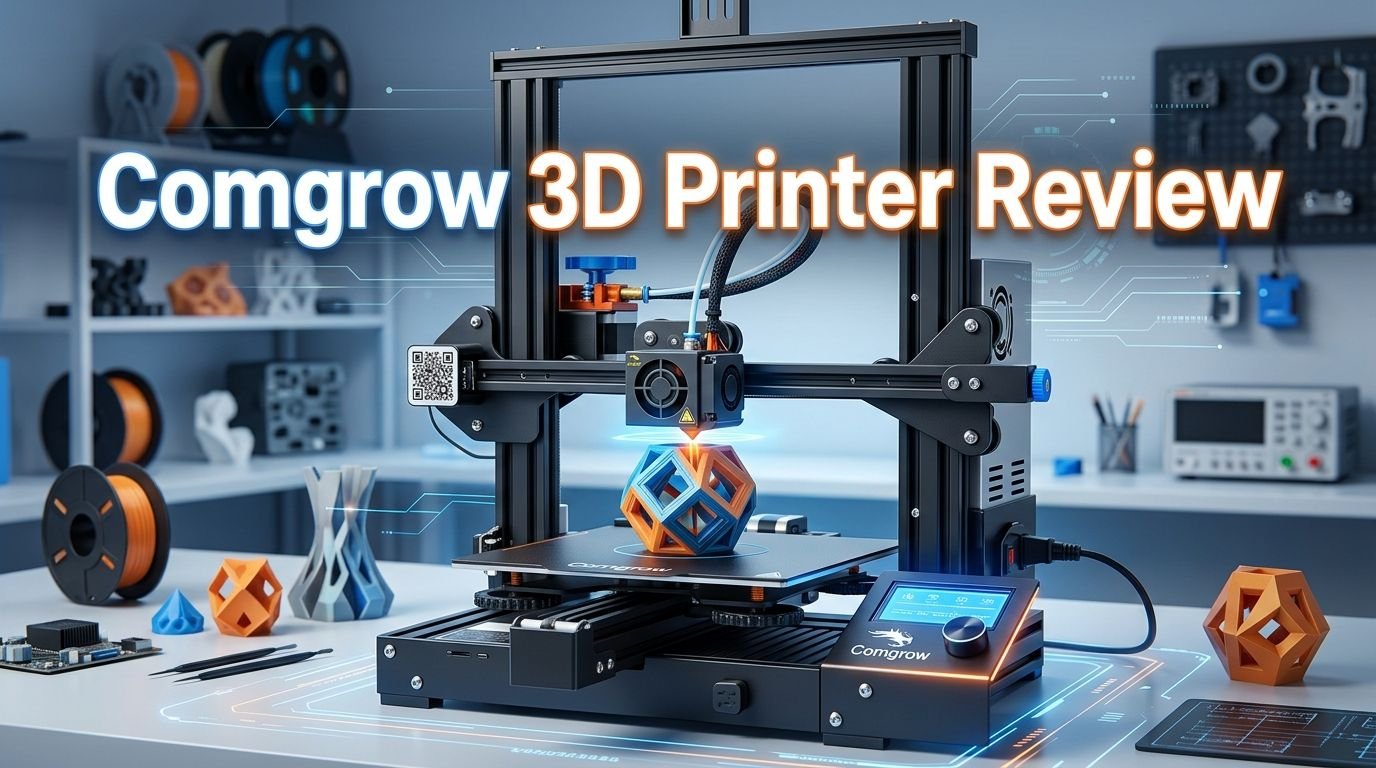
Comgrow 3D Printer Review 2026: Is It Worth Your Money?
Are you thinking about buying a Comgrow 3D printer but unsure which model fits your needs? You are in the right place. Comgrow has become a popular name in the 3D printing space.
The brand sells affordable printers through Amazon and its own online store. In 2026, Comgrow offers a strong lineup of FDM 3D printers. These include the massive T500, the fast T300, and the classic Ender 3 series through its partnership with Creality.
This review covers the best Comgrow 3D printers available right now. We tested print quality, build volume, speed, ease of use, and value for money.
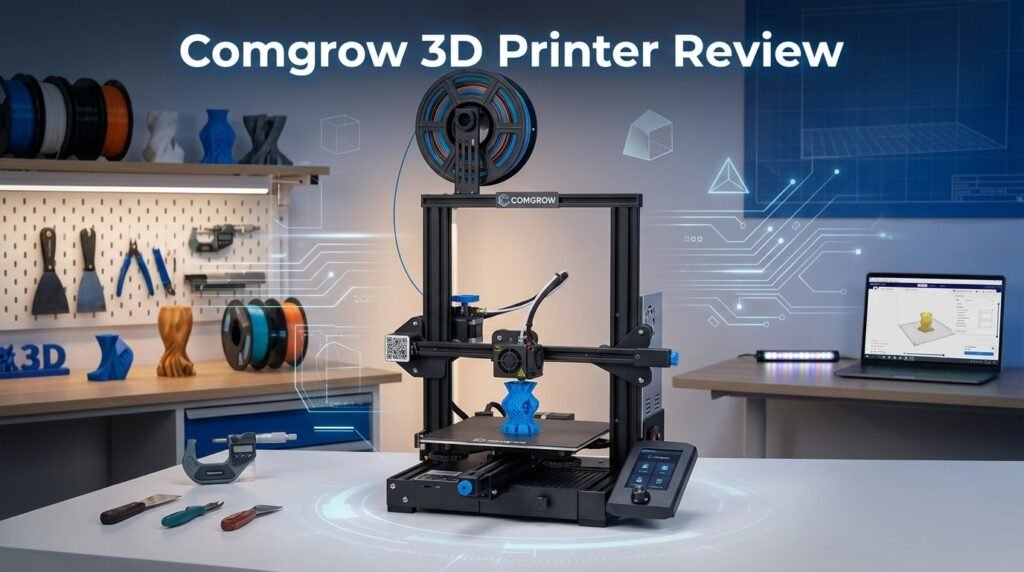
Key Takeaways
- Comgrow offers three standout 3D printers in 2026. The T500 delivers a huge 500x500x500mm build volume. The T300 runs Klipper firmware with 600mm/s speed. The Ender 3 remains the best budget entry point for beginners.
- Comgrow and Sovol share a parent company. This means their printers share parts, firmware, and customer support resources. You get a bigger support ecosystem with either brand name.
- Klipper firmware comes factory installed on the T500 and T300. You do not need a Raspberry Pi or separate setup. Input shaping and pressure advance work right out of the box.
- The T500 is one of the largest affordable 3D printers on the market. Its 500mm cubed build volume beats most competitors in its price range. It suits large prototypes, cosplay props, and batch production runs.
- Print quality across all Comgrow models is strong for the price. Dimensional accuracy stays within 0.1 to 0.15mm on PLA. PETG and other materials also perform well with proper settings.
- Budget buyers should consider the Ender 3 series first. It costs far less than the T300 or T500. The open-source design means thousands of upgrades and community resources are available online.
Comgrow T500 3D Printer
The Comgrow T500 is the flagship large-format printer in the Comgrow lineup. It features a massive 500x500x500mm build volume. That is nearly 20 inches in each direction. Very few printers at this price point offer that much printing space.
This printer runs Klipper firmware with a 7-inch IPS touchscreen. It supports speeds up to 500mm/s with 8000mm/s² acceleration. The all-metal hotend reaches 300°C, so you can print PLA, PETG, ABS, and even some composite filaments.
Check Out The Product Here
Linear rails on all three axes provide smooth, stable motion. The 49-point auto bed leveling system ensures your first layer sticks evenly across that huge print surface. The T500 arrives 95% pre-assembled, so most users report starting their first print within two hours.
The printer weighs about 39 kilograms. It needs a sturdy desk or workbench. The open frame design works great for PLA and PETG. However, ABS and ASA prints will need a DIY enclosure to prevent warping on larger parts.
At its current price range of $659 to $899, the T500 offers one of the best price-to-volume ratios on the market. Print farm operators and large-format hobbyists will find real value here.
Comgrow T300 3D Printer
The Comgrow T300 sits in the sweet spot between size and speed. It offers a 300x300x350mm build volume with print speeds up to 600mm/s. The 12000mm/s² acceleration and 30mm³/s flow rate make it one of the fastest bed-slinger printers you can buy.
This machine uses linear rails on all axes. That is a premium feature usually found on more expensive CoreXY printers. The direct drive dual-gear extruder has a 6.5:1 gear ratio. This ratio gives precise control over flexible filaments like TPU.
Check Out The Product Here
Klipper firmware comes pre-installed. The web interface through Mainsail or Fluidd lets you control the printer from any browser. You can upload files, monitor progress, and change settings without touching the printer. The built-in touchscreen handles basic tasks.
The T300 prints a standard Benchy boat in about 13 minutes. That saves around 73% of the time compared to older printers. The hotend heats up in just 30 seconds. The heated bed reaches target temperature quickly too.
For users who want fast printing with a large build area, the T300 is a strong pick. It typically sells in the $400 to $550 range, which makes it an excellent value for Klipper-powered printing.
Comgrow Creality Ender 3
The Comgrow Creality Ender 3 remains one of the best-selling 3D printers on Amazon. Comgrow is the official authorized seller of Creality products on the platform. This printer costs less than $200 and offers a solid 220x220x250mm build volume.
The Ender 3 is fully open source. Thousands of upgrade guides, modifications, and community profiles exist online. You can improve almost every part of this printer over time. Many professional 3D printing experts started with an Ender 3.
Check Out The Product Here
The V-slot rail system provides stable movement for the X and Y axes. The magnetic build plate removes easily for part removal. Resume printing saves your progress during power outages. The Bowden extruder handles PLA and PETG well.
Print speed is moderate at around 180mm/s maximum. The printer does not include auto bed leveling in the base model. You will need to manually level the bed, which takes a few minutes each time. Newer versions like the Ender 3 V3 SE add auto leveling.
For complete beginners on a tight budget, the Ender 3 is hard to beat. It teaches you the fundamentals of 3D printing. The massive community means you will always find help online. It is the printer that launched millions of makers.
Build Quality and Frame Construction
Comgrow printers share a common design philosophy. They use aluminum extrusion frames with steel components at critical joints. The T500 and T300 both feature heavy-duty construction that resists flex during fast printing.
The T500 uses a wide-stance frame with extra cross braces. This matters because a 500mm print bed creates significant inertia during Y-axis movement. Without proper frame stiffness, you would see ringing and ghosting on prints. Comgrow addressed this with thicker extrusions than competitors in the same class.
The T300 uses a similar construction approach in a smaller package. Its frame is rigid enough to handle 600mm/s speeds. The all-linear-rail motion system adds to the stability. Compared to V-slot wheel printers, linear rails hold tighter tolerances over thousands of hours.
The Ender 3 uses a simpler frame. It works well for its intended speed range. The V-slot aluminum profile is sturdy for a budget printer. Over time, the eccentric nuts on the wheels may need adjustment. This is normal maintenance for wheel-based systems.
All three printers have clean cable management out of the box. Connectors are labeled for easy assembly. The overall fit and finish across the Comgrow lineup is above average for the price points.
Print Quality Across Comgrow Models
Print quality depends on your settings, filament, and calibration. With proper setup, Comgrow printers produce impressive results for their price range.
The T500 delivers clean prints on large surfaces. Wall quality stays consistent even on tall prints. Dimensional accuracy sits within 0.1 to 0.15mm on PLA. The PEI magnetic bed gives excellent first layer adhesion. Top surfaces look smooth with ironing enabled.
The T300 offers the best surface finish in the lineup. Its higher acceleration and input shaping produce tight corners and minimal ghosting. On well-tuned profiles, perimeter walls are crisp. PETG prints show excellent layer adhesion. The pressure advance feature reduces blobbing at corners.
The Ender 3 produces good quality at slower speeds. You will need to spend time dialing in your slicer settings. The Bowden tube adds a small amount of stringing compared to direct drive systems. With calibration, the Ender 3 creates prints that rival machines twice its price.
PETG works well on all three printers. The PEI beds on the T500 and T300 grip PETG firmly. ABS remains challenging on the open-frame models. An enclosure fixes most warping issues for high-temperature materials.
Klipper Firmware and Software Features
The T500 and T300 ship with factory-installed Klipper firmware. This gives you advanced features that older Marlin-based printers cannot match.
Input shaping compensates for vibrations caused by the moving bed. This feature alone lets bed-slinger printers print 30% to 50% faster without quality loss. The factory calibration is a good starting point, but running your own accelerometer test yields better results.
Pressure advance adjusts filament flow at corners and direction changes. It reduces oozing and improves sharpness on geometric features. Each material needs its own pressure advance value. PLA, PETG, and TPU all behave differently.
The web interface through Mainsail or Fluidd lets you control the printer remotely. You can upload files, start prints, monitor temperatures, and edit configuration files from any browser. Print farm operators can manage multiple printers from a single laptop.
OrcaSlicer is the recommended slicing software for Comgrow Klipper printers. It includes native pressure advance calibration tools and Klipper-specific settings. PrusaSlicer works as a solid second option. Cura is acceptable but lacks deep Klipper integration.
The Ender 3 uses Marlin firmware. It does not include Klipper features without a manual upgrade. Many owners add Klipper later with a Raspberry Pi.
Setup and Assembly Experience
Comgrow printers arrive mostly pre-assembled. The T500 and T300 are both 95% pre-assembled. You connect the gantry to the base, tighten a few bolts, route the cables, and power on the machine.
Most users report completing T500 assembly in about 90 minutes to two hours. The T300 takes slightly less time due to its smaller size. Both printers include clear instruction manuals with labeled connectors. You do not need special tools beyond what ships in the box.
The Ender 3 requires more hands-on assembly. Expect to spend two to three hours putting it together. The process teaches you how the printer works. Every screw you tighten gives you deeper understanding of the machine. That knowledge helps with future maintenance and upgrades.
First-time calibration on the T500 and T300 is straightforward. The auto bed leveling runs automatically. You level the Z-offset, load filament, and start your first test print. The touchscreen guides you through each step.
The Ender 3 needs manual bed leveling before your first print. Use the paper method to set the distance between the nozzle and bed at each corner. This step takes about five minutes. Newer Ender 3 variants include auto leveling.
Speed and Performance Comparison
Speed is a major selling point for the T500 and T300. Both printers use Klipper firmware to push beyond traditional FDM speeds.
The T300 leads the lineup with a maximum speed of 600mm/s and 12000mm/s² acceleration. In real-world printing, expect sustained speeds of 180 to 250mm/s on PLA perimeters. The volumetric flow rate of the hotend determines your actual speed ceiling, not the marketing number.
The T500 reaches up to 500mm/s with 8000mm/s² acceleration. Its larger bed mass means you hit vibration limits sooner than on the T300. Input shaping compensates well, but the physics of moving a 500mm bed favor moderate speeds. Practical printing speeds sit around 150 to 200mm/s for quality results.
The Ender 3 prints at a comfortable 40 to 80mm/s by default. Experienced users push it to 120 to 150mm/s with firmware modifications and upgraded cooling. It is the slowest option in the lineup, but speed is not its primary selling point.
For fast turnaround on large parts, the T300 offers the best balance. Its 300mm bed is large enough for most projects while still printing fast. The T500 trades speed for sheer build volume. The Ender 3 prioritizes affordability.
Material Compatibility
All Comgrow printers support PLA, PETG, and TPU at minimum. The T500 and T300 add ABS, ASA, and composite filament support thanks to their 300°C hotends.
PLA is the easiest material on all three printers. It prints at low temperatures and produces smooth surfaces. The PEI beds on the T500 and T300 give reliable adhesion. The Ender 3’s magnetic build plate also works well with PLA.
PETG is the second most popular choice. It offers better heat resistance and durability than PLA. All Comgrow printers handle PETG without issues. The direct drive extruders on the T300 and T500 reduce stringing compared to the Ender 3’s Bowden setup.
ABS and ASA require higher temperatures and a stable ambient environment. The open frames on all three printers make ABS printing challenging without an enclosure. The T500 and T300 can reach the needed temperatures. Adding a simple enclosure solves most warping problems.
The T300’s dual-gear direct drive extruder handles TPU flexible filament well. The 6.5:1 gear ratio gives precise control over soft materials. The T500 also supports TPU. The Ender 3’s Bowden setup makes flexible filament printing difficult without modifications.
Carbon fiber reinforced filaments work on the T300 and T500. You will need a hardened steel nozzle to prevent wear from the abrasive fibers. The stock brass nozzle will degrade quickly with composite materials.
Value for Money in 2026
Comgrow printers offer strong value at every price tier. The brand consistently undercuts competitors while delivering comparable features.
The Ender 3 at under $200 remains the king of budget 3D printing. No other printer at this price has the same level of community support and upgrade potential. It is the smartest first printer for most beginners in 2026.
The T300 at $400 to $550 delivers Klipper, linear rails, and a 300mm build volume. Competing CoreXY printers with similar features cost $700 or more. You get roughly twice the build volume per dollar compared to enclosed alternatives.
The T500 at $659 to $899 is the most affordable way to get a 500mm cubed print area. The Creality CR-10 S5 offered similar build volume years ago but lacked Klipper, linear rails, and modern features. The T500 represents a significant upgrade for large-format printing.
Print farm operators benefit the most from Comgrow’s pricing. You can buy three T300 units for the price of one premium CoreXY machine. Each T300 fills a 300mm bed reliably. The Klipper web interface lets you manage an entire fleet from one screen.
Who Should Buy a Comgrow 3D Printer
The Comgrow Ender 3 is best for beginners and hobby users. If you want to learn 3D printing without a large investment, start here. The open-source community provides endless resources. You can upgrade it piece by piece as your skills grow.
The Comgrow T300 is best for experienced hobbyists and small businesses. It offers the best balance of speed, size, and price. Klipper firmware gives you professional-level control. If you print functional parts, cosplay items, or run small batch production, the T300 fits perfectly.
The Comgrow T500 is best for large-format projects and print farms. Cosplay builders, furniture designers, and industrial prototypers need this much build space. It is also excellent for batch printing multiple smaller parts at once. The 500mm bed lets you arrange dozens of parts per job.
You should avoid Comgrow printers if you need plug-and-play ABS printing. The open frame design requires aftermarket enclosures for high-temperature materials. Enclosed CoreXY machines like the Bambu Lab P1S or Creality K1C handle ABS better out of the box.
Common Issues and How to Fix Them
Every 3D printer has occasional problems. Comgrow printers are no exception, but most issues have simple solutions.
Bed adhesion problems on the T500 can happen because of the large bed size. Temperature variations across a 500mm surface cause uneven sticking. Clean the PEI bed with isopropyl alcohol regularly. Run the 49-point mesh leveling before critical prints. Increasing the first layer temperature by 5°C also helps.
The T300 may show ringing on fast prints with factory input shaping settings. Running your own accelerometer calibration with an ADXL345 sensor fixes this. The sensor costs about $5. The calibration takes 10 minutes and produces noticeably cleaner results.
Ender 3 owners often fight bed leveling issues. The manual process requires patience. Upgrade to a CR Touch or BL Touch sensor if you find manual leveling frustrating. This single upgrade changes the Ender 3 experience dramatically.
Filament clogs happen on all printers. Use quality filament stored in dry conditions. Moisture in filament causes popping, stringing, and clogs. A filament dryer box solves most clog-related problems. Comgrow sells their own dryer box on Amazon.
Electronics overheating affects the T300 and T500 during long prints. Upgrade the electronics bay cooling fan to a 60mm or 80mm model. This costs under $10 and prevents thermal throttling during marathon sessions.
Comgrow vs. Bambu Lab and Creality in 2026
The 3D printer market in 2026 is competitive. Comgrow holds its own against bigger brands through pricing and build volume.
Bambu Lab printers like the P1S and P2S offer faster speeds and enclosed designs. They work better for ABS and multi-material printing. But they cost significantly more and offer smaller build volumes. If speed and plug-and-play simplicity are your top priorities, Bambu Lab wins.
Creality competes directly with Comgrow through their partnership and separate product lines. The Creality K1C and K1 Max offer enclosed CoreXY printing. Comgrow sells these through their Amazon store as an authorized dealer. The Comgrow T300 and T500 are unique products not found in the Creality lineup.
Comgrow wins on price-to-volume ratio. No other brand offers 500mm cubed build volume at the T500’s price. The T300 undercuts most Klipper-powered competitors. The Ender 3 remains the cheapest proven entry point.
Where Comgrow falls short is the enclosed printer category. They do not currently sell an enclosed printer under their own brand. Users who need temperature-controlled printing must add aftermarket enclosures or buy from Creality or Bambu Lab.
Pros and Cons Summary
Comgrow T500 Pros: Massive 500mm build volume, Klipper firmware, linear rails, 300°C hotend, auto bed leveling, 95% pre-assembled.
Comgrow T500 Cons: Heavy at 39kg, open frame limits ABS use, bed mass reduces effective speed on small detailed parts.
Comgrow T300 Pros: Fast 600mm/s speed, Klipper firmware, linear rails, excellent print quality, great value under $550.
Comgrow T300 Cons: Open frame, electronics cooling needs upgrade for production use, requires tuning for best results.
Comgrow Ender 3 Pros: Cheapest entry point, huge community, fully open source, thousands of available upgrades.
Comgrow Ender 3 Cons: Manual bed leveling, slower print speeds, Bowden extruder struggles with flexible materials.
Final Verdict on Comgrow 3D Printers
Comgrow delivers solid 3D printers at aggressive price points. Each model serves a different type of user. The lineup covers beginners, experienced hobbyists, and professional operators.
The T500 is the best choice if you need the biggest prints possible without spending thousands of dollars. Its 500mm build volume opens up projects that other printers simply cannot handle.
The T300 is the smartest buy for most experienced users in 2026. It balances speed, quality, size, and price better than any other printer in its class. Klipper firmware and linear rails at under $550 is a deal that is hard to match.
The Ender 3 still earns its place as the best starter printer. It has proven itself over millions of units sold worldwide. The learning experience alone justifies the low cost.
If you want a reliable, affordable 3D printer with strong community backing, Comgrow deserves a spot on your shortlist. Test your filament settings, tune your slicer profiles, and these printers will deliver results that punch well above their price tags.
Frequently Asked Questions
Is Comgrow the same as Sovol?
Comgrow and Sovol share a parent company. They overlap in parts, firmware, and support resources. The Comgrow T300 and T500 are the same printers sometimes listed under the Sovol brand name. You get the same hardware regardless of which brand label appears on the listing.
Can the Comgrow T500 print ABS?
Yes, the T500’s hotend reaches 300°C, which handles ABS temperatures. However, the open frame design causes warping on larger ABS parts. You will need to add an enclosure for reliable ABS printing. PLA and PETG work perfectly without any modifications.
Is the Comgrow Ender 3 good for beginners?
The Ender 3 is one of the most recommended beginner printers. It costs under $200 and has the largest online community of any 3D printer. Thousands of guides, videos, and forums exist to help new users. Manual bed leveling is the main learning curve.
What slicer works best with Comgrow printers?
OrcaSlicer is the best option for Klipper-based Comgrow printers like the T300 and T500. It has native pressure advance calibration and Klipper-specific tools. For the Ender 3, Cura or PrusaSlicer both work well. All three slicers are free to download.
How long does it take to set up a Comgrow 3D printer?
The T500 and T300 take about 90 minutes to two hours from unboxing to first print. Both arrive 95% pre-assembled. The Ender 3 takes two to three hours because it requires more hands-on assembly. No special tools are needed for any model.
Does Comgrow offer a warranty?
Comgrow provides a standard manufacturer warranty on all printers purchased through authorized channels. Amazon purchases through the official Comgrow store include standard return and warranty coverage. Contact Comgrow support directly for firmware help and replacement parts.

Hi, my name is Lily you can say i am a gadget hunter at this point. Welcome to Gadget Gallery The Gallery of Gadget Reviews