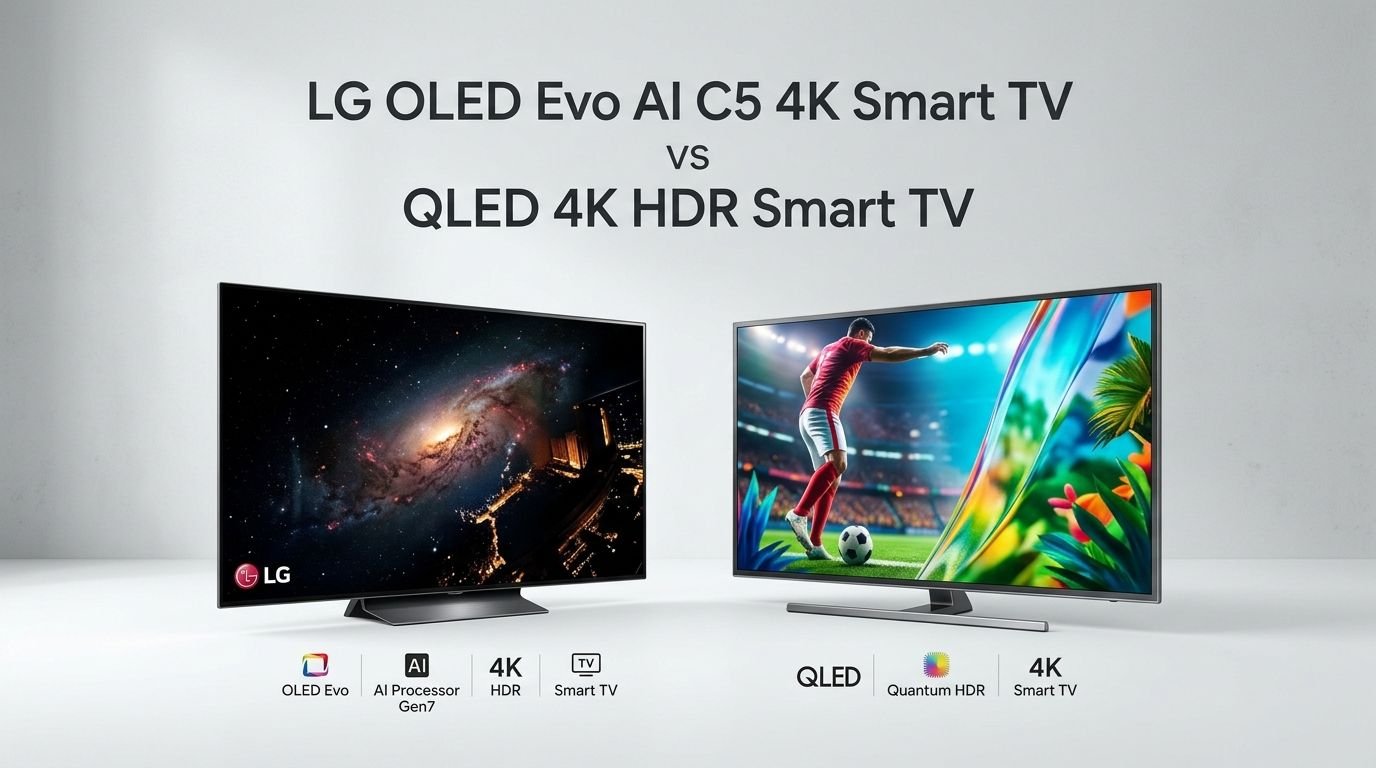
LG OLED Evo AI C5 4K Smart TV vs QLED 4K HDR Smart TV
Buying a new 4K TV can feel overwhelming. Two of the most popular choices right now are the LG OLED Evo AI C5 and the Samsung QLED Q8F 4K HDR Smart TV. Both deliver stunning picture quality, smart features, and impressive performance. But they use very different display technologies.
One uses self-lit OLED pixels. The other relies on Quantum Dot LED backlighting. The differences between these two technologies affect everything from black levels to brightness to price.
So which TV deserves a spot in your living room? This head-to-head comparison breaks down every key detail. We cover picture quality, gaming features, smart TV platforms, sound, design, and value. By the end of this post, you will know exactly which TV fits your needs and budget.
Key Takeaways:
- The LG OLED Evo AI C5 uses self-emissive pixel technology. Each pixel produces its own light, which means the TV achieves perfect blacks and infinite contrast. This is a major advantage for watching movies in dark rooms and enjoying HDR content at its finest.
- The Samsung QLED Q8F 4K HDR Smart TV uses Quantum Dot technology with an LED backlight. It delivers 100% color volume and gets significantly brighter than the LG C5. This makes it a strong pick for well-lit living rooms and daytime viewing.
- For gaming, the LG C5 has a clear edge. It offers a 144Hz VRR refresh rate, four HDMI 2.1 ports, NVIDIA G-Sync, AMD FreeSync Premium, and a blazing 0.1ms response time. The Samsung Q8F supports VRR and ALLM but operates at a lower native refresh rate.
- The LG C5 runs webOS and supports Dolby Vision. The Samsung Q8F runs Tizen and supports HDR10+ and Quantum HDR. Neither TV supports the other’s preferred HDR format, so your streaming preferences matter.
- Price is a significant factor. The Samsung QLED Q8F costs roughly half the price of the LG OLED C5 at the same screen size. If budget is your top priority, the Samsung offers tremendous value. If picture quality is king, the LG OLED wins.
- Burn-in risk exists on OLED but has improved dramatically. LG has added multiple burn-in prevention features to the C5. QLED TVs like the Samsung Q8F have zero burn-in risk, making them ideal for households that display static content often.
LG OLED Evo AI C5 4K Smart TV: Overview

Last update on 2026-10-07 / Affiliate links / Images from Amazon Product Advertising API Some of the links on this website are affiliate links, which means that at no additional cost to you, I earn a commission if you click through and make a purchase. I only recommend products and services that I believe will add value to my readers. Thank you for your support!
The LG OLED Evo AI C5 is the 2025 edition of LG’s beloved C-Series OLED lineup. It packs the Alpha 9 AI Processor Gen8, which handles AI-powered picture and sound optimization. The TV supports Dolby Vision, Dolby Atmos, HDR10, and HLG.
LG calls this model “Bright Room Ready.” The C5 pushes higher peak brightness than previous C-Series models. This closes the gap between OLED and LED-based TVs for daytime viewing.
The display offers 4K resolution at a native 120Hz refresh rate, with VRR support up to 144Hz. It ships with four full-bandwidth HDMI 2.1 ports. That makes it a top-tier pick for PS5 and Xbox Series X owners.
Pros:
- Perfect blacks with infinite contrast ratio
- 144Hz VRR for ultra-smooth gaming
- Four HDMI 2.1 ports with full 48Gbps bandwidth
- Dolby Vision and Dolby Atmos support
- AI Super Upscaling 4K makes lower-resolution content look sharp
- Ultra-thin design with minimal bezels
Cons:
- Higher price compared to QLED alternatives
- Peak brightness still lower than top-tier QLED and Mini LED TVs
- Potential burn-in risk with prolonged static images
- Built-in speakers are average for the price
Samsung QLED Q8F 4K HDR Smart TV: Overview

Last update on 2026-10-12 / Affiliate links / Images from Amazon Product Advertising API Some of the links on this website are affiliate links, which means that at no additional cost to you, I earn a commission if you click through and make a purchase. I only recommend products and services that I believe will add value to my readers. Thank you for your support!
The Samsung QLED Q8F is a 2025 mid-range QLED TV that punches above its weight. It features the Q4 AI Processor, Quantum Dot technology, and 100% Color Volume. The TV delivers vibrant colors and impressive brightness at a very competitive price.
Samsung equipped the Q8F with its AirSlim design, which keeps the TV impressively thin. The Tizen-based smart platform provides access to all major streaming apps. Samsung Vision AI adds intelligent features like automatic picture adjustment and object recognition.
The Q8F supports Quantum HDR, HDR10+, and HLG. It does not support Dolby Vision. The display works well in bright rooms because of its strong peak brightness and anti-glare properties.
Pros:
- Excellent brightness for well-lit rooms
- 100% Color Volume with Quantum Dot for vivid colors
- Very affordable compared to OLED options
- Zero burn-in risk
- Samsung Vision AI for smart content optimization
- AirSlim design looks modern and sleek
Cons:
- Black levels and contrast fall short of OLED
- No Dolby Vision support
- Fewer HDMI 2.1 ports than the LG C5
- Viewing angles are narrower than OLED
- Sound quality is basic
Display Technology: OLED vs QLED Explained
The core difference between these two TVs is the display technology. The LG C5 uses OLED (Organic Light Emitting Diode) panels. Each pixel generates its own light. This means pixels can turn off completely to produce absolute black.
The Samsung Q8F uses QLED, which is an LCD panel enhanced with a Quantum Dot filter. A backlight sits behind the LCD layer. This backlight cannot turn off individual pixels. Light bleed can cause slightly washed-out blacks in dark scenes.
OLED wins for contrast and black levels. QLED wins for peak brightness and resistance to burn-in. Your choice depends on what you watch and where you watch it. Dark room movie lovers lean OLED. Bright room sports fans lean QLED.
Picture Quality Comparison
The LG C5 delivers outstanding picture quality for movies, shows, and gaming. Colors look natural and accurate right out of the box. The infinite contrast ratio creates a sense of depth that QLED cannot match.
The Samsung Q8F holds its own with punchy, saturated colors and strong brightness. Quantum Dot technology produces a wide color gamut that covers most of the DCI-P3 spectrum. Daytime viewing looks fantastic because the screen fights ambient light well.
For HDR content, the LG C5 supports Dolby Vision, which offers scene-by-scene optimization. The Samsung Q8F supports HDR10+, which provides similar dynamic metadata. Both formats improve HDR playback, but Dolby Vision has broader content support on streaming platforms.
Side by side, the LG C5 produces more lifelike images in controlled lighting. The Samsung Q8F looks better in a sun-filled living room.
Gaming Performance: Which TV Wins?
Gamers will find the LG OLED C5 hard to beat. It supports 4K gaming at up to 144Hz with VRR. The response time is under 0.1 milliseconds. That is the fastest you can get on any consumer TV right now.
The C5 includes NVIDIA G-Sync compatibility, AMD FreeSync Premium, and ALLM (Auto Low Latency Mode). Its Game Optimizer menu lets you tweak settings quickly. All four HDMI ports are full HDMI 2.1, so you can connect multiple gaming consoles without swapping cables.
The Samsung Q8F supports VRR and ALLM. It is a capable gaming TV at its price point. But it has a lower refresh rate ceiling and fewer HDMI 2.1 ports. Input lag is higher than the C5, though still good for casual gaming.
If competitive or high-performance gaming is a priority, the LG C5 is the clear winner.
Smart TV Features and Operating System
The LG C5 runs webOS, which is a clean and fast interface. The home screen shows your apps, recommendations, and inputs. LG’s ThinQ AI lets you control the TV with voice commands. Alexa and Google Assistant are both built in.
The Samsung Q8F runs Tizen OS, now branded under Samsung’s One UI platform. It offers a similar experience with a customizable home screen, smart recommendations, and voice control through Bixby and Alexa. Samsung’s SmartThings integration makes it a strong hub for smart home devices.
Both platforms support all major apps: Netflix, Disney+, YouTube, Apple TV+, and more. Neither TV has a significant advantage in app availability. The choice comes down to personal preference. WebOS feels more streamlined. Tizen offers deeper smart home features.
Sound Quality: Built-In Speakers
Neither TV delivers audiophile-grade sound from its built-in speakers. But both offer decent audio for casual watching.
The LG C5 features AI Sound Pro and supports Dolby Atmos. The Wow Orchestra feature synchronizes the TV speakers with a compatible LG soundbar. This creates a wider soundstage without extra setup.
The Samsung Q8F includes Object Tracking Sound Lite (OTS Lite), which matches sound to on-screen movement. It also supports Adaptive Sound, which adjusts audio based on content type. The speakers are thin but produce clear dialogue.
For the best experience, both TVs benefit from an external soundbar or speaker system. The LG C5 has a slight edge in audio features thanks to Dolby Atmos and Wow Orchestra support.
Design and Build Quality
The LG C5 is incredibly thin, especially at the top where the OLED panel sits. The lower portion houses the electronics and is slightly thicker. The bezels are minimal, and the overall look is sleek and modern. It ships with a slim pedestal stand.
The Samsung Q8F features the AirSlim design. It is impressively thin for a QLED TV. The bezels are clean and narrow. Samsung’s stand is stable and positions the TV at a good viewing height.
Both TVs look premium from the front. The LG C5 wins on sheer thinness because OLED panels have no backlight layer. Wall mounting either TV produces a clean, flush look. Design is a draw for most buyers.
Viewing Angles and Room Placement
OLED technology gives the LG C5 excellent viewing angles. Colors and contrast stay consistent even at wide angles. This makes it a great TV for large seating arrangements where not everyone sits directly in front of the screen.
The Samsung Q8F has narrower viewing angles. Colors shift and contrast drops when you move off-center. This is a common trait of VA-type LCD panels used in most QLED TVs. If your couch faces the TV head-on, this will not bother you.
For open-concept living rooms or wide seating, the LG C5 is a better fit. For dedicated media rooms with centered seating, the Samsung Q8F performs just fine.
Price and Value Comparison
Price is where the Samsung QLED Q8F shines the brightest. The 65-inch Samsung Q8F retails for roughly $700 to $900. The 65-inch LG OLED C5 starts around $1,500 to $1,800. That is nearly double the cost.
The LG C5 offers superior picture quality, better gaming features, and wider viewing angles. But the Samsung Q8F delivers excellent performance at a fraction of the price. For budget-conscious buyers, the Q8F represents outstanding value.
If you want the best picture money can buy in this price tier, invest in the LG C5. If you want a great-looking 4K TV without breaking the bank, the Samsung Q8F is a smart choice.
Who Should Buy the LG OLED Evo AI C5?
The LG C5 is ideal for movie enthusiasts, serious gamers, and home theater fans. If you watch a lot of content in a dimly lit room, the perfect blacks and infinite contrast will impress you every time.
Gamers who play on PS5, Xbox Series X, or a high-end PC will love the 144Hz refresh rate, G-Sync, and 0.1ms response time. The four HDMI 2.1 ports future-proof the TV for years.
Buyers who value color accuracy, Dolby Vision HDR, and a premium viewing experience should choose this TV. It costs more, but it delivers a noticeably better picture.
Who Should Buy the Samsung QLED Q8F 4K HDR Smart TV?
The Samsung Q8F suits budget-minded buyers, bright room viewers, and casual entertainment fans. It delivers vibrant 4K HDR pictures at a very attractive price.
If your living room gets a lot of natural light, the Q8F handles glare and ambient light better than most OLED TVs. The Quantum Dot color technology keeps images looking vivid even in daylight.
Families who leave the TV on for long hours or display cable news and sports channels benefit from the zero burn-in risk. The Samsung Q8F is a reliable, high-quality TV that serves most households extremely well.
Final Verdict: LG OLED C5 vs Samsung QLED Q8F
Both TVs are excellent. The LG OLED Evo AI C5 wins on picture quality, gaming performance, viewing angles, and HDR experience. The Samsung QLED Q8F wins on brightness, price, and burn-in peace of mind.
Choose the LG C5 if picture quality is your top priority and your budget allows it. Choose the Samsung Q8F if you want great value, bright room performance, and worry-free daily use.
There is no wrong answer here. Both TVs deliver a fantastic 4K experience in 2025.
Frequently Asked Questions
Is the LG OLED C5 worth the extra cost over a QLED TV?
Yes, if picture quality matters most to you. The LG C5 offers perfect blacks, infinite contrast, and superior HDR performance. These advantages are visible in dark and moderately lit rooms. However, the Samsung QLED Q8F delivers strong performance at a much lower price.
Does the Samsung QLED Q8F support Dolby Vision?
No. The Samsung Q8F supports HDR10+ and Quantum HDR but does not include Dolby Vision. If you stream a lot of Dolby Vision content on Netflix or Apple TV+, the LG C5 is the better option for you.
Will OLED burn-in be a problem on the LG C5?
Burn-in risk has decreased significantly with modern OLED TVs. The LG C5 includes pixel refresher and screen shift technology to prevent static image retention. Normal viewing habits rarely cause issues. Avoid displaying static logos or tickers for extended hours.
Which TV is better for gaming, the LG C5 or Samsung Q8F?
The LG C5 is the better gaming TV. It offers 144Hz VRR, G-Sync, FreeSync Premium, 0.1ms response time, and four HDMI 2.1 ports. The Samsung Q8F supports basic gaming features but cannot match the C5 in speed or connectivity.
Can the Samsung Q8F handle bright rooms better than the LG C5?
Yes. The Samsung Q8F gets brighter and handles reflections and ambient light more effectively. If your living room has large windows or strong overhead lighting, the Q8F will maintain a clearer, more visible picture throughout the day.
Which TV has better sound quality?
The LG C5 has a slight edge thanks to Dolby Atmos support and Wow Orchestra compatibility. The Samsung Q8F uses OTS Lite for decent audio. Both TVs sound acceptable for casual use, but a soundbar upgrade improves the experience on either model.

Hi, my name is Lily you can say i am a gadget hunter at this point. Welcome to Gadget Gallery The Gallery of Gadget Reviews