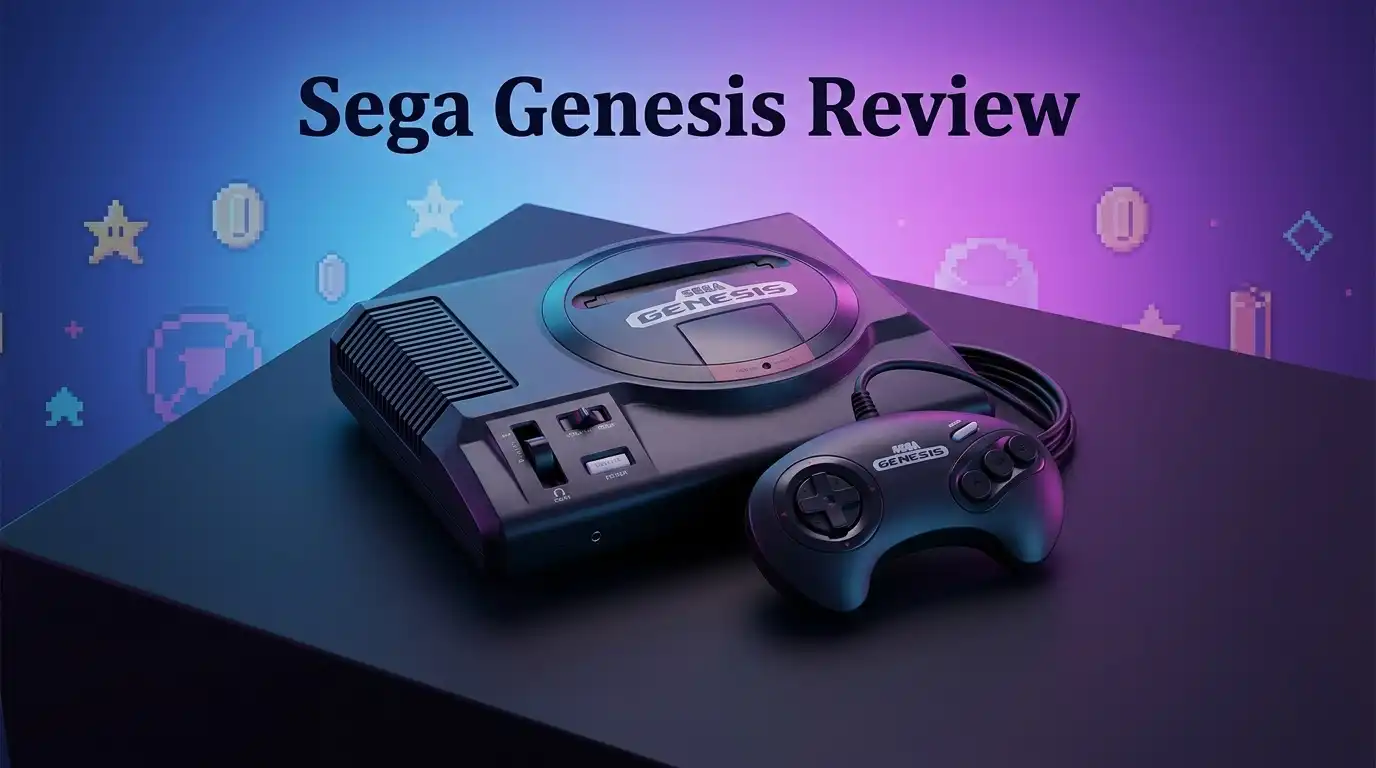
Sega Genesis Review 2026: Still Worth It?
The Sega Genesis turned heads in 1989, and it still turns heads today. Retro gaming keeps growing every year, and Sega hardware sits right at the center of that hobby.
You might remember blowing into cartridges as a kid. You might be discovering Sonic and Streets of Rage for the first time. Either way, one question keeps popping up in 2026: does a Sega Genesis still deserve space under your TV?
This review answers that question honestly. I cover the official Sega Genesis Mini consoles, the original 1989 hardware, the game libraries, the controllers, and the picture quality on modern displays.
Key Takeaways:
- The Sega Genesis Mini 2 remains the best all in one Sega package. It packs 60 games, including Sega CD titles like Sonic CD, Final Fight CD, and Silpheed. The emulation runs clean, the menus look sharp, and the box needs no cartridges at all.
- The original Sega Genesis Mini still holds strong value. Its 42 game lineup leans on famous hits like Sonic the Hedgehog 2, Streets of Rage 2, Gunstar Heroes, and Castlevania Bloodlines. Beginners usually enjoy this lineup more.
- Prices climbed hard in 2025 and 2026. Sega stopped producing both Mini consoles, so listings now sit far above the original $99 tag. Patience saves real money here.
- Original 1989 hardware still works, but it demands effort. You need an upscaler, clean cables, and a healthy cartridge collection. Costs add up quickly, and old capacitors fail.
- Controllers matter more than the console. The Mini 2 ships with a three button pad in North America, which frustrates fighting game fans. A six button pad fixes that problem fast.
- This purchase suits nostalgia and couch multiplayer. It does not suit anyone chasing modern convenience features like online play, achievements, or big storage.
What Is the Sega Genesis in 2026?

Last update on 2026-08-22 / Affiliate links / Images from Amazon Product Advertising API Some of the links on this website are affiliate links, which means that at no additional cost to you, I earn a commission if you click through and make a purchase. I only recommend products and services that I believe will add value to my readers. Thank you for your support!
The Sega Genesis is a 16 bit home console that Sega launched in North America in 1989. Europe and Japan knew it as the Mega Drive. It sold roughly 30 million units worldwide and defined the console wars of the early 1990s.
In 2026, the name covers three very different products. First, you have the original plastic console from the 1990s. Second, you have the official Sega Genesis Mini and Mini 2, released in 2019 and 2022. Third, you have third party clone systems that accept real cartridges.
Each option targets a different buyer. The Mini consoles suit casual players who want games right now. Original hardware suits collectors who already own cartridges. Clone systems sit in the middle, offering cartridge support at a lower price.
The library explains the continued interest. Sega published Sonic, Streets of Rage, Golden Axe, Shinobi, and Phantasy Star. Third parties added Gunstar Heroes, Contra Hard Corps, Earthworm Jim, and Mortal Kombat. That catalog aged surprisingly well.
Modern indie games borrow heavily from this era. Titles like Sonic Mania and Streets of Rage 4 exist because these originals still feel good to play. The Genesis is not just a museum piece. It remains a working game system with a deep and playable catalog.
Sega Genesis Mini 2 Review: The Best Modern Option
The Sega Genesis Mini 2 launched in October 2022 as an Amazon exclusive in North America. Sega priced it at $103.80 plus shipping, which annoyed buyers at the time. Today that price looks like a bargain.
The console holds 60 games. Sega mixed standard Genesis cartridges with Sega CD titles, which nobody expected. Sonic CD, Final Fight CD, Silpheed, and Shining Force CD all run natively on the hardware. Night Trap and Sewer Shark also appear, full motion video and all.
The deep cuts impress me most. Alien Soldier, Crusader of Centy, Ranger X, Rocket Knight Adventures, and Super Street Fighter 2 sit alongside Fantasy Zone and Star Mobile. Sega even included Devi and Peace, a game that never shipped commercially.
Emulation quality is strong. M2, the studio behind the port work, handled the software. Frame pacing stays smooth, sprite flicker matches the originals, and save states work on every title.
The lineup skews toward hardcore fans though. Casual players may not recognize half the list. If you want Sonic 1, Sonic 2, and Streets of Rage 2, those live on the first Mini instead.
The shell measures roughly 5.5 inches wide. The cartridge flap opens and closes. The volume slider moves but does nothing, which is a fun and slightly silly touch.
Sega Genesis Mini Review: The Original Classic

Last update on 2026-08-22 / Affiliate links / Images from Amazon Product Advertising API Some of the links on this website are affiliate links, which means that at no additional cost to you, I earn a commission if you click through and make a purchase. I only recommend products and services that I believe will add value to my readers. Thank you for your support!
The first Sega Genesis Mini arrived in September 2019 at $79.99. Reviewers praised it heavily, and it earned a reputation as the best mini console of that whole retro wave.
It holds 42 games. The lineup covers the greatest hits with almost no filler. Sonic the Hedgehog, Sonic the Hedgehog 2, Streets of Rage 2, Gunstar Heroes, Castlevania Bloodlines, Contra Hard Corps, Shining Force, Phantasy Star 4, Ecco the Dolphin, and Comix Zone all appear.
Sega added two bonus games as well. Darius arrived as an arcade conversion built for this console. Tetris also appeared, a version that Sega never released back in the 1990s due to licensing chaos.
The North American box ships with two three button controllers. Both pads use wired USB and copy the original shape closely. They feel accurate, though the fighting game crowd will want more buttons.
The interface deserves credit. Yuzo Koshiro composed the menu music. You can rotate box art, flip between Japanese and American versions of games, and pick from multiple aspect ratio settings.
This model suits newcomers better than the Mini 2. The names are famous, the difficulty curves are friendlier, and almost every title still plays great in 2026.
Unboxing Experience: What You Actually Get
Both Mini consoles arrive in compact retail boxes that copy the 1990s packaging style. The Mini 2 box uses the classic red and black Sega branding. Cardboard quality feels thick and sturdy.
Lift the lid and you find the console resting in a molded plastic tray. The little machine feels heavier than expected, which helps it feel like a real product rather than a toy. The matte black plastic resists fingerprints well.
Under the tray sit the accessories. You get the controller or controllers, one HDMI cable, and one USB power cable. Sega includes a short manual with a game list printed inside.
Here is the first small disappointment. Neither Mini console includes a wall power adapter. You must supply your own USB brick or plug the cable into your TV. Most people own a spare phone charger, but the omission still stings.
The cables run short. The controller cord measures about 6 feet, which works for most living rooms but not all. The HDMI cable measures shorter still.
Setup takes under two minutes. Plug in HDMI, plug in power, connect the pad, switch input, and the menu appears. No accounts, no updates, no downloads. That simplicity is genuinely refreshing in 2026.
Top 3 Alternative for Sega Genesis Mini 2

Last update on 2026-08-22 / Affiliate links / Images from Amazon Product Advertising API Some of the links on this website are affiliate links, which means that at no additional cost to you, I earn a commission if you click through and make a purchase. I only recommend products and services that I believe will add value to my readers. Thank you for your support!
Retro-Bit Super RetroTRIO Plus 3 in 1 System Console

Last update on 2026-08-22 / Affiliate links / Images from Amazon Product Advertising API Some of the links on this website are affiliate links, which means that at no additional cost to you, I earn a commission if you click through and make a purchase. I only recommend products and services that I believe will add value to my readers. Thank you for your support!
Retro-Bit Generations Plug and Play Game Console

Last update on 2026-08-22 / Affiliate links / Images from Amazon Product Advertising API Some of the links on this website are affiliate links, which means that at no additional cost to you, I earn a commission if you click through and make a purchase. I only recommend products and services that I believe will add value to my readers. Thank you for your support!
Sega Genesis Classics for Nintendo Switch
Design and Build Quality: Small but Faithful
Sega shrank the Genesis to roughly 55 percent of the original size. The proportions stay accurate, which matters to anyone who owned the real thing. Place a Mini next to a 1989 model and the resemblance is immediate.
The plastic feels solid. There is no hollow rattle when you shake it, and the weight sits around 250 grams. Panel gaps stay tight, and the shell shows no visible mold flash.
Sega added moving parts purely for fun. The cartridge slot flap swings open. The volume slider glides side to side. The reset button clicks. None of these affect gameplay, and I love them anyway.
Two USB ports sit on the front for controllers. HDMI out and USB power input sit on the back. That is the entire port selection.
The rear port placement causes cable clutter. The console is light enough that a stiff HDMI cable can drag it around your shelf. A small strip of adhesive putty solves this.
Heat is not an issue. The hardware runs a modest ARM chip, so it stays cool during long sessions. No fan exists, which means total silence.
Build quality clearly beats the cheap plug and play boxes flooding online marketplaces. Those clones use thin plastic and sloppy paint. Sega did this properly.
Game Library Breakdown: What You Can Play
Library quality decides whether a retro console earns shelf space. Here the two Minis split into different personalities.
The original Mini plays the greatest hits. You get roughly a dozen genuine classics that most people already recognize. Streets of Rage 2 remains one of the best beat em ups ever made. Gunstar Heroes still stuns people who see it for the first time.
The Mini 2 plays the collector picks. Alien Soldier, Ranger X, Crusader of Centy, and Atomic Runner rarely appear on compilations. Sega CD support pushes this further with Sonic CD, Popful Mail, Shining Force CD, and Mansion of Hidden Souls.
Some Mini 2 inclusions feel like filler. Night Trap and Sewer Shark are historical curiosities more than good games. Clay Fighter has aged poorly. Roughly ten titles on the Mini 2 get one play and never return.
Both consoles let you save anywhere. Four save slots exist per game. You can also rewind on the Mini 2, which softens brutal 1990s difficulty spikes.
Neither console supports adding games officially. What ships in the box is what you play forever. Hardware modders have found workarounds, but those void any warranty and carry risk.
Controllers and Comfort: The Weak Point
Controllers make or break retro consoles. Sega got this partly right and partly wrong.
The North American Mini 2 ships with a single three button pad. One controller in the box means you cannot play two player games until you buy a second pad. For a console built around Streets of Rage and Golden Axe, that decision hurts.
The original Mini ships with two three button pads in North America. Europe and Japan received six button controllers instead. That regional difference still frustrates buyers today.
Three buttons work fine for platformers and shooters. They fail badly in fighting games. Super Street Fighter 2 on the Mini 2 basically demands a six button pad.
The pads themselves feel accurate. The D pad uses the classic circular design with a smooth pivot. Directional inputs register cleanly, and diagonals feel reliable. Button travel is short and snappy.
Long sessions expose the flat shape though. The original Genesis pad was never ergonomic, and Sega copied it faithfully. Your palms will notice after an hour.
A Retro-Bit six button pad solves most of these complaints for around $20. I consider it a required purchase, not an optional one.
Picture Quality on Modern TVs
Old consoles and modern televisions rarely get along. The Mini consoles handle this problem well.
Output runs at 720p over HDMI. The image looks clean, stable, and free of the input lag that plagues cheap clone systems. Measured lag sits in the same range as playing on original hardware through a decent upscaler.
Three display modes exist. The default 4:3 mode preserves correct proportions. A pixel perfect mode sharpens edges. A CRT filter adds scanlines for that authentic tube television look.
The CRT filter is decent but not great. It adds scanlines without simulating phosphor bloom or shadow mask patterns. Purists will find it flat compared to a real CRT or a high end scaler.
Wide mode stretches the image to fill 16:9 screens. Avoid it. Sonic becomes an oval, and nothing looks right.
Original hardware presents a bigger challenge. Composite cables produce a soft, noisy image on modern displays. You need an RGB SCART cable plus an upscaler like a RetroTINK to get sharp results. That combination costs more than the console itself.
The Mini consoles win this category by a wide margin. Plug in one cable and you get a clean picture with no configuration.
Sound and Music Performance
The Genesis sound chip has a distinct personality. The Yamaha YM2612 produces that crunchy, metallic FM synthesis that fans either love or hate.
Sega captured it accurately on the Mini consoles. Streets of Rage 2 basslines hit with the correct punch, and Sonic the Hedgehog 2 keeps its bright, chirpy leads. Sound emulation was a known weak point on many earlier compilations, and Sega fixed it here.
The Mini 2 adds a fun audio quirk. Sega CD games play redbook audio tracks, so Sonic CD delivers full quality soundtracks. The difference between cartridge chip music and CD music becomes obvious immediately.
Volume output runs through HDMI only. No headphone jack exists on either Mini. If your TV speakers are weak, plan on using a soundbar or receiver.
Menu music deserves a mention. Yuzo Koshiro composed original tracks for both consoles. They loop pleasantly and never grate.
Original hardware sound varies by model revision. Early Model 1 consoles produce warmer, louder audio with more bass. Later Model 2 units sound thinner and noisier. Collectors pay premiums for early Model 1 units specifically for this reason.
What the Sega Genesis Does Not Do Well
Honest reviews cover failures. This section is the important one.
Availability is the biggest problem in 2026. Sega discontinued both Mini consoles. New sealed units now sell for double or triple the original price, sometimes reaching $200 or more. That price destroys the value proposition.
Game selection cannot expand. You buy a fixed library and live with it. Modern retro handhelds let you load thousands of titles. The Mini gives you 42 or 60 forever.
Difficulty design has aged. Many Genesis games use limited lives, no checkpoints, and cheap enemy placement. Rewind and save states help, though some titles simply feel unfair by modern standards.
Controller quantity disappoints. The Mini 2 ships with one pad. Buying a second pad and a six button upgrade adds real cost.
No wireless support exists out of the box. You sit close to the TV or you buy an adapter.
Original hardware carries different problems. Capacitors dry out, cartridge contacts corrode, and power supplies fail. Model 1 units often need recapping after 30 years. Repairs demand soldering skills or paid service.
Neither option offers online play, cloud saves, achievements, or streaming. This is deliberately old technology, and that limitation is permanent.
Pros and Cons of Buying a Sega Genesis in 2026
Here is the honest balance sheet.
Pros
- Emulation quality is excellent on both Mini consoles, with accurate sound, smooth frame pacing, and low input lag that matches original hardware closely.
- Setup takes two minutes. One HDMI cable, one power cable, and you are playing. No accounts, patches, or downloads exist anywhere in the process.
- The game libraries hold genuine classics. Streets of Rage 2, Gunstar Heroes, Sonic CD, and Shining Force still play brilliantly and cost nothing extra.
- Save states and rewind remove old frustrations. You can enjoy brutally hard 1990s games without losing an afternoon to one boss fight.
- Build quality feels premium. Solid plastics, accurate proportions, and working cosmetic details make these feel like real Sega products.
- Couch multiplayer works instantly. Two players, one screen, no lobbies. That experience is rare on modern consoles.
Cons
- Prices have climbed far above retail since Sega ended production, which weakens the value argument considerably.
- The Mini 2 ships with only one controller in North America, forcing an extra purchase for two player games.
- Three button pads struggle with fighting games, making a six button upgrade close to mandatory.
- You cannot add games officially. The library is permanently locked to what Sega included.
- No wall power adapter is included in either box, which feels cheap on a $100 product.
- The CRT filter looks basic compared to modern scalers and dedicated FPGA hardware.
Original Hardware vs Mini Consoles
Some fans insist original hardware is the only real option. The truth is more balanced.
Original consoles play real cartridges. That matters if you own a collection, and it matters emotionally. Nothing quite replaces sliding a cartridge into a slot and hearing that click.
Cost is the catch. A working Model 1 console runs $60 to $120. Add an RGB cable at $40, an upscaler at $150 or more, and a controller at $25. Then buy games at $15 to $80 each.
Reliability varies. Thirty year old electronics fail. Expect to clean cartridge contacts, replace capacitors, or repair controller cables at some point.
Mini consoles remove all of that. One purchase, one cable, zero maintenance. For most people that convenience wins easily.
Analogue’s Mega Sg sits between the two. It uses FPGA hardware rather than software emulation, plays real cartridges, and outputs 1080p. Analogue has run limited production batches, so stock disappears quickly and resale prices spike hard.
My honest recommendation splits by goal. Want to play great games tonight? Buy a Mini. Want to build a collection and chase authenticity? Go original hardware and budget accordingly.
Price, Value, and Where to Buy in 2026
Pricing is where this review gets complicated.
Sega originally sold the Mini at $79.99 and the Mini 2 at $103.80. Both represented strong value at those numbers. Current listings frequently sit between $150 and $250, which changes the calculation completely.
New sealed Mini 2 units command the highest premiums because production ended and Amazon held exclusivity. Renewed units cost less and generally arrive in good condition, though controller wear varies.
The original Mini appears more often in the used market. Complete boxed copies with both controllers usually offer the best deal per dollar.
Watch for seasonal dips. Prices soften slightly after the holiday rush in January and February. Setting a price alert saves real money here.
Clone consoles cost far less. The Retro-Bit Super RetroTRIO Plus runs around $80 and plays real Genesis, NES, and SNES cartridges. Audio quality and compatibility fall short of original hardware, but the value is obvious.
Software compilations offer the cheapest entry point. Sega Genesis Classics on Switch, PlayStation, and Xbox includes over 50 games for roughly $30. You lose the hardware charm and gain a much bigger library for less money.
Who Should Buy a Sega Genesis in 2026?
Not everyone needs this console. Let me be specific.
Buy the Mini 2 if you already know Sega deeply. The library rewards existing knowledge with rare titles and Sega CD games you probably never played. Collectors get the most out of it.
Buy the original Mini if you are new to Sega. The 42 game lineup covers the essentials with almost zero filler. Sonic, Streets of Rage, and Shining Force make a perfect introduction.
Buy original hardware if you value cartridges and already own games. Accept the maintenance and the setup costs going in.
Buy a software compilation if you mainly want the games. Sega Genesis Classics gives you the largest library at the lowest price on hardware you already own.
Skip all of it if you want modern features. No online play, no trophies, and no expandable library exist here. That gap frustrates some buyers badly.
Parents should note the appeal for kids. Short levels, instant loading, and simple controls work well for younger players. Some difficulty spikes will still cause frustration, so save states help.
Gift buyers get excellent results. The packaging, presentation, and instant setup make these fantastic presents for anyone who grew up in the 1990s.
Final Verdict: Is the Sega Genesis Worth It in 2026?
Yes, with conditions attached.
The Sega Genesis Mini 2 remains a genuinely excellent product. Emulation quality is high, the game selection is bold, and Sega CD support adds real value. At its original $104 price it earned an easy recommendation.
At today’s inflated resale prices, the recommendation narrows. You are paying a collector premium, not a fair market price. Only committed Sega fans should pay $200 for it.
The original Mini offers better value right now. It appears more often in the used market, ships with two controllers, and carries the more famous game lineup.
Both consoles do the core job well. Games look sharp, sound right, and play with no noticeable lag. Setup takes two minutes. Maintenance is zero.
The weak points are real. One controller in the Mini 2 box, no power adapter, locked libraries, and no wireless support all count against these machines.
My scoring lands at 8.5 out of 10 for the hardware and roughly 6.5 out of 10 for current value. That gap comes entirely from pricing, not from quality.
If you find either console near its original price, buy it without hesitation. If prices stay high, a software compilation delivers most of the fun for a fraction of the cost.
Frequently Asked Questions
Is the Sega Genesis Mini 2 still being made?
No. Sega ended production, and the console now circulates mainly through used listings and remaining retail stock. Prices have risen well above the original $103.80 launch price as a result.
How many games does each Sega Genesis Mini include?
The original Sega Genesis Mini includes 42 games, covering 40 titles plus Darius and Tetris as bonuses. The Sega Genesis Mini 2 includes 60 games, mixing Genesis cartridges with Sega CD titles.
Can you add more games to a Sega Genesis Mini?
Not officially. Sega locked both libraries at the factory. Hardware modders have created unofficial methods, though these carry risk and void any warranty protection.
Does the Sega Genesis Mini 2 come with two controllers?
No. The North American Mini 2 ships with one three button controller. You must buy a second pad separately for two player games like Streets of Rage and Golden Axe.
Do original Sega Genesis cartridges work on the Mini consoles?
No. The cartridge slot is purely cosmetic on both Mini models. The flap opens and closes, but no electrical contacts sit inside. For cartridge support you need original hardware, a clone console, or an Analogue Mega Sg.
Is the picture quality good on a modern 4K TV?
Yes for the Mini consoles. They output 720p over HDMI with clean scaling and low input lag. Original hardware needs an RGB cable and an external upscaler to look sharp on modern displays.
What is the best Sega Genesis game for beginners?
Sonic the Hedgehog 2 and Streets of Rage 2 both make excellent starting points. Both offer approachable controls, strong soundtracks, and two player modes that stay fun today.
Should I buy the Mini or the Mini 2 first?
Buy the original Mini first if you are new to Sega, since it holds the more famous library. Choose the Mini 2 if you already played the classics and want deeper cuts plus Sega CD games.

Hi, my name is Lily you can say i am a gadget hunter at this point. Welcome to Gadget Gallery The Gallery of Gadget Reviews