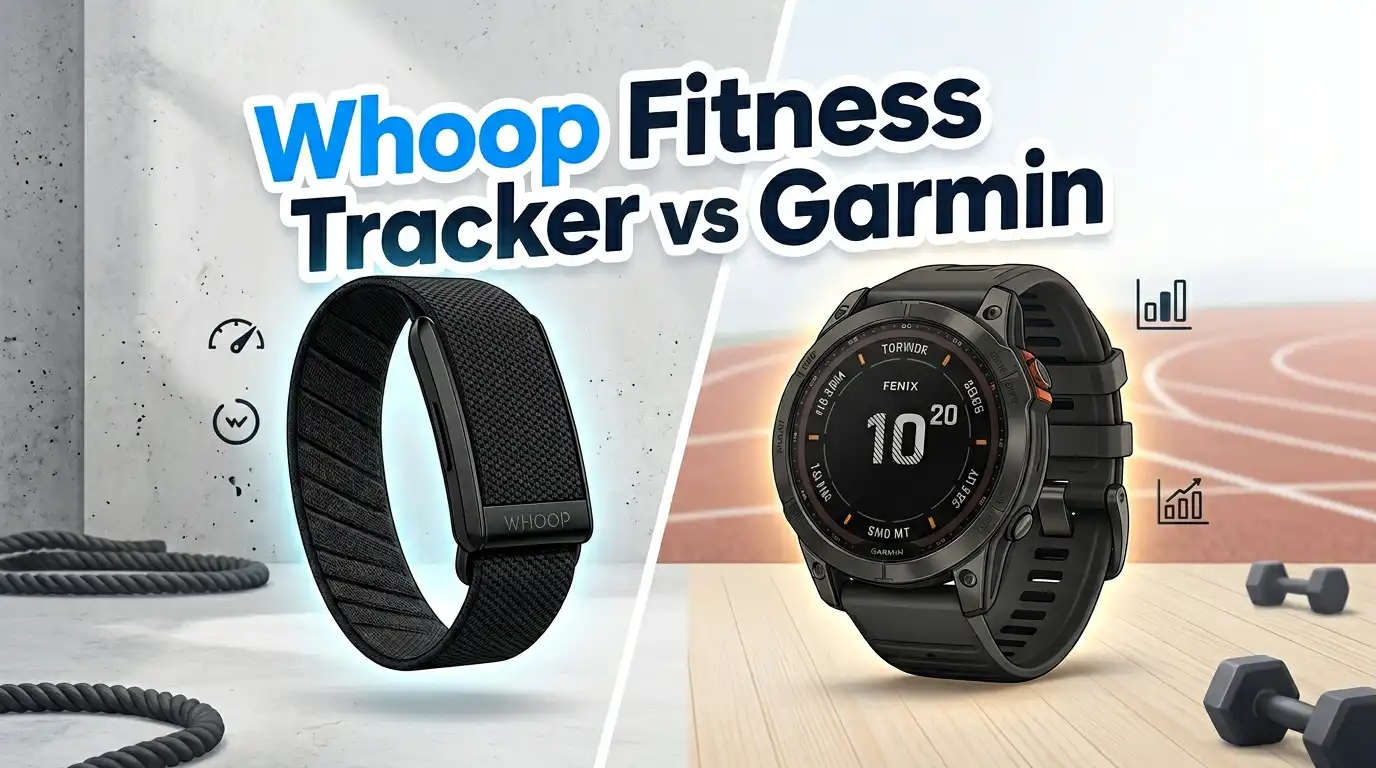
Whoop Fitness Tracker vs Garmin in 2026: Who Wins?
Are you stuck between the Whoop fitness tracker and a Garmin smartwatch? You are not alone. Thousands of fitness enthusiasts face this exact decision every day. Both brands promise to help you train smarter, sleep better, and recover faster.
But they do it in very different ways. Whoop uses a screenless wristband that relies on a phone app for all your data. Garmin uses a full smartwatch with a bright display, built-in GPS, and on-device coaching. One requires a monthly subscription.
The other is a one-time purchase. So which one actually delivers more value in 2026? This guide breaks down every major difference between Whoop and Garmin. We compare design, health tracking, battery life, accuracy, price, and much more.
Key Takeaways
- Whoop 5.0 is a screenless recovery tracker that focuses on HRV, sleep stages, strain, and respiratory rate. It requires a mandatory subscription starting around $30 per month. There is no built-in GPS or display. All data lives in the Whoop app on your phone.
- Garmin offers a wide range of smartwatches from the budget-friendly Venu 3 to the premium Fenix 8. Every Garmin model includes a screen, built-in GPS, and free access to the Garmin Connect app. There is no subscription required for core features.
- Whoop excels at passive recovery monitoring. It tracks your body around the clock without any interaction. This makes it ideal for elite athletes who work with professional coaches and want clean recovery data.
- Garmin excels at active workout tracking. It gives you real-time pace, distance, heart rate zones, and coaching directly on your wrist. This makes it the better choice for runners, cyclists, hikers, and triathletes who train independently.
- Over two years, Garmin costs significantly less. A Garmin Venu 3 is a one-time purchase around $350. Whoop costs roughly $600 or more over the same period due to its recurring subscription model.
- Garmin is preparing a screenless competitor called Cirqa that could directly challenge Whoop in the recovery-focused wearable space. This may shift the landscape later in 2026.
Whoop 5.0 Overview and Features

Last update on 2026-08-23 / Affiliate links / Images from Amazon Product Advertising API Some of the links on this website are affiliate links, which means that at no additional cost to you, I earn a commission if you click through and make a purchase. I only recommend products and services that I believe will add value to my readers. Thank you for your support!
The Whoop 5.0 launched as the latest generation of Whoop’s screenless fitness tracker. It sits on your wrist like a slim band and collects data 24 hours a day. The device tracks heart rate, HRV, skin temperature, respiratory rate, blood oxygen, and sleep stages without any manual input.
Whoop 5.0 introduced improved battery life of roughly five days on a single charge. It also added a faster processor and better sensor accuracy compared to the Whoop 4.0. The new Whoop MG variant goes further with ECG capability and medical-grade sensors.
You view all your data through the Whoop app. The app gives you a daily recovery score, strain score, and sleep performance rating. It also offers AI-powered coaching insights based on your trends. There is no screen on the device itself. This keeps distractions low but means you always need your phone nearby.
Pros:
- Excellent passive HRV and sleep tracking
- Comfortable and lightweight for 24/7 wear
- No screen means zero distractions during training or sleep
- AI-driven recovery and strain insights
- Water-resistant design
Cons:
- Mandatory subscription ($30+ per month)
- No built-in GPS
- No display on the device
- Requires a phone for all data access
- Expensive over time compared to one-time purchase alternatives
Garmin Venu 3 Overview and Features


Last update on 2026-08-23 / Affiliate links / Images from Amazon Product Advertising API Some of the links on this website are affiliate links, which means that at no additional cost to you, I earn a commission if you click through and make a purchase. I only recommend products and services that I believe will add value to my readers. Thank you for your support!
The Garmin Venu 3 is a full-featured health and fitness smartwatch. It has a bright 1.4-inch AMOLED touchscreen display that shows your data in real time. You get built-in GPS, heart rate monitoring, SpO2, Body Battery energy tracking, sleep coaching, and over 30 sport modes.
Garmin Venu 3 also introduced a built-in speaker and microphone. This allows you to take phone calls directly from your wrist. Battery life reaches up to 14 days in smartwatch mode. The watch supports Garmin Coach training plans, morning reports, and nap detection.
The Garmin Connect app is free and provides deep data analysis. You can sync workouts, view trends, create custom training plans, and share your stats. There is no subscription needed for any core feature.
Pros:
- Vibrant AMOLED display with always-on option
- Built-in GPS with multi-satellite support
- Up to 14 days battery life
- Free Garmin Connect app with full analytics
- Speaker and microphone for calls
- No subscription required
Cons:
- Bulkier than Whoop on the wrist
- Less focused on passive recovery data than Whoop
- Higher upfront cost compared to Whoop’s initial signup
- Some advanced features require learning the Garmin ecosystem
Garmin Fenix 8 for Serious Athletes

Last update on 2026-08-23 / Affiliate links / Images from Amazon Product Advertising API Some of the links on this website are affiliate links, which means that at no additional cost to you, I earn a commission if you click through and make a purchase. I only recommend products and services that I believe will add value to my readers. Thank you for your support!
The Garmin Fenix 8 is built for serious athletes and outdoor adventurers. It features a 1.4-inch AMOLED display with a scratch-resistant sapphire lens. The watch is dive-rated, tested to U.S. military standards, and has a built-in LED flashlight.
Battery life on the Fenix 8 reaches up to 29 days in smartwatch mode. It supports multi-band GPS for the most accurate location tracking available. You get advanced metrics like VO2 max, training load, recovery time, running dynamics, and climb planning.
The Fenix 8 is the watch you pick if you need everything in one device. It handles trail running, swimming, cycling, hiking, skiing, and more. It does cost significantly more than both the Venu 3 and Whoop. But you pay once and own it forever.
Pros:
- Premium AMOLED display with sapphire lens
- Up to 29 days battery life
- Multi-band GPS for top-tier accuracy
- Dive-rated and military-grade durability
- Built-in flashlight
- Massive range of sport and outdoor features
Cons:
- High price point (starting around $950)
- Heavier and larger than most fitness trackers
- Overkill for casual fitness users
- Steep learning curve for all features
Design and Comfort Comparison
Whoop and Garmin take opposite approaches to design. The Whoop 5.0 is a small, flat sensor attached to a fabric or silicone band. It weighs very little. Many users forget they are wearing it. This makes Whoop ideal for all-day, all-night wear without any discomfort.
Garmin watches are traditional smartwatches with screens, buttons, and thicker cases. The Venu 3 weighs about 47 grams while the Fenix 8 comes in heavier. Garmin watches look more like regular watches, which appeals to people who want a stylish daily accessory.
The Whoop MG takes comfort even further. It embeds sensors into clothing like compression shirts, bras, and boxers. This removes the wristband entirely. For athletes in contact sports or those who dislike wearing anything on their wrist, the MG is a unique option.
Garmin wins on style and versatility. Whoop wins on invisible, distraction-free wear.
Sleep Tracking Head to Head
Sleep tracking is a major reason people buy both Whoop and Garmin. Both devices monitor sleep stages, heart rate, HRV, blood oxygen, and respiratory rate during the night.
Whoop presents sleep data through its Sleep Performance score. This score tells you how well you slept compared to your body’s actual sleep need. Whoop also tracks sleep consistency and gives you a target bedtime based on your recovery needs. Many users consider Whoop’s sleep insights to be among the best available in any wearable.
Garmin uses its Sleep Score system along with Body Battery and HRV Status. The Garmin Venu 3 added nap detection and a detailed sleep coaching feature. Garmin also provides a Morning Report on your wrist that summarizes your sleep quality, HRV, and readiness for the day.
Both platforms deliver strong sleep analytics. Whoop has a slight edge in sleep-specific coaching. Garmin offers broader context by linking sleep data to your overall training load and energy levels.
Heart Rate and HRV Accuracy
Heart rate accuracy matters for every fitness metric you track. Both Whoop and Garmin use optical heart rate sensors on the wrist. Independent tests show similar accuracy during steady-state activities like jogging, cycling, and walking.
Whoop has a known strength in continuous overnight HRV monitoring. Because the band stays flat against your skin and does not shift around, the sensor contact is very consistent. This gives Whoop an edge for resting heart rate and HRV trend data over weeks and months.
Garmin’s latest sensors, found in the Venu 3 and Fenix 8, have improved significantly. They now offer HRV Status tracking, real-time heart rate zones during workouts, and abnormal heart rate alerts. Garmin also supports external chest strap pairing for maximum accuracy during intense exercise.
For workout heart rate, Garmin matches Whoop closely. For passive overnight HRV, Whoop holds a small advantage due to its wristband design.
GPS and Activity Tracking
This category is not close. Garmin dominates GPS and activity tracking. Every Garmin watch includes built-in GPS with multi-satellite support (GPS, GLONASS, Galileo). The Fenix 8 adds multi-band GPS for even better accuracy in dense forests and urban canyons.
Whoop has no built-in GPS at all. If you want location data for a run or bike ride, you must carry your phone. Whoop can pull GPS data from a connected phone, but this adds inconvenience and drains your phone battery.
Garmin also offers a much wider range of sport profiles. The Venu 3 has over 30 sports. The Fenix 8 supports over 40, including open water swimming, trail running, mountain biking, skiing, and golf. Each sport mode provides specific metrics relevant to that activity.
If outdoor activities, running routes, or GPS-based training matter to you, Garmin is the clear choice.
Recovery and Strain Tracking
Whoop built its reputation on recovery and strain tracking. Each morning, Whoop gives you a Recovery Score from 0 to 100. This score is based on your HRV, resting heart rate, respiratory rate, and sleep performance. A green score means you are ready to push hard. A red score means you should rest.
Whoop’s Strain Score measures how much stress your body experienced during the day. It uses heart rate data to calculate strain on a 0 to 21 scale. The app then recommends how much strain your body can handle based on your recovery.
Garmin offers similar features through Body Battery, Training Readiness, and Training Load. Body Battery scores your energy from 0 to 100. Training Readiness combines sleep, recovery, and training history to tell you if you should train hard or easy. These features are free and available on-device.
Whoop’s recovery system is more focused and refined for this single purpose. Garmin’s system is broader and integrates recovery into a larger fitness picture.
Subscription Cost vs One-Time Purchase
The pricing model is one of the biggest differences between these two brands. Whoop operates on a subscription. You pay roughly $30 per month (or about $240 per year on an annual plan) for Whoop One. The Whoop Peak plan with advanced metrics costs more.
The Whoop device itself is included with the subscription. But if you cancel, you lose access to all your data and the device stops working as a tracker. Over two years, Whoop costs between $480 and $580 or more.
Garmin watches are a one-time purchase. The Garmin Venu 3 costs around $350. The Forerunner 265 costs about $300. The Fenix 8 starts around $950. You buy it once, and all features and app access are free forever. There is no recurring fee.
For budget-conscious buyers, Garmin offers much better long-term value. Whoop’s subscription model suits users who prefer a lower upfront cost and do not mind ongoing payments.
Garmin Forerunner 265 for Runners

Last update on 2026-08-23 / Affiliate links / Images from Amazon Product Advertising API Some of the links on this website are affiliate links, which means that at no additional cost to you, I earn a commission if you click through and make a purchase. I only recommend products and services that I believe will add value to my readers. Thank you for your support!
The Garmin Forerunner 265 is a top pick for dedicated runners. It features a colorful AMOLED display, built-in GPS, and detailed running metrics. You get pace alerts, cadence tracking, ground contact time, vertical oscillation, and race predictor tools right on your wrist.
Battery life reaches up to 13 days in smartwatch mode and about 20 hours in GPS mode. The watch supports Garmin Coach adaptive training plans that adjust based on your progress. It also gives you daily suggested workouts and morning reports.
The Forerunner 265 is lighter and more comfortable for running than the Fenix 8. It costs significantly less too. For runners who want real-time data, GPS routes, and structured training, this watch delivers everything Whoop cannot.
Pros:
- Bright AMOLED display optimized for outdoor visibility
- Accurate multi-satellite GPS
- Advanced running dynamics and training metrics
- Garmin Coach with adaptive training plans
- 13 days battery life in smartwatch mode
- No subscription required
Cons:
- Not as rugged as Fenix 8
- Limited to running and basic sport modes compared to Fenix
- Larger than Whoop on the wrist
- Missing some premium features found in higher-tier Garmin models
Who Should Buy Whoop in 2026
Whoop is not for everyone. It works best for a specific type of user. You should consider Whoop if you are an elite or competitive athlete who works with a coach. Coaches can use your Whoop recovery and strain data to adjust your training load on a daily basis.
Whoop also suits people who want completely passive health monitoring. You never interact with the device. It just collects data silently. If you find smartwatch notifications and screens distracting, Whoop removes all of that.
The Whoop MG line appeals to athletes in contact sports like wrestling, boxing, or martial arts where wrist-worn devices are not allowed. Embedding sensors into clothing is a genuine advantage for these users.
However, if you train alone, coach yourself, and want real-time feedback during workouts, Whoop will likely frustrate you. The lack of GPS and screen means you still need a phone or a second device for active training.
Who Should Buy Garmin in 2026
Garmin fits a much broader audience. Runners, cyclists, swimmers, hikers, gym-goers, and casual fitness enthusiasts all benefit from a Garmin watch. The built-in GPS, on-device coaching, and wide range of sport modes make it a versatile daily companion.
Garmin is also the better choice if you want a single device that handles fitness tracking, smartwatch features, and health monitoring. You get notifications, music storage, payment support, and phone calls on models like the Venu 3.
For people who manage health conditions and want to pair fitness data with nutrition tracking or medical apps, Garmin’s open ecosystem and third-party integrations offer more flexibility. The Garmin Connect app syncs with many popular health platforms.
Budget-conscious buyers benefit from Garmin’s no-subscription model. You pay once. You own the watch. All software updates and app features remain free. Over time, this saves hundreds of dollars compared to Whoop.
The Future: Garmin Cirqa and the Screenless Battle
Garmin is reportedly developing a screenless wristband called Cirqa. Leaks and trademark filings from early 2026 suggest this device will directly compete with Whoop 5.0. Cirqa may offer recovery tracking, HRV, sleep analysis, and strain monitoring without a screen, similar to what Whoop does.
The key difference? Garmin is expected to offer Cirqa without a mandatory subscription. If true, this would give users a Whoop-like experience with Garmin’s proven sensor technology and the free Garmin Connect ecosystem.
This could be a game changer in the wearable market. Whoop’s biggest weakness is its recurring cost. A screenless Garmin band with no subscription would address that pain point directly. We expect more details on Cirqa in the second half of 2026.
For now, if you are choosing between Whoop and Garmin today, the decision comes down to your training style, budget, and whether you need a screen. Garmin serves most fitness users better. Whoop serves recovery-focused athletes with coaching support.
Frequently Asked Questions
Is Whoop worth the subscription cost?
Whoop is worth it if you are a serious athlete who uses recovery data daily to guide training. The subscription includes the device, app access, and AI coaching. However, if you train casually or coach yourself, Garmin offers similar recovery metrics at no recurring cost.
Can Garmin track recovery like Whoop?
Yes. Garmin uses Body Battery, HRV Status, Training Readiness, and Morning Report to measure recovery. These features cover most of what Whoop’s Recovery Score provides. Garmin’s approach is broader and links recovery data to your training load and daily energy levels.
Does Whoop have GPS?
No. Whoop 5.0 has no built-in GPS. You must carry your phone to log GPS data for outdoor activities. Garmin includes built-in GPS with multi-satellite support on every watch model.
Which is more accurate for heart rate?
Both devices offer comparable heart rate accuracy during steady-state exercise. Whoop has a slight advantage in overnight resting HRV due to its flat wristband design. Garmin supports external chest straps for the highest accuracy during intense workouts.
Can I use Whoop and Garmin together?
Yes. Some athletes wear both devices. They use Garmin for real-time workout data and GPS tracking during exercise. They use Whoop for overnight recovery monitoring and passive strain tracking. This combination provides the most complete data picture but doubles the cost.
What is the Garmin Cirqa?
Garmin Cirqa is a rumored screenless fitness band from Garmin. It is expected to offer recovery and sleep tracking similar to Whoop but without a subscription. Official details are expected later in 2026.

Hi, my name is Lily you can say i am a gadget hunter at this point. Welcome to Gadget Gallery The Gallery of Gadget Reviews