Motorola Smartwatch Review 2026: Is It Worth Buying?
So you are thinking about buying the Motorola Moto Watch in 2026. Good news — you landed in the right place. This watch has been making a lot of noise lately, and not just because it looks sharp.
It packs Polar-powered fitness tracking, a 13-day battery life claim, and dual-frequency GPS, all for just $149.99. That sounds almost too good to be true, right?
Well, we wore it for weeks, ran with it, slept with it, and even took calls from our wrist. And honestly? It surprised us in some ways and disappointed us in others.
Key Takeaways
- The Moto Watch 2026 costs $149.99 and is available on Amazon USA. It is one of the most affordable smartwatches with Polar-level fitness technology built in. For budget-conscious buyers who want accurate health data without spending $300 or more, this watch is worth serious attention.
- The battery life is genuinely impressive. Motorola claims up to 13 days on a single charge. Real-world testing shows it hits 5 days at about 49% battery remaining. That means the 13-day claim is realistic for moderate users. Most premium Android smartwatches barely last 2 days by comparison.
- Polar powers the health and fitness engine. This means you get heart-rate variability data, sleep stage tracking, recovery scores, stress monitoring, and SpO2 readings. These are features you normally see on dedicated sports watches costing $400 or more.
- Dual-frequency GPS is a major upgrade at this price. This technology delivers more accurate location and pace data, especially in dense urban areas or trails with tree cover. It is usually reserved for flagship or sports-specific devices.
- The watch does not run Wear OS and has no third-party app store. This is the biggest limitation. You cannot download apps beyond what comes preinstalled. If app flexibility is important to you, this may be a dealbreaker.
- It works best with Android phones. Motorola designed this watch for Android users. iPhone compatibility exists for basic features, but the full experience requires an Android device.

Last update on 2026-10-13 / Affiliate links / Images from Amazon Product Advertising API Some of the links on this website are affiliate links, which means that at no additional cost to you, I earn a commission if you click through and make a purchase. I only recommend products and services that I believe will add value to my readers. Thank you for your support!
What Is the Motorola Moto Watch 2026?
The Motorola Moto Watch 2026 is a budget-friendly smartwatch powered by Polar fitness technology. Motorola launched it at CES 2026 and positioned it as a strong option for people who want great fitness tracking without a flagship price tag.
This watch is not your average $150 gadget. Motorola partnered with Polar, a brand famous for high-accuracy heart rate chest straps used by professional athletes. That partnership brings serious health tracking credibility to a watch that costs as much as a pair of sneakers.
The watch runs a proprietary operating system developed in collaboration with Polar. This means it does not use Google’s Wear OS. The interface is clean and fast, and it handles daily tasks well. You get over 100 workout modes, health monitoring tools, smart notifications, and even hands-free calling through a built-in speaker and microphone.
It also integrates with the Moto Things ecosystem and Motorola’s Moto AI on select devices. The Moto Watch 2026 is aimed at people who want a capable, stylish daily companion that handles fitness and health without draining the battery every night.
Design and Build Quality of the Moto Watch 2026
The first thing you notice about this watch is that it does not look like a $150 smartwatch. It looks and feels far more premium than its price suggests.
The watch features a 47mm circular aluminum frame with a stainless steel crown on the upper right side. The overall dimensions are 47 x 47 x 12mm, and the weight is a comfortable 40 grams. Yes, it is slightly larger than some rivals, but it wears well on the wrist and does not feel bulky during workouts or sleep.
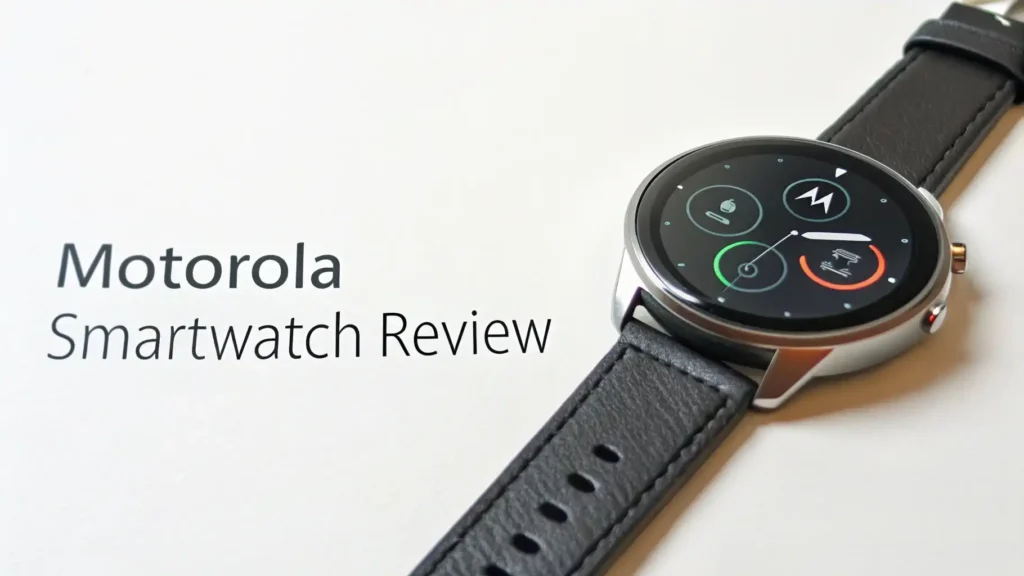
The design style mixes rugged sportwatch aesthetics with polished everyday wear. It looks good with a gym outfit and equally good with a business-casual shirt. The crown is functional and lets you navigate menus with precision. Below the crown is a customizable button that opens your most-used feature by default.
Band options are 22mm universal width, so you can swap in silicone, leather-like, or stainless steel bands from any third-party brand. The watch ships in one color only: Volcanic Ash, which is a dark charcoal black. The matte finish looks professional and does not attract fingerprints easily. Overall, the build quality is one of the strongest selling points for this watch at this price.
Display Quality: How Good Is That OLED Screen?
The Moto Watch 2026 uses a 1.43-inch round OLED display protected by Corning Gorilla Glass 3. The screen is vibrant, colorful, and very easy to read in daylight. Colors pop with good saturation levels, and the round shape gives it a classic watch aesthetic that many users prefer over rectangular smartwatch displays.
Motorola offers an always-on display mode that reduces battery life from 13 days down to approximately 7 days. That is still a very strong battery performance even with always-on activated. The display brightness adjusts automatically based on ambient light, so you never have to squint outdoors.
The touch response is quick and accurate. Swiping down opens Quick Settings, swiping up shows your notifications, and swiping left or right cycles through health widgets like your step count or weather data.
The OLED panel produces deep blacks and solid contrast ratios, giving the watch face designs a premium look. There are dozens of proprietary Motorola watch faces to choose from through the companion app. The display is one of the best features of this watch, especially considering the entry-level price.
Top 3 Alternatives for the Motorola Moto Watch
![Samsung Galaxy Watch 7 44mm Bluetooth AI Smartwatch w/Energy Score, Wellness Tips, Heart Rate Tracking, Sleep Monitor, Fitness Tracker, 2024, Silver [US Version, 1Yr Manufacturer Warranty]](https://gadgetgallery.blog/wp-content/plugins/aawp/public/image.php?url=YUhSMGNITTZMeTl0TG0xbFpHbGhMV0Z0WVhwdmJpNWpiMjB2YVcxaFoyVnpMMGt2TkRGb2VITmtUakJCVDB3dVgxTk1NVFl3WHk1cWNHYz18MTc5MjQyNjI4NQ=)

Last update on 2026-10-13 / Affiliate links / Images from Amazon Product Advertising API Some of the links on this website are affiliate links, which means that at no additional cost to you, I earn a commission if you click through and make a purchase. I only recommend products and services that I believe will add value to my readers. Thank you for your support!

Last update on 2026-10-13 / Affiliate links / Images from Amazon Product Advertising API Some of the links on this website are affiliate links, which means that at no additional cost to you, I earn a commission if you click through and make a purchase. I only recommend products and services that I believe will add value to my readers. Thank you for your support!

Last update on 2026-10-13 / Affiliate links / Images from Amazon Product Advertising API Some of the links on this website are affiliate links, which means that at no additional cost to you, I earn a commission if you click through and make a purchase. I only recommend products and services that I believe will add value to my readers. Thank you for your support!
Battery Life: Can It Really Last 13 Days?
Battery life is one of the biggest reasons people are talking about the Moto Watch 2026. Motorola claims up to 13 days on a single charge in raise-to-wake mode. With always-on display turned on, that drops to around 7 days.
Real-world testing confirms the battery lives up to its promise. After five full days of use that included daily workout tracking, sleep monitoring, and regular notifications, the battery sat at 49% remaining. That suggests the 13-day claim is realistic for users who keep GPS and always-on display off most of the time.
For context, the Samsung Galaxy Watch FE lasts a maximum of 30 hours, and most Wear OS watches need daily charging. The Moto Watch completely changes the charging routine. You charge it roughly once every one to two weeks instead of every night.
Even better, the watch supports fast charging. Just 5 minutes on the charger adds approximately one full day of battery life. This is a lifesaver when you realize you are running low before a big workout or a long travel day. The battery performance alone makes this watch stand out in the sub-$200 category.
Fitness Tracking Powered by Polar
Polar is not a brand most casual smartwatch buyers know, but serious athletes do. Polar builds heart rate chest straps used by professional sports teams and elite runners. Motorola bringing Polar’s technology into a $150 watch is genuinely exciting.
The Moto Watch 2026 tracks over 100 workout modes with auto-pause functionality. When you start a run or ride, the watch automatically detects when you stop and resumes tracking when you start again. After a workout, you see your peak heart rate, total calories burned, and an energy breakdown showing how much fuel came from carbs, fat, or protein.
Heart-rate variability data is a standout feature here. Most budget smartwatches only give you average heart rate. The Moto Watch gives you HRV data, which measures the variation in time between heartbeats. This is a key indicator of recovery quality and stress levels. It tells you not just how hard your heart is working, but how well your body is handling the load.
During running tests, heart rate data needed about 3 minutes to fully sync with external chest strap readings. Once synced, accuracy was solid at moderate intensities. At peak exertion levels, the wrist sensor struggled slightly to match chest strap readings, which is a known limitation of all wrist-based heart rate monitors.
GPS Performance: Dual-Frequency Precision
The Moto Watch 2026 uses dual-frequency GPS, which is a significant technical upgrade at this price. Standard single-band GPS can lose accuracy in cities with tall buildings, thick forests, or canyon trails. Dual-band GPS uses two satellite frequency bands simultaneously to deliver more accurate location and pace data in those conditions.
This technology is typically found in watches costing $300 and above, such as the Garmin Fenix series or Apple Watch Ultra. Finding it in a $149.99 smartwatch is a real value proposition for outdoor runners, cyclists, and hikers.
In practice, the GPS takes about 10 to 15 seconds to acquire a signal at the start of a workout. Once connected, tracking is reliable and consistent.
Route maps displayed in the Moto Watch app after a run show clean, accurate paths. Pace data is updated every second, which gives real-time feedback during interval training. If you run or cycle outdoors regularly, the GPS performance of this watch is more than enough for your daily tracking needs.
Health Monitoring Features You Will Love
Beyond fitness tracking, the Moto Watch 2026 functions as a continuous health monitoring device throughout your entire day. The watch measures several key health signals in real time.
Continuous heart rate monitoring alerts you when your heart rate goes above or below your personal threshold. SpO2 monitoring tracks your blood oxygen saturation levels, which is useful for detecting breathing irregularities during sleep or at high altitude. Stress monitoring uses heart rate variability data to assign a real-time stress score throughout the day.
The watch also sends hydration and movement reminders to build healthier daily habits. These reminders are subtle vibrations on your wrist that nudge you to drink water or take a short walk if you have been sitting too long.
The health dashboard inside the Moto Watch app consolidates all this data into easy-to-read summaries. You can see trends over days, weeks, and months. Motorola also integrates this data with Moto AI on select Motorola phones, allowing personalized health summaries without scrolling through pages of data manually.
Software and App Support: What You Get and What You Miss
The Moto Watch 2026 runs Motorola’s proprietary operating system built in partnership with Polar. The interface is clean and responsive. It resembles Wear OS in layout, using an app grid that you navigate with the crown or touchscreen.
The companion Moto Watch app on Android handles everything from pairing to health data syncing to watch face customization. Setup takes under five minutes, which is genuinely impressive for a smartwatch. One app controls personalization, settings, and data review.
However, the software has a significant limitation. There is no third-party app store. You cannot install Google Maps, Spotify, or any other application. What comes preinstalled is what you get. Motorola confirmed that users can choose which apps send notifications to the watch, but you cannot run those apps directly on the device.
This puts the Moto Watch closer in spirit to a fitness band than a full smartwatch. If you want to pay from your wrist, stream music directly, or check navigation on your watch face, this is not the right device. But if you just want clean notifications, fitness data, and a reliable health companion, the software handles all of that very well.
Sleep Tracking and Recovery Insights
Sleep tracking is handled through a feature called Nightly Recharge, which is a Polar-powered sleep analysis tool. Every morning, you get a sleep score and a breakdown of your sleep stages, including light sleep, deep sleep, and REM sleep.
The Nightly Recharge system also evaluates your autonomic nervous system recovery overnight. This tells you whether your body has truly rested and regenerated or if you are still carrying fatigue from the previous day. A green score means you are ready to push hard. A yellow or red score means your body needs more rest.
In testing, the sleep stage detection performed accurately when compared to subjective sleep quality reports. The watch is comfortable enough to wear during sleep and does not cause any wrist irritation. The battery lasts long enough that you do not need to charge overnight, which is a common issue with Wear OS watches that need daily top-ups.
One area that needs improvement is the guidance quality. When the app detects poor sleep, the advice it gives is vague. Suggestions like “do something relaxing” or “focus on your surroundings” are not actionable enough. More specific recovery coaching would make this feature genuinely powerful rather than just informative.
Smart Features and Connectivity
The Moto Watch 2026 goes beyond fitness with several daily smart features that make it a true companion device.
The watch has a built-in microphone and speaker, which allows you to answer and make phone calls directly from your wrist. Call quality is clear enough for short conversations, and the speaker volume is audible in moderately noisy environments. This is a feature that many budget smartwatches skip entirely.
Notifications sync from your phone in real time. You can read full messages, see caller IDs, and dismiss alerts without taking your phone out of your pocket. A remote camera shutter lets you trigger your smartphone camera from your wrist, which is handy for group photos.
For Motorola phone users, the watch integrates with Smart Connect, Motorola’s cross-device connectivity platform. It also connects with Moto AI, which can deliver personalized “Catch me up” summaries that pull together your notifications, fitness data, and reminders into a short spoken or visual briefing. The watch is compatible with the Motorola Moto Things ecosystem, which ties together phones, tablets, earbuds, and wearables into one connected experience.
Pricing and Value for Money
The Motorola Moto Watch 2026 is priced at $149.99 on Amazon USA. At that price, the value proposition is hard to ignore. You get a premium aluminum design, Corning Gorilla Glass 3, a vibrant OLED display, Polar-powered health tracking, dual-frequency GPS, 13-day battery life, and hands-free calling in a single device.
Compare that to the competition:
The Samsung Galaxy Watch 7 starts at around $196 and runs full Wear OS with a third-party app store. The Fitbit Versa 4 costs around $169 and includes Google Wallet and Google Maps. The Garmin Venu 3 sits near $394 and targets serious athletes with advanced training metrics.
For what you pay, the Moto Watch 2026 packs features that most watches charge a premium for. The dual-band GPS alone typically adds $50 to $100 to competing devices. The Polar health platform integration brings credibility that no other budget smartwatch can match in 2026.
The only real value concern is the 512MB of storage. That is enough for a small music playlist or a single audiobook. For a watch at this price, more storage would make the offline media experience much more practical. Still, if your goal is health tracking and smart notifications, the pricing is genuinely competitive.
Who Should Buy the Motorola Moto Watch 2026?
The Moto Watch 2026 is the right choice for a specific type of buyer. If you match one or more of these descriptions, this watch belongs on your wrist.
You should buy the Moto Watch 2026 if:
You use an Android phone and want a stylish, capable smartwatch without paying flagship prices. You care about accurate fitness and health data but do not want to manage a Garmin training plan. You want a watch that lasts more than a week on a single charge. You value a clean, lightweight interface over a feature-packed but complex operating system. You run or cycle outdoors and want reliable dual-band GPS tracking for pace and route accuracy.
You should probably skip it if:
You use an iPhone as your primary device and need full feature support. You want to install third-party apps or use contactless payments from your wrist. You need more than 512MB of local storage for offline music or podcasts. You want a watch that competes directly with Wear OS or watchOS feature sets.
The Moto Watch 2026 is the best budget smartwatch of 2026 for Android users who prioritize battery life, design, and accurate health monitoring. It is not perfect, but at $149.99, nothing close to it comes with this combination of features and style.
Frequently Asked Questions
Does the Motorola Moto Watch 2026 work with iPhone?
The Moto Watch 2026 offers basic compatibility with iPhones for receiving notifications and viewing health data in the companion app. However, the full feature set, including Moto AI integration and advanced Smart Connect features, requires an Android device. iPhone users will get a limited experience compared to Android users.
How long does the Moto Watch 2026 battery really last?
Motorola claims up to 13 days with raise-to-wake mode active. With always-on display turned on, the battery drops to around 7 days. Real-world testing by multiple reviewers confirms the watch comfortably reaches 10 to 13 days under typical use conditions, which includes daily workouts, sleep tracking, and regular notifications.
Does the Moto Watch 2026 run Wear OS?
No, the Moto Watch 2026 does not run Google’s Wear OS. Motorola built a proprietary operating system in collaboration with Polar. The interface is clean and easy to use, but it does not support Google Play or any third-party app installation. What comes preinstalled on the watch is the full extent of the software library.
Can you swim with the Motorola Moto Watch 2026?
The Moto Watch 2026 carries an IP68 water resistance rating plus 1 ATM pressure resistance. This means the watch handles splashes, sweat, and brief freshwater submersion up to one meter. However, Motorola advises against wearing it for prolonged swimming sessions, as extended water exposure can degrade the water resistance seals over time.
What is the Polar partnership and why does it matter?
Polar is one of the most respected names in athletic heart rate monitoring and sports science. The brand makes precision heart rate chest straps used by professional athletes worldwide. By partnering with Polar, Motorola gained access to Polar’s health algorithms for features like heart-rate variability analysis, sleep stage detection, Nightly Recharge recovery scoring, and stress monitoring. This partnership gives the Moto Watch health tracking accuracy that goes beyond what most budget smartwatches deliver.
Is the Motorola Moto Watch 2026 good for running?
Yes, the Moto Watch 2026 is a solid running companion. It offers dual-frequency GPS for accurate pace and route tracking, continuous heart rate monitoring, cadence data, calorie tracking, and real-time audio feedback during runs. The auto-pause feature works well during interval training or stoplight pauses. For casual to intermediate runners, it delivers everything you need. Serious competitive runners may want the more advanced metrics available on Garmin devices.
Can you make phone calls from the Moto Watch 2026?
Yes, the Moto Watch 2026 has a built-in microphone and speaker that supports hands-free calling. You can answer and make calls directly from your wrist when your phone is nearby. Call audio quality is clear enough for basic conversations. This feature sets the Moto Watch apart from many fitness bands in the same price range that only display call notifications without actually letting you speak.

Hi, my name is Lily you can say i am a gadget hunter at this point. Welcome to Gadget Gallery The Gallery of Gadget Reviews