
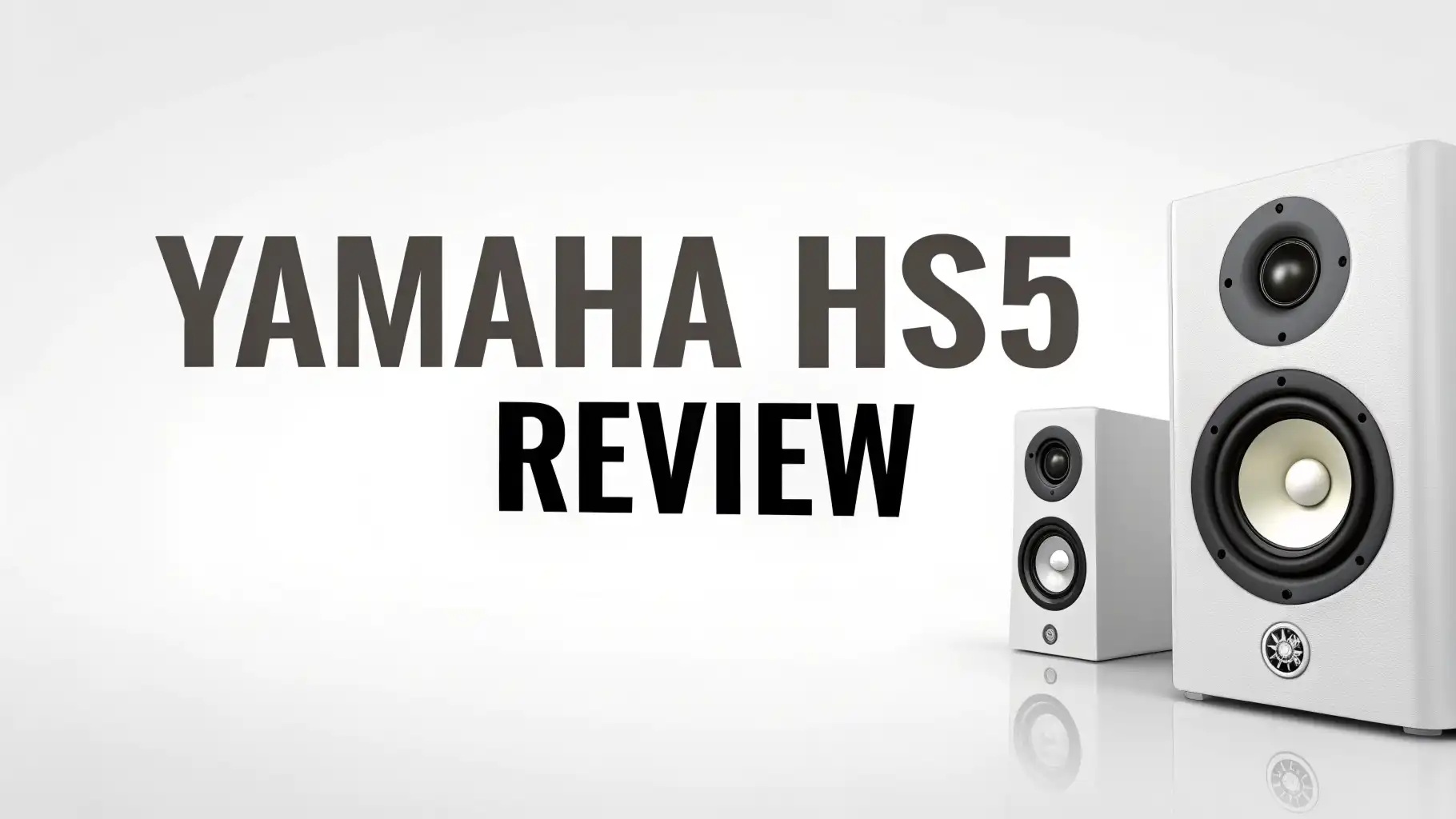
Yamaha HS5 Review 2026: Your Complete Guide
Finding the right studio monitors can feel overwhelming. You want clear sound. You need accurate mixing. And you definitely don’t want to waste money on speakers that disappoint.
The Yamaha HS5 has become one of the most talked-about studio monitors in home studios and professional setups alike.
This compact powerhouse promises studio-quality sound without breaking the bank. But does it really deliver? I’ve spent considerable time testing these monitors, and I’m here to share everything you need to know.
Key Takeaways:
- Compact size meets big sound – These 5-inch monitors fit perfectly in smaller studios while delivering surprisingly full audio reproduction that punches above their weight class.
- Flat frequency response for honest mixing – The HS5 provides accurate sound reproduction without artificial enhancement, which means your mixes will translate better across different playback systems.
- Built-in room control features – Adjustable high trim and room control switches help you adapt the sound to your specific studio environment, making acoustic treatment more forgiving.
- Professional quality at home studio prices – You get legendary Yamaha engineering and build quality without the premium price tag of high-end monitoring solutions.
- Limited low-end extension – The 5-inch woofer reaches down to about 54Hz, so you might need a subwoofer if you’re working heavily with bass-heavy genres like EDM or hip-hop.
- Industry-standard white cone design – The iconic white cone isn’t just for looks; it helps you visually detect any cone movement, making it easier to identify potential issues during extended use.

Yamaha HS5 Studio Monitor
The Yamaha HS5 represents decades of monitor design excellence packed into a compact form factor. These monitors belong to Yamaha’s HS series, which takes inspiration from the legendary NS10 monitors that dominated professional studios for years.
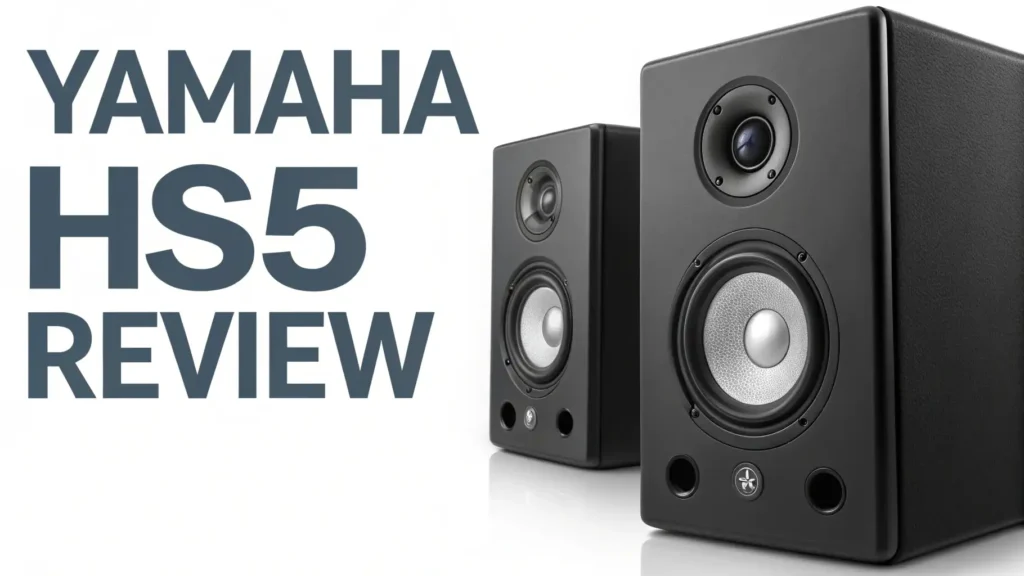
Each monitor features a 5-inch cone woofer and a 1-inch dome tweeter. This combination delivers 45 watts of total power through a bi-amplified design. The cabinet measures just 6.7 inches wide, making it perfect for cramped studio spaces.
The build quality feels solid and professional. The dense MDF cabinet minimizes unwanted resonances. The front-mounted bass reflex port helps with low-frequency response while allowing flexible placement near walls. These monitors come individually, so remember to order two for a stereo setup.
What strikes you immediately is the flat, honest sound signature. These monitors don’t hype the bass or brighten the highs artificially. This honesty might sound less exciting than consumer speakers at first, but it’s exactly what you need for accurate mixing and production work.
Sound Quality and Frequency Response
The HS5 delivers remarkably balanced sound across its frequency range. The frequency response spans from 54Hz to 30kHz, covering most of the audible spectrum with consistent accuracy.
The midrange reproduction stands out as particularly excellent. Vocals sit clearly in the mix without any coloration. Instruments maintain their natural character. This midrange clarity makes the HS5 perfect for vocal-heavy productions, podcasts, and acoustic music mixing.
High frequencies sound crisp and detailed without harshness. The 1-inch tweeter provides excellent transient response, letting you hear every cymbal shimmer and hi-hat detail. You can make precise EQ decisions in the upper frequencies with confidence.
The low end presents the biggest compromise due to the 5-inch woofer size. Bass extends down to 54Hz, which covers most musical fundamentals. However, sub-bass content below 50Hz falls off quickly. Hip-hop producers and electronic music creators working with deep 808s and sub-bass will definitely want to add a subwoofer like the Yamaha HS8S to complete the system.
The stereo imaging impresses for monitors in this price range. Proper placement creates a focused center image with good width. You can pinpoint instrument positions in the stereo field accurately, which helps during mixing sessions.
Design and Build Quality
Yamaha didn’t cut corners with the HS5 construction. The cabinet uses high-density MDF that feels substantial and well-damped. This material choice reduces cabinet vibrations that could color the sound.
The iconic white cone design serves multiple purposes. Beyond looking distinctive, the light color lets you see cone movement clearly. This visual feedback helps identify problems like distortion or excessive excursion during loud playback.
The front bass port positions the reflex opening away from walls. This design choice gives you more flexibility with placement compared to rear-ported designs. You can position these monitors closer to walls without significant bass buildup issues.
Control switches on the back panel include ROOM CONTROL and HIGH TRIM options. The room control switch offers -2dB and -4dB settings to compensate for boundary bass buildup when placing monitors near corners or walls. The high trim provides -2dB adjustment for rooms with overly reflective surfaces.
Input options include both XLR and TRS quarter-inch balanced connections. This flexibility lets you connect directly from audio interfaces, mixers, or other professional gear without adapters. The input sensitivity control helps match the monitors to your playback level preferences.
Top 3 Alternatives for Yamaha HS5


Performance for Music Production
Music producers will find the HS5 delivers honest feedback during the creative process. The flat response helps you make better EQ decisions because you’re hearing the actual sound rather than a hyped version.
Mixing translates well across different playback systems when you use these monitors as your reference. What sounds good on the HS5 generally sounds good on car stereos, headphones, and consumer speakers. This translation quality saves countless hours of second-guessing your mix decisions.
The clarity in the midrange makes vocal mixing particularly enjoyable. You can hear subtle compression artifacts, de-essing needs, and reverb tails with precision. Producers working with singer-songwriters or podcast content will appreciate this midrange focus.
Electronic music production reveals the HS5’s low-end limitation. While you can hear kick drums and bass lines clearly, the visceral sub-bass impact isn’t there. Pairing with a subwoofer transforms the system into something capable of handling any genre confidently.
The detailed high-frequency response helps with percussion mixing and mastering decisions. You can hear exactly what your cymbals and hi-hats are doing. This detail helps prevent harsh, fatiguing high-end that plagues amateur mixes.
Room Acoustics and Placement
Room acoustics affect any monitor’s performance significantly. The HS5 includes features to help adapt to your space, but proper placement still matters enormously.
Position these monitors at ear height when seated at your mixing position. The tweeters should aim directly at your ears for optimal high-frequency response. Many users invest in desktop monitor stands to achieve the proper height and angle.
Create an equilateral triangle between your head and the two monitors. This spacing typically means placing monitors about 3 to 4 feet apart for most desk setups. This geometry creates the best stereo imaging and phantom center focus.
The room control switches help compensate for boundary reinforcement. If your monitors must sit close to walls or in corners, engage the -2dB or -4dB room control setting. This reduces bass buildup that occurs when speakers interact with nearby surfaces.
Acoustic treatment makes any monitor sound better. Even basic treatment like bass traps in corners and absorption panels at first reflection points dramatically improves what you hear. The HS5 reveals these improvements clearly, making acoustic investment worthwhile.
Comparison with Other Studio Monitors
The studio monitor market offers many competitors at similar price points. Understanding how the HS5 compares helps you make the right choice.
JBL 305P MkII monitors offer more low-end extension and slightly louder output. They provide a bit more excitement in the sound but sacrifice some of the HS5’s clinical accuracy. The JBL’s might suit producers who want fuller bass without adding a subwoofer immediately.
KRK Rokit RP5 G4 monitors bring built-in DSP room correction and a slightly warmer sound signature. They’re less brutally honest than the HS5 but more forgiving of poor recordings. The KRK approach suits producers who want a more flattering sound during creative sessions.
PreSonus Eris E5 XT monitors cost less while offering acoustic tuning controls similar to the HS5. They don’t quite match Yamaha’s midrange clarity but deliver solid value. Budget-conscious producers should consider them seriously.
The Adam Audio T5V sits at a higher price point but brings ribbon tweeter technology and extended frequency response. They offer more detail and accuracy than the HS5 but require a larger investment.
Within Yamaha’s own lineup, the HS7 offers deeper bass extension and more headroom while maintaining the same sound character. If budget and space allow, the HS7 might eliminate the need for a subwoofer depending on your genre.
Connectivity and Setup Options
Setting up the HS5 monitors proves straightforward for most users. Each monitor operates as an active speaker with its own built-in amplification, simplifying the setup compared to passive monitor systems.
Connect your audio interface outputs directly to the HS5 inputs using balanced cables. XLR cables work perfectly, as do TRS quarter-inch cables. Balanced connections reject noise and interference, maintaining clean signal transmission even over longer cable runs.
The input sensitivity control on each monitor’s back panel adjusts the gain. Start with this control at the middle position, then adjust your audio interface output to reach comfortable listening levels. This approach maintains optimal signal-to-noise ratio throughout your signal chain.
Power management is simple with the rear-mounted power switch. Some users wish for an auto-standby feature to save energy, but the manual switch approach ensures the monitors are always ready when you need them.
Consider adding a monitor controller to your setup. Devices like the Mackie Big Knob or PreSonus Monitor Station provide convenient volume control, multiple input switching, and output routing options. This upgrade improves workflow compared to adjusting volume in software or on your audio interface.
Value for Money Analysis
The Yamaha HS5 delivers exceptional value in the budget studio monitor category. Street prices typically range between $200-250 per monitor, placing them in the affordable range for serious home studios.
What you get for this investment includes legendary Yamaha engineering, proven sound quality, and build construction that should last for years. These monitors appear in countless professional and home studios worldwide, proving their value proposition.
The main cost consideration comes from potential subwoofer needs. If you produce bass-heavy music, budget an additional amount for a subwoofer like the Yamaha HS8S. This addition roughly doubles your speaker investment but completes the system properly.
Compared to entry-level monitors costing less than $150 per speaker, the HS5 justifies its premium with noticeably better accuracy and build quality. Compared to monitors costing $400-500+ per speaker, the HS5 delivers perhaps 80% of the performance at half the cost.
The longevity and resale value factor into the equation favorably. These monitors hold their value well in the used market. If you decide to upgrade later, you’ll recoup a decent portion of your investment.
Who Should Buy the Yamaha HS5
The HS5 suits several types of audio professionals and enthusiasts perfectly. Understanding whether you fit these profiles helps determine if these monitors match your needs.
Home studio producers with limited space will love the compact footprint. The 5-inch size fits on crowded desks without dominating the workspace. Despite the small size, the sound quality supports serious production work.
Podcast producers and voice-over artists benefit tremendously from the excellent midrange clarity. The honest vocal reproduction helps you make better EQ and compression decisions on spoken word content.
Mix engineers working in treated rooms will appreciate the flat, accurate response. The HS5 reveals mix problems clearly without flattering or hiding issues. This honesty helps you deliver mixes that translate well across playback systems.
Budget-conscious producers starting their first serious studio setup get professional-quality monitors without massive investment. The HS5 provides a solid foundation that won’t need immediate upgrading as skills develop.
Electronic and hip-hop producers should consider carefully whether the limited low-end extension works for their needs. If deep sub-bass monitoring matters critically to your productions, budget for a subwoofer from the start or consider the larger HS7 or HS8 models instead.
Potential Drawbacks and Limitations
No monitor system is perfect for everyone. Understanding the HS5’s limitations helps set appropriate expectations.
The limited low-frequency extension represents the most significant compromise. That 54Hz lower limit means you’re missing the deepest bass fundamentals. Subwoofer addition solves this but adds cost and complexity to your setup.
Volume levels might disappoint producers who like loud monitoring. The 70-watt total system power provides adequate levels for nearfield monitoring but won’t fill large rooms or satisfy headbanging listening sessions. These monitors are designed for critical listening, not party volume.
The brutally honest sound signature can feel unflattering compared to consumer speakers or hyped studio monitors. Poorly recorded or mixed material sounds exactly as flawed as it is. This honesty serves mixing purposes perfectly but makes casual music listening less exciting.
Hiss becomes audible at very low volumes when your ear is close to the tweeter. This slight self-noise is common in active monitors and rarely matters during actual use, but quiet environment testing reveals it.
The monitors sell individually rather than in pairs, which can confuse first-time buyers. Remember to order two units for stereo monitoring. This packaging approach does allow easy replacement if one monitor fails.
Long-Term Reliability and Maintenance
Yamaha’s reputation for reliability extends to the HS5 monitors. These speakers use proven technology and quality components that should provide years of service.
The amplifier design uses sufficient cooling to prevent thermal issues during extended use. The rear heat sink dissipates warmth effectively. Avoid blocking ventilation and these monitors should run cool even during long mixing sessions.
Cone and surround materials resist deterioration better than older speaker technologies. The black woofer surround maintains flexibility over time without the foam rot issues that plagued vintage speakers.
Regular dusting keeps the monitors looking good and prevents dust buildup in the ports or ventilation areas. A soft cloth or compressed air cleaning every few months maintains appearance.
The warranty coverage typically includes one year from authorized dealers. Extended warranties are sometimes available. Keeping purchase receipts ensures warranty service if issues develop.
User reports suggest these monitors maintain their sound quality over many years of use. The components don’t seem prone to drift or degradation. Purchasing HS5 monitors represents an investment that should serve you throughout many projects.
Final Verdict on the Yamaha HS5
The Yamaha HS5 studio monitors earn their popularity through consistent performance and honest sound reproduction. These compact speakers deliver professional monitoring quality that helps producers and engineers create better mixes.
The flat frequency response provides the accuracy needed for critical mixing decisions. Your mixes will translate better across different playback systems when referenced on these monitors. This translation quality represents the fundamental purpose of studio monitors.
The compact size makes the HS5 perfect for smaller studios without sacrificing too much performance. Desktop producers and bedroom studio operators get professional-quality monitoring without overwhelming their workspace.
Budget considerations favor the HS5 strongly in the under-$250 per monitor category. Few competitors deliver comparable accuracy and build quality at this price point. The value proposition remains excellent years after these monitors first launched.
The bass limitation requires honest assessment based on your production style. Acoustic, rock, pop, and vocal productions work beautifully on these monitors alone. Electronic, hip-hop, and bass-heavy genres benefit from subwoofer addition.
Overall, the Yamaha HS5 deserves its status as an industry-standard nearfield monitor. These speakers provide honest feedback that helps you improve your craft. Whether you’re just starting serious production work or adding to an existing studio, the HS5 represents a safe, reliable choice that won’t disappoint.
Frequently Asked Questions
Do I need a subwoofer with Yamaha HS5 monitors?
Whether you need a subwoofer depends on your music genre and production needs. The HS5 extends down to 54Hz, which covers most musical fundamentals adequately. If you produce pop, rock, acoustic music, or podcasts, you probably don’t need a subwoofer immediately. However, if you create electronic music, hip-hop, or any bass-heavy genres, a subwoofer like the Yamaha HS8S becomes very beneficial.
Can I use Yamaha HS5 for casual music listening?
Yes, you can absolutely use the HS5 for casual listening, but the experience differs from consumer speakers. These monitors provide very accurate, flat sound reproduction without the enhanced bass or brightened highs that consumer speakers often add. This means some music might sound less exciting or punchy than you’re used to. Well-produced recordings sound fantastic and reveal details you might miss on regular speakers.
What cables do I need to connect Yamaha HS5 monitors?
You need balanced audio cables to connect the HS5 monitors to your audio interface or mixer. The monitors accept both XLR cables and TRS quarter-inch cables. Most audio interfaces feature TRS outputs, so TRS to TRS cables work perfectly. If your interface has XLR outputs, use XLR to XLR cables instead. Cable length depends on your setup, but 6 to 10 feet typically provides enough reach for desktop studio arrangements.
How far should Yamaha HS5 monitors be from the wall?
The ideal distance from the wall depends on your room characteristics and the bass response you want. The HS5 features front-mounted bass ports, allowing closer wall placement than rear-ported designs. Generally, placing monitors at least 6 to 12 inches from the wall provides good results. If you must place them closer due to space constraints, engage the room control switch on the back panel to reduce bass buildup.
Are Yamaha HS5 good for beginners?
The Yamaha HS5 makes an excellent choice for beginners who are serious about learning proper mixing and production techniques. The honest, flat frequency response teaches you what accurate sound reproduction sounds like, helping develop critical listening skills from the start. The setup process is straightforward with simple connections and minimal adjustments needed. The price point fits beginner budgets without forcing quality compromises that might limit learning.