
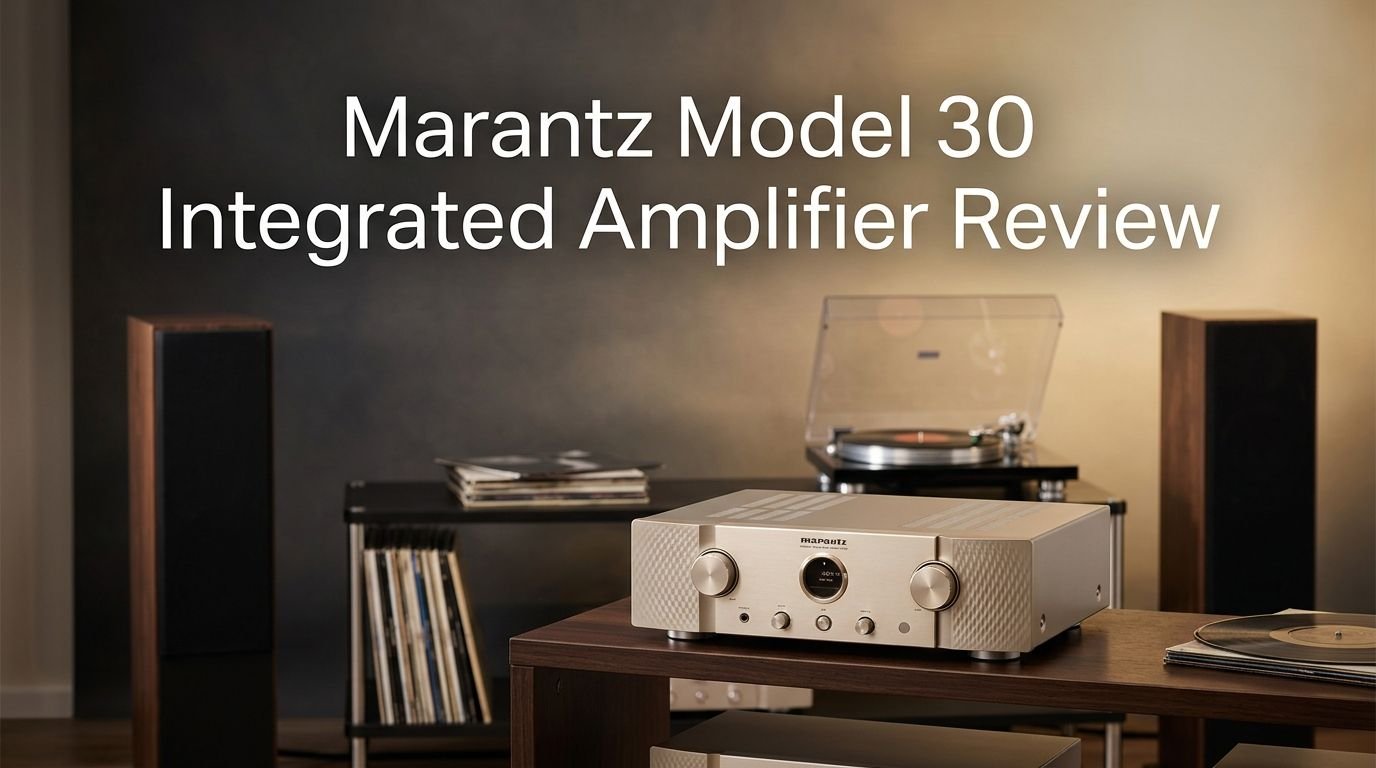
Marantz Model 30 Integrated Amplifier Review 2026
Are you searching for an integrated amplifier that blends classic audiophile craftsmanship with modern audio technology?
The Marantz Model 30 has been turning heads since its release, and it continues to impress listeners in 2026. This all analog, fully discrete integrated amplifier delivers 100 watts per channel into 8 ohms and 200 watts into 4 ohms, all while looking absolutely stunning on your audio rack.
But here is the real question. Does this amplifier justify its premium price tag in a market full of feature packed competitors? In this review, we break down every important detail about the Marantz Model 30.
Key Takeaways:
- The Marantz Model 30 is a pure analog integrated amplifier that uses Class D Hypex NC500 amplifier modules. It pushes 100 watts per channel into 8 ohms and doubles that to 200 watts per channel into 4 ohms, giving you serious speaker driving power.
- Built at Marantz’s Shirakawa Audio Works factory in Japan, this amplifier reflects decades of audio engineering expertise. Every unit benefits from hand selected components and quality control that mass produced competitors simply cannot match.
- The built in phono stage supports both Moving Magnet (MM) and Moving Coil (MC) cartridges, making it an excellent choice for turntable users. The phono stage uses a Premium Phono EQ circuit with two stage amplification, JFETs, and HDAM modules.
- The HDAM SA3 (Hyper Dynamic Amplifier Module) technology is a signature Marantz feature. These custom discrete circuit modules replace standard op amps and deliver superior signal purity with lower noise.
- There are no digital inputs, no streaming, no HDMI, and no room correction. This amplifier focuses entirely on analog audio performance. If you want digital features, you will need a separate source like the Marantz SACD 30n.
- At a retail price of around $3,500 in 2026, the Model 30 sits in a competitive space. However, its exceptional build quality, musical sound signature, and long term reliability make it a strong value for serious audio enthusiasts.

Marantz Model 30 Integrated Amplifier Overview
The Marantz Model 30 is a two channel integrated stereo amplifier built for audiophiles who prioritize sound quality over features. Marantz designed this unit as a pure analog amplifier with no built in DAC, no Wi-Fi, and no Bluetooth. Every design decision serves one goal: deliver the most musical sound possible.
This amplifier uses Hypex NC500 Class D amplifier modules paired with Marantz’s proprietary HDAM SA3 preamp circuits. The result is a powerful yet refined sound signature. The dual mono construction and separate power supplies for the preamp and power amp sections reduce interference between stages.
The Model 30 weighs 32.3 pounds despite its compact dimensions of 17.4 x 16.7 x 5.1 inches. That weight comes from a triple layer chassis, a large toroidal transformer for the amplifier section, and premium internal components. Every part of this amplifier feels solid and purposeful.
Marantz positions the Model 30 as a companion to the SACD 30n network player. Together, they form a complete high end stereo system with streaming, disc playback, and amplification. But the Model 30 also works beautifully with any analog or digital source you connect to it.
Build Quality and Design Language
The Marantz Model 30 is one of the most visually striking integrated amplifiers available today. It features a floating aluminum front panel with Marantz’s signature porthole display in the center. The side panels have elongated dimples that add texture and visual interest.
You can choose between Silver Gold and Black finishes. Both options look premium, but the Silver Gold version has a warm, luxurious tone that pairs beautifully with the matching SACD 30n player. The black finish offers versatility and blends with most setups.
Adjustable backlighting behind the front panel creates a classy ambient glow in dimly lit rooms. You can adjust the brightness or turn it off entirely. The knobs rotate with smooth precision, and every switch and button has a satisfying tactile response.
The rear panel includes machined brass RCA terminals for the CD and phono inputs. Standard RCA terminals handle the remaining inputs. Five way binding posts for speaker connections feel solid and accept banana plugs, spades, or bare wire. This level of hardware quality is uncommon at this price point.
Sound Quality and Performance
The Marantz Model 30 delivers a sound signature that Marantz describes as “the most musical sound.” In practice, this means a slightly warm midrange with excellent detail retrieval and a wide, layered soundstage.
Vocals sound full bodied and natural through this amplifier. Instruments have realistic weight and texture. The Class D Hypex NC500 modules provide clean, controlled power without the harshness that older Class D designs sometimes produced. At both low and high volumes, the Model 30 maintains composure and clarity.
Bass performance is tight and well controlled. The amplifier handles demanding low frequency content without compression or distortion. Even at higher volumes, the bass remains full and articulate. The separate toroidal transformer for the power amp section plays a big role here.
The soundstage extends horizontally beyond the speakers with good depth and imaging. Instruments and voices occupy specific positions in the stereo field. This spatial accuracy makes the Marantz Model 30 a joy to listen to for extended sessions. The overall presentation leans toward musicality rather than clinical accuracy, which many listeners prefer.
Top 3 Alternatives for Marantz Model 30
1. Yamaha A-S2200 Integrated Amplifier

2. Denon PMA-1700NE Integrated Amplifier

3. Cambridge Audio CXA81 Integrated Amplifier

The HDAM Technology Explained
HDAM stands for Hyper Dynamic Amplifier Module. It is Marantz’s proprietary technology that replaces standard integrated circuit op amps with discrete component modules. The Model 30 uses the latest HDAM SA3 version, which Marantz has refined over many years.
Standard op amps are cheap and functional, but they introduce subtle colorations and limitations. HDAM modules use hand selected discrete components arranged in a custom configuration. This approach provides faster slew rates, lower noise, and greater signal purity compared to standard op amps.
In the Model 30, HDAM modules appear in the preamplifier section and work alongside fully discrete circuits with wide range current feedback. The preamp section has its own dedicated power supply, separate from the power amplifier. This isolation prevents the power amp’s demands from affecting the delicate preamp signal.
The result of all this engineering is a preamp section that sounds clean, open, and dynamic. The HDAM technology is a key reason the Marantz Model 30 sounds different from competitors that rely on off the shelf op amps. It is one of the features that truly sets this amplifier apart.
Phono Stage Quality
The Marantz Model 30 includes a Premium Phono EQ circuit that supports both MM and MC cartridges. This is not a basic phono input added as an afterthought. Marantz engineered this phono stage as a serious component within the amplifier.
The phono section uses two stage amplification that combines HDAM modules with JFET input transistors. This design lowers distortion and preserves the delicate signal from your turntable’s cartridge. MC cartridge users will appreciate the selectable input impedance settings that allow proper cartridge loading.
Reviewers and users consistently praise the Model 30’s phono stage. It delivers detail, warmth, and dynamics that compete with many standalone phono preamps in the $500 to $800 range. Vinyl records sound rich and engaging through this stage.
If you own a turntable or plan to start a vinyl collection, the Model 30 eliminates the need for a separate phono preamp. The dedicated machined brass RCA terminals for the phono input also ensure a clean, reliable connection. For vinyl enthusiasts, this phono stage alone adds significant value to the overall package.
Power Output and Speaker Compatibility
The Marantz Model 30 uses Hypex NC500 Class D amplifier modules. These modules deliver 100 watts per channel into 8 ohm speakers and 200 watts per channel into 4 ohm speakers. Measurements by independent reviewers show the amplifier exceeds these specifications.
Stereophile’s measurements revealed the Model 30 producing over 170 watts into 8 ohms and over 300 watts of peak power into 4 ohms. These numbers far exceed the official ratings and demonstrate the amplifier’s ability to drive difficult speakers with ease.
Class D amplification offers several practical advantages. The Model 30 runs cool and uses only 130 watts of power consumption at maximum. There is no need for large heat sinks or excessive ventilation. You can place it in enclosed cabinets without worrying about overheating.
This amplifier works well with a wide range of speakers. Floor standing speakers, bookshelf monitors, and even planar magnetic designs all receive plenty of clean power. The combination of high current delivery and low distortion means the Model 30 controls speaker drivers with authority and precision.
Connectivity and Inputs
The Marantz Model 30 offers a straightforward but complete set of analog connections. The rear panel includes five line level RCA inputs, a dedicated phono input, a power amplifier direct input, and a recording input/output loop.
The CD input and phono input use premium machined brass RCA terminals. These connectors provide a tighter grip and better signal transfer than standard RCA jacks. The remaining inputs use quality standard RCA connectors.
There is a power amplifier direct input that bypasses the preamp section entirely. This is useful if you want to use an external preamp or a home theater processor with the Model 30’s power amp section only.
One notable absence is balanced XLR connections. The Model 30 is entirely single ended. If your source equipment uses balanced outputs, you will need RCA adapters or a different amplifier. The matching Marantz SACD 30n also lacks balanced outputs, so this is consistent within the Marantz 30 series ecosystem. For most home audio setups, the single ended connections perform excellently.
The Marantz Remote Control Experience
The Marantz Model 30 ships with a redesigned remote control that uses more metal and feels premium. This is a noticeable upgrade from the plastic remotes included with most amplifiers and receivers.
The remote provides access to volume, source selection, mute, bass/treble controls, and the display dimmer. Button layout is clean and logical. You do not need to search for the right button in the dark. The labels are clear and the buttons provide satisfying tactile feedback.
If you pair the Model 30 with the Marantz SACD 30n, a single remote controls both units. This reduces clutter on your coffee table and simplifies daily use. Volume adjustments and source switching happen quickly and responsively.
The Model 30 also has remote control in/out terminals on the rear panel. These allow integration with multi room systems or custom control solutions like Crestron or Control4. While the amplifier itself is simple, Marantz ensures it plays well with modern control systems.
Tone Controls and Purist Mode
The Marantz Model 30 includes bass and treble tone controls accessible from the front panel. This feature may surprise audiophile purists who expect a direct signal path with no processing. However, Marantz includes these controls for a practical reason.
Not every recording is perfectly mastered. Some albums sound thin or overly bright. Others may lack bass energy. The tone controls allow you to make subtle adjustments to match your room, speakers, and personal preferences.
If you prefer a pure signal path, the tone controls are fully defeatable. Engaging the bypass mode removes them from the circuit entirely. This gives you the best of both worlds. Use them when needed, bypass them when you want the purest signal.
The inclusion of tone controls reflects Marantz’s philosophy with the Model 30. This amplifier prioritizes the listening experience over audiophile ideology. It gives you tools to enjoy your music rather than forcing a rigid approach to playback.
Who Should Buy the Marantz Model 30
The Marantz Model 30 is ideal for audiophiles who want a high quality integrated amplifier without digital complexity. If you already own a separate streamer, DAC, or CD player, the Model 30 focuses purely on amplification and delivers excellent results.
Vinyl collectors will love this amplifier. The built in phono stage handles both MM and MC cartridges with skill and finesse. You save money on a separate phono preamp and get a cohesive signal path from cartridge to speakers.
Listeners who value long term ownership will appreciate the Model 30. Because it has no digital features, there are no firmware updates to worry about and no streaming protocols that might become obsolete. This amplifier will perform the same way in ten years as it does today.
However, if you want built in streaming, HDMI, or room correction, the Model 30 is not the right choice. Consider the Marantz Model 50 or competing products from NAD, Naim, or JBL. The Model 30 rewards listeners who keep their signal path simple and their expectations for sound quality high.
Marantz Model 30 vs Separates
A common question among audiophiles is whether the Model 30 can compete with separate preamp and power amp combinations. The answer depends on your budget and priorities.
At $3,500, the Model 30 gives you a preamp, power amp, and phono stage in one box. Buying comparable separate components would cost significantly more. A quality preamp alone can run $2,000 or more. Add a power amp and phono preamp, and you are looking at $5,000 to $8,000 for similar performance.
The Model 30’s integrated design also offers advantages in signal path length and impedance matching. The preamp and power amp sections are optimized to work together. There are no additional interconnects to introduce noise or signal degradation.
Separates do offer more flexibility and potential for upgrades. You can mix and match brands, upgrade one component at a time, and choose balanced connections. But for most listeners, the Marantz Model 30 delivers 90% or more of what good separates provide at a fraction of the cost. It sits in a sweet spot between convenience and audiophile performance.
Long Term Value and Resale
The Marantz Model 30 holds its value well on the used market. Several factors contribute to this strong resale performance.
Build quality is the first factor. The triple layer chassis, premium components, and Japanese manufacturing ensure this amplifier lasts for decades. It does not feel like a product that will develop issues after a few years of use.
Brand recognition plays an important role. Marantz is one of the most respected names in audio. The Model 30 carries the legacy of decades of audiophile engineering. Buyers on the used market actively seek out Marantz products.
The absence of digital features actually helps with long term value. Digital streaming protocols change rapidly. Amplifiers with built in streaming from five years ago often feel outdated. The Model 30 avoids this problem entirely. Its analog connections and amplification circuitry do not become obsolete.
Current used prices for the Model 30 remain strong, typically 70% to 80% of the original retail price for units in good condition. This makes the Marantz Model 30 not just a great amplifier, but also a solid investment in your audio future.
Final Verdict on the Marantz Model 30
The Marantz Model 30 integrated amplifier earns a strong recommendation in 2026. It delivers beautiful sound quality, outstanding build standards, and a premium ownership experience that few competitors match at this price.
Its strengths lie in its musical sound signature, excellent phono stage, and purposeful simplicity. The HDAM SA3 preamp technology and Hypex NC500 power modules work together to create an amplifier that sounds warm, detailed, and effortlessly powerful.
The main limitations are the lack of digital connectivity and absence of balanced inputs. These are intentional design choices rather than oversights. If you accept the Model 30 for what it is, a pure analog amplifier built for sound quality above all else, it will reward you for years.
Would we recommend it? Absolutely. If you want an integrated amplifier that sounds fantastic, looks stunning, and lasts a lifetime, the Marantz Model 30 deserves a spot on your shortlist. It proves that sometimes, doing fewer things exceptionally well beats doing many things adequately.
Frequently Asked Questions
Is the Marantz Model 30 a Class D amplifier?
Yes. The Marantz Model 30 uses Hypex NC500 Class D amplifier modules for its power amp section. However, the preamp section uses fully discrete analog circuits with HDAM SA3 modules. The Class D power stage delivers 100 watts per channel into 8 ohms and 200 watts per channel into 4 ohms. Despite using Class D technology, the sound is warm, musical, and free from the harshness associated with older Class D designs.
Does the Marantz Model 30 have a built in DAC?
No. The Marantz Model 30 is a pure analog integrated amplifier. It has no digital inputs, no USB port, and no built in DAC. If you need digital to analog conversion, Marantz recommends pairing it with the SACD 30n, which handles streaming, disc playback, and DAC duties. You can also use any external DAC connected via the Model 30’s RCA line level inputs.
Can the Marantz Model 30 drive difficult speakers?
Yes. Independent measurements show the Model 30 producing over 170 watts into 8 ohms and over 300 watts peak into 4 ohms. These numbers significantly exceed the official ratings. The Hypex NC500 modules deliver high current output that controls demanding speaker loads with ease. Most home speakers will work well with this amplifier.
Is the Marantz Model 30 good for vinyl records?
The Marantz Model 30 is excellent for vinyl. It includes a Premium Phono EQ circuit that supports both MM and MC cartridges with selectable MC impedance loading. The phono stage uses HDAM modules and JFET input transistors for low noise and high detail. Many users and reviewers consider it one of the best built in phono stages available in an integrated amplifier.
Where is the Marantz Model 30 manufactured?
The Marantz Model 30 is built at the Shirakawa Audio Works facility in Japan. This factory employs engineers and skilled workers, many with close to 40 years of experience. Components are hand selected, and quality control standards are high. This Japanese manufacturing is a key part of the Model 30’s premium appeal and long term reliability.
What is the price of the Marantz Model 30 in 2026?
The Marantz Model 30 retails for approximately $3,500 in 2026. Prices may vary slightly depending on the retailer and color option. The Silver Gold and Black versions are priced identically. Used units in good condition typically sell for 70% to 80% of the retail price, making the Model 30 a strong value on both the new and pre owned markets.