Logitech RS50 Review 2026: Live Up To The Hype?
So you want to jump into direct drive sim racing but you do not want to spend a fortune. The Logitech RS50 has landed right in the sweet spot.
It promises 8 Nm of torque, TrueForce haptic feedback, an OLED display on the base, and full support for PC, PlayStation 5, and Xbox Series X|S. All from one box. All for $349.99 for the base alone.
That sounds almost too good. And if you have been around sim racing long enough, you know Logitech had some catching up to do. The G29 and G923 were fine entry points. But they were gear driven.
Key Takeaways
- The Logitech RS50 delivers 8 Nm of peak torque through a direct drive motor. This puts it on par with the Fanatec CSL DD with its boost kit and well above the Thrustmaster T598 at 5 Nm. It is a significant upgrade from any gear driven wheel.
- TrueForce haptic technology sets the RS50 apart. It pulls a second data stream directly from the game engine. You feel engine vibrations, tyre slip across different surfaces, and individual kerb strips. This level of detail is rare at this price point.
- Tri platform support is a major selling point. The RS50 works on PC, PlayStation 5, and Xbox Series X|S without needing separate hubs. No other direct drive base at $349 can match this convenience.
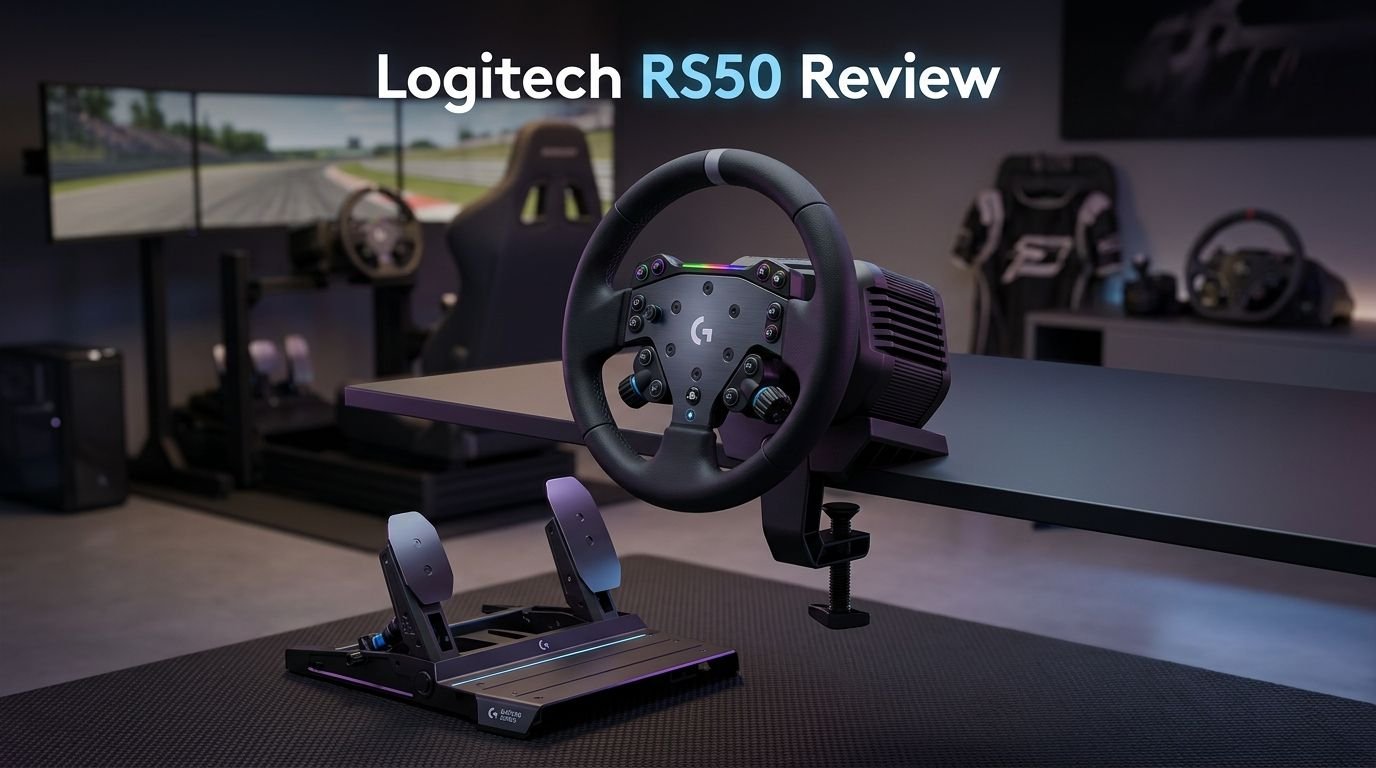
- The RS50 System bundle costs $699.99 and includes the wheelbase, RS Wheel Hub, 11 inch round wheel, and RS Pedals with a 75 kg load cell brake. This is a complete setup out of the box.
- The proprietary quick release is the biggest drawback. You cannot attach third party wheels from Cube Controls, Ascher, or anyone else. You are locked into Logitech’s ecosystem, and only one wheel rim is available right now.
- PC only racers chasing raw torque have better options. The Moza R9 V3 offers 9 Nm for $329, and the Moza R12 V1 pushes 12 Nm at the same $349. But neither supports consoles.

Logitech RS50 Overview and First Impressions
The Logitech RS50 arrives in a compact, understated package. The base unit is smaller than a Fanatec CSL DD. It has a clean matte finish with no flashy RGB lighting. It looks serious and professional.
Pick it up and you notice the weight feels balanced. It is heavy enough to stay planted on a desk clamp. It is light enough to move around if you need to shift your setup.
The OLED display on the front catches your eye immediately. It shows live telemetry data, your active profile name, and current force feedback settings. You can adjust settings right on the base without opening any software. This is a small detail that makes a huge difference during a racing session.
Build quality punches above its price. Several reviewers have noted that blindfolded, you would guess this costs $450 to $500. The materials feel premium. The buttons on the RS Wheel Hub click with satisfying precision. The 11 inch round wheel has a high performance silicone leather grip that feels comfortable during long stints.
Setup takes less than 10 minutes. You mount the base with the included desk clamp or bolt it to a sim rig. Plug in the USB C cable. Install Logitech G HUB. The wheel calibrates itself and you are ready to race. No complicated firmware processes. No confusing adapter chains.
Direct Drive Force Feedback Performance
The heart of the RS50 is its 8 Nm direct drive motor. This is the number that matters most. Direct drive means the motor connects directly to the wheel shaft. There are no gears, no belts, no slop.
Coming from a G29 or G923, the difference is night and day. Force feedback arrives instantly. There is zero lag between what happens on screen and what you feel in your hands. Oversteer, understeer, weight transfer, road texture. It all comes through with stunning clarity.
TrueForce is the secret weapon here. Standard force feedback relies on one data stream from the game. TrueForce adds a second stream pulled directly from the game engine. This layer includes engine rumble, surface texture changes, and granular kerb detail.
Take a few laps at Spa in iRacing. You can feel each individual kerb strip through La Source. You sense the transition from smooth tarmac to rougher patches at the exit of Eau Rouge. This is haptic information that the Fanatec CSL DD and Moza R9 simply do not deliver at stock settings.
Is 8 Nm enough torque? For most sim racers, absolutely yes. Professional esports drivers often run their 20+ Nm bases at 8 to 10 Nm anyway. You do not need more power. You need better information. The RS50 prioritizes quality of feedback over raw strength, and that trade off pays off on track.
RS Pedals and Load Cell Brake
The RS50 System bundle at $699.99 includes Logitech’s RS Pedals. These are a massive upgrade from the old G29 and G923 pedal sets. The headline feature is the 75 kg load cell brake.
A load cell measures pressure, not travel. This means you brake based on how hard you push, not how far the pedal moves. This is how real race cars work. It transforms your braking consistency almost overnight.
The accelerator pedal uses Hall Effect sensors. These are contactless magnetic sensors that do not wear out over time. They deliver smooth, linear input with no dead zones. The clutch pedal also uses Hall Effect technology.
Pedal spacing, height, and angle are all adjustable without tools. You can customize the layout to match your driving style or replicate a real car’s pedal box. The heavy duty steel frame keeps everything stable under hard braking. There is no flex, no wobble, no sliding on the floor.
The RS Pedals connect via USB. This is important. It means they are not locked to the RS50 base. You can use them with any wheelbase from any brand. It also means you can replace them later with aftermarket pedals like Heusinkveld Sprints or Asetek Invictas without any compatibility issues.
For the price included in the bundle, these pedals offer excellent value. A standalone load cell pedal set from competitors often costs $200 or more. Getting one bundled with the wheelbase and wheel for $699 total is a strong deal.
Top 3 Alternatives for Logitech RS50

Fanatec Gran Turismo DD Pro

Thrustmaster T598 Racing Wheel

MOZA R5 Bundle
TrueForce Haptic Technology Explained
TrueForce is Logitech’s proprietary haptic feedback system. It first appeared on the G923 in a limited form. On the RS50, it has been fully enhanced for direct drive.
Here is how it works. Most racing games send one stream of force feedback data to your wheelbase. This stream covers major forces like steering resistance, weight transfer, and tyre grip levels. TrueForce adds a second high frequency data channel pulled directly from the game’s physics engine.
This second channel carries subtle details. You feel the vibration of your engine at different RPMs. You sense the texture difference between asphalt and grass. You pick up on tyre slip before it becomes a full spin. These are small details that add up to a more immersive and informative driving experience.
Not every game supports TrueForce. But the list is growing. Gran Turismo 7, iRacing, Assetto Corsa Competizione, F1 24, and Forza Motorsport all support it to varying degrees. In supported titles, the effect is noticeable and genuinely useful. It gives you more data through your hands, which helps you drive faster.
In games without TrueForce support, the RS50 still delivers standard force feedback. The 8 Nm motor handles traditional FFB signals very well on its own. TrueForce is a bonus layer, not a crutch. The base performs capably either way.
Some reviewers describe the RS50’s force feedback as “clinical” compared to the Fanatec CSL DD. The Fanatec has a slightly warmer, organic quality to its feedback. The RS50 is crisper and more precise. This is a matter of personal preference. Both are excellent.
OLED Display and On Base Controls
The RS50 has a small OLED screen on the front face of the wheelbase. This feature does not exist on any other wheelbase at this price point.
The display shows real time information. You can see your current force feedback strength, spring rate, damper settings, and active profile name. During a race, it can show telemetry data like speed, gear, and lap times depending on the game.
The real value comes from on the fly adjustments. Imagine you are strapped into your sim rig between qualifying and the race. You want to bump your force feedback strength up by 5%. On a Fanatec or Moza, you alt tab to the software, find the setting, change it, and switch back to the game. On the RS50, you press a button on the base and scroll through the OLED menu. Done in seconds.
Fanatec has offered on device tuning for years through their base’s button and LED system. But Logitech’s OLED screen is easier to read and faster to navigate. The visual feedback is clearer. You can see exactly what you are changing without guessing.
This is a quality of life feature. It will not make you faster on its own. But it removes friction from your setup process. Less time in menus means more time on track. For a $349 base, including this screen shows that Logitech thought carefully about the user experience.
Compatibility and Platform Support
This is where the RS50 truly separates itself. It supports PC, PlayStation 5, PlayStation 4, and Xbox Series X|S from a single unit. No adapters. No extra hubs. No separate versions for each platform.
At $349, no other direct drive base offers this. The Moza R9 and R12 are PC only. The Simagic Alpha EVO Sport is PC only. The Fanatec GT DD Pro supports PlayStation and PC but not Xbox without additional hardware. The Thrustmaster T598 covers PlayStation and PC but charges extra for Xbox compatibility.
For someone who plays Gran Turismo 7 on PS5, Forza Motorsport on Xbox, and iRacing on PC, the RS50 handles all three without any fuss. This flexibility alone justifies the purchase for many sim racers.
The wheelbase connects via USB C. The RS Pedals also connect via USB, independent of the base. This means you can mix and match pedals from other brands. Plug in Heusinkveld, Asetek, or any USB pedal set and it works.
Mounting is versatile too. The included desk clamp works for casual setups. A standard bolt pattern on the bottom of the base fits aluminum sim rigs like the Sim Lab P1 X, Next Level Racing F GT Elite, and others. Hard mounting eliminates all flex and provides the best experience.
Logitech G HUB Software Experience
G HUB is Logitech’s universal software for all their peripherals. It has a complicated reputation in the sim racing community. Older versions were buggy. Firmware updates sometimes caused problems. Profiles occasionally failed to load.
On the RS50, G HUB has improved significantly. Force feedback strength, spring rate, damper, and centering force are all adjustable. You can create separate profiles for each game. An iRacing profile with high detail. An ACC profile with stronger centering spring. A casual Forza profile with lighter overall force. Each loads automatically when you start the game.
Firmware updates have been smooth according to most user reports. The initial setup process detects the RS50 and guides you through calibration. Profile management works reliably. Settings save correctly and persist between sessions.
That said, G HUB is not the most polished software. The interface feels cluttered compared to Fanatec’s FanaLab or Moza’s Pit House. Finding specific settings sometimes requires extra clicks. The layout could be more intuitive.
The OLED display on the base reduces your dependence on G HUB. Once your profiles are set up, you rarely need to open the software again. Most quick adjustments happen directly on the wheelbase. This is a smart design choice that sidesteps the software’s rough edges.
If G HUB has been a deal breaker for you in the past, give it another chance with the RS50. The experience has genuinely improved. It is not perfect. But it stays out of the way once configured.
Build Quality and Design
The RS50 uses a matte black finish across the entire base. There is no glossy plastic that picks up fingerprints. No aggressive gamer aesthetic. It looks clean and professional on any desk or rig.
The base unit is compact. It measures smaller than both the Fanatec CSL DD and the Thrustmaster T598 servo base. This matters if you have limited desk space or a smaller cockpit. It fits without dominating your setup.
Material quality exceeds expectations at this price. The housing feels solid with no creaks or rattles under load. The desk clamp grips firmly. The quick release mechanism clicks into place with a reassuring snap. Everything feels tight and well assembled.
The RS Wheel Hub included in the bundle has 13 buttons and adjustable paddle shifters. Button placement is logical. You can reach every input without taking your hands off the wheel. The paddle shifters have a crisp click with no mushiness. They feel substantially better than the paddles on the old G29 and G923.
The 11 inch round wheel rim has a high performance silicone leather wrap. It provides good grip even with sweaty hands. It does not degrade quickly with regular use. The diameter is comfortable for both GT and open wheel style driving, though dedicated formula racers may want a smaller flat bottom option when Logitech releases one.
Heat management is solid. After a two hour endurance session, the motor housing gets warm but never hot. There is no thermal throttling. No force feedback drop off during extended racing. The RS50 handles long stints without complaint.
Who Should Buy the Logitech RS50
The RS50 is perfect for console racers who want direct drive. If you play on PlayStation 5 or Xbox Series X|S and you want premium force feedback, this is the easiest and most cost effective path to get there. No other base at $349 offers tri platform support with 8 Nm of torque.
If you currently own a G29 or G923, this is the natural upgrade. You stay within the Logitech ecosystem. Your familiarity with G HUB transfers over. And the jump from gear driven to direct drive will transform how your games feel and how fast you can drive.
First time sim racers with a moderate budget should look at the $699.99 RS50 System bundle. You get the base, wheel, and load cell pedals in one box. No research paralysis about which pedals to pair with which base. No compatibility worries. Just open the box and race.
Who should look elsewhere? PC only racers who want maximum torque per dollar. The Moza R9 V3 gives you 9 Nm for $329. The Moza R12 V1 gives you 12 Nm for $349. Both beat the RS50 on raw power. You lose TrueForce and console support, but if those do not matter to you, Moza offers more muscle for the money.
Sim racing enthusiasts who love swapping wheel rims and modding their gear will find the RS50’s ecosystem too limited right now. One wheel option. No third party rim adapters. No aftermarket quick release solutions. Fanatec’s ecosystem has years of community built accessories and dozens of wheel choices. If variety matters to you, Fanatec remains the safer bet.
Logitech RS50 vs Fanatec GT DD Pro
This is the comparison most buyers will make. Both target console sim racers at a similar price point. Both offer direct drive force feedback. Both support PlayStation and PC. The differences are in the details.
The RS50 delivers 8 Nm of peak torque out of the box. The Fanatec GT DD Pro starts at 5 Nm and requires a separate boost kit to reach 8 Nm. That boost kit adds cost and complexity. The RS50 gives you full power immediately.
TrueForce gives the RS50 an edge in haptic detail. The Fanatec has good force feedback, but it does not pull that second data stream from the game engine. You miss out on the subtle engine vibrations and surface texture details that TrueForce delivers.
Fanatec wins on ecosystem and upgrade path. You can choose from dozens of wheel rims. Formula style, GT style, round, flat bottom, carbon fiber. Fanatec has it all. The RS50 currently offers one wheel. If you are someone who wants to change rims for different racing disciplines, Fanatec gives you far more options.
Fanatec also supports Xbox through its universal hub system, though it adds cost. The RS50 supports Xbox natively without extra hardware. For cross platform flexibility, Logitech wins this round decisively.
Both are excellent choices. The RS50 is better for plug and play simplicity, tri platform support, and out of the box power. The Fanatec GT DD Pro is better for long term expandability and wheel rim variety.
Logitech RS50 vs Moza R9 and R12
Moza has become the torque per dollar champion in sim racing. The R9 V3 delivers 9 Nm at $329. The R12 V1 pushes 12 Nm at $349. On paper, both outgun the RS50.
But here is the catch. Both are PC only. No PlayStation. No Xbox. If console gaming is part of your life, Moza is off the table entirely.
The Moza R9 and R12 are also base only products. You need to buy a wheel and pedals separately. A Moza ES wheel costs around $200. SR P Lite pedals cost around $150. Your total system cost for a Moza R12 setup reaches $700 or more. The RS50 System bundle at $699.99 includes everything with a load cell brake.
Force feedback quality differs in character. The RS50 with TrueForce has more texture and granularity at the cost of raw strength. Moza bases deliver more raw torque but lack that secondary haptic data layer. Some racers prefer more power. Others prefer more information. It depends on your priorities.
Build quality leans in Logitech’s favor. The RS50 feels more premium in hand compared to the Moza R9 at a similar price. The OLED screen adds a level of polish that Moza’s bases do not offer.
For pure PC sim racers who want maximum torque and plan to build a custom setup piece by piece, Moza makes strong financial sense. For everyone else, the RS50’s combination of convenience, platform support, and haptic technology makes it the smarter buy.
Pros and Cons Summary
What the RS50 does well. The force feedback is precise and detailed. TrueForce adds a haptic layer that competitors cannot match at this price. Tri platform support works flawlessly. The OLED display makes on the fly adjustments quick and easy. Build quality exceeds expectations. The RS Pedals with 75 kg load cell brake deliver real braking feel. Setup is fast and simple.
What could be better. The proprietary quick release limits you to Logitech wheels only. Right now, that means one wheel. The ecosystem is brand new with few accessories or community mods. G HUB software works but is not the slickest. At 8 Nm, it falls behind Moza’s offerings in raw torque for the same money. There is no boost kit option to increase power later.
The bottom line. The Logitech RS50 is the best all around mid range direct drive wheelbase in 2026 for anyone who values platform flexibility, plug and play simplicity, and haptic feedback quality. It is not the most powerful. It is not the most expandable. But it does more things well than any single competitor at this price.
If you race on console, this is the one to buy. If you race on PC and console, this is still the one to buy. If you are PC only and want raw torque above all else, check out Moza. For everyone else, the RS50 hits the sweet spot.
Frequently Asked Questions
Is the Logitech RS50 compatible with PS5 and Xbox?
Yes. The RS50 supports PC, PlayStation 5, PlayStation 4, and Xbox Series X|S from a single unit. You do not need separate hubs, adapters, or different versions. Just plug it in and switch platforms through the OLED display on the base.
How much torque does the Logitech RS50 have?
The RS50 delivers 8 Nm of peak torque through its direct drive motor. This is enough for the vast majority of sim racers. It matches the Fanatec CSL DD with its boost kit and exceeds the Thrustmaster T598 at 5 Nm.
Does the Logitech RS50 have a load cell brake?
The RS50 base does not include pedals. However, the RS50 System bundle at $699.99 includes the RS Pedals with a 75 kg load cell brake. You can also buy the RS Pedals separately and pair them with the base.
Can I use third party wheels with the Logitech RS50?
No. The RS50 uses a proprietary quick release system. Only Logitech’s own wheel rims are compatible. No third party adapters exist at this time. This is the biggest limitation of the RS50.
Is the Logitech RS50 worth it over a Fanatec CSL DD?
It depends on your priorities. The RS50 offers tri platform support, TrueForce haptics, and full 8 Nm out of the box. The Fanatec CSL DD offers a much larger ecosystem with dozens of wheel rim options. If you want simplicity and console support, go RS50. If you want upgrade flexibility, go Fanatec.
What games support TrueForce on the RS50?
TrueForce is supported in Gran Turismo 7, iRacing, Assetto Corsa Competizione, F1 24, Forza Motorsport, and several other titles. The list continues to grow. In unsupported games, the RS50 still delivers standard direct drive force feedback.
Can I desk mount the Logitech RS50?
Yes. The RS50 includes a desk clamp in the box. It also has a standard bolt pattern on the bottom for hard mounting to aluminum sim rigs. Hard mounting provides the most stable experience, but the desk clamp works well for casual setups.