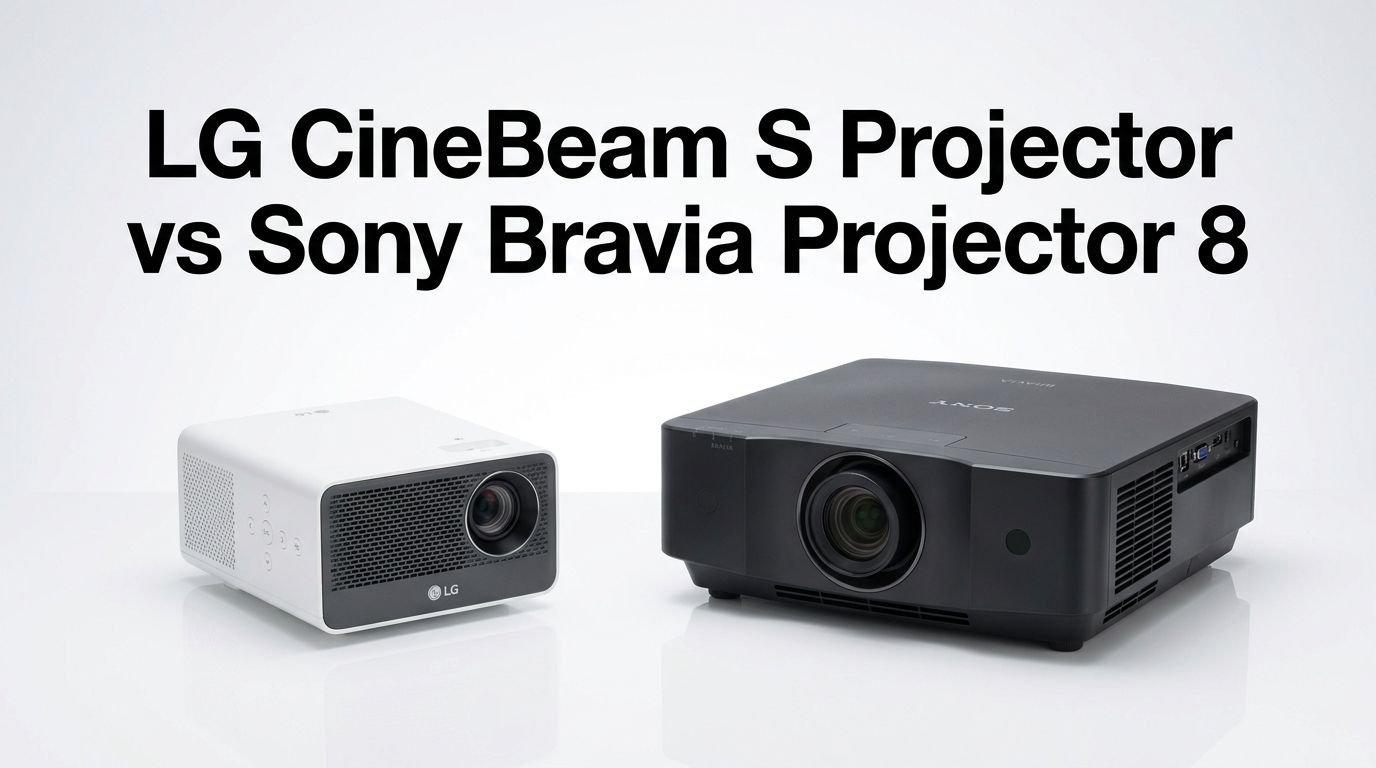
LG CineBeam S Projector vs Sony Bravia Projector 8
You want a big screen experience at home. You have narrowed your choices down to two popular options: the LG CineBeam S (PU615U) and the Sony Bravia Projector 8 (VPL-XW6100ES). Both use laser light sources. Both deliver 4K resolution. But they serve very different audiences at very different price points.
The LG CineBeam S is an ultra short throw mini projector priced at $1,299. It sits inches from your wall and projects up to a 100 inch screen.
The Sony Bravia Projector 8 is a premium home theater projector priced at $15,999. It uses a native 4K SXRD panel and delivers 2,700 lumens of brightness.
Key Takeaways
- The LG CineBeam S and Sony Bravia Projector 8 sit in completely different categories. The LG is a compact, portable ultra short throw projector built for convenience. The Sony is a dedicated home cinema machine built for picture perfection.
- The price gap is massive. The LG CineBeam S costs around $1,299 while the Sony Bravia Projector 8 costs around $15,999. That is more than a 10x difference. Your budget will likely make the decision for you.
- Brightness heavily favors the Sony. The Sony outputs up to 2,700 lumens compared to 500 ANSI lumens on the LG. This means the Sony performs far better in rooms with ambient light.
- The LG wins on portability and setup ease. It measures just 4.3 x 6.3 x 6.3 inches and weighs very little. You can move it from room to room or take it on trips. The Sony is a traditional throw projector that needs permanent mounting or shelf placement.
- The Sony delivers superior gaming performance with input lag as low as 12ms at 4K/120Hz. The LG has input lag around 50ms and maxes out at 60Hz for 4K content. Serious gamers should lean toward the Sony.
- Both projectors offer smart features, but the LG runs webOS with built in streaming apps. The Sony relies on external devices for streaming content.
LG CineBeam S PU615U: Overview and First Impressions

The LG CineBeam S PU615U is a mini ultra short throw 4K projector that launched in late 2025. It uses a triple RGB laser light source and DLP technology with pixel shifting to achieve 4K UHD resolution (3840 x 2160). The projector measures just 4.3 x 6.3 x 6.3 inches, making it one of the smallest UST projectors on the market.
You place this projector inches from a wall and it creates a screen size between 40 and 100 inches. The throw ratio is an impressive 0.25:1. This means you do not need a large room or ceiling mount. Just set it on a table or shelf near the wall and power it on.
The CineBeam S runs LG’s webOS platform, so you get built in access to Netflix, Disney+, Apple TV+, and other streaming services. It also has Bluetooth and Wi-Fi connectivity for wireless audio and screen mirroring. The built in stereo speakers support Dolby Atmos virtualization, which adds some spatial audio depth.
LG rates the brightness at 500 ANSI lumens. The contrast ratio is listed at 450,000:1 dynamic. The laser light source has an estimated lifespan of 20,000 hours. Color coverage reaches 154% of the DCI-P3 color space, which means vibrant and accurate colors on screen.
Pros:
- Ultra compact and portable design at just 4.3 x 6.3 x 6.3 inches
- Ultra short throw projects up to 100 inches from inches away
- Built in webOS with streaming apps and Dolby Atmos speakers
- Triple RGB laser with 4K UHD resolution and wide color gamut
- Affordable price at around $1,299
Cons:
- Only 500 ANSI lumens, struggles in bright rooms
- Input lag around 50ms makes competitive gaming difficult
- Maximum screen size capped at 100 inches
- No optical zoom or lens shift adjustment
- 60Hz maximum refresh rate at 4K
Sony Bravia Projector 8 VPL-XW6100ES: Overview and First Impressions

The Sony Bravia Projector 8 (VPL-XW6100ES) is a premium native 4K home theater projector. It uses Sony’s proprietary SXRD panel technology to deliver true 4K resolution without pixel shifting. The Z-Phosphor laser light source produces up to 2,700 lumens of brightness.
This projector is built for dedicated home theater rooms. It has a throw ratio of 1.35 to 2.84, so you need several feet of distance between the projector and your screen. It features motorized zoom, motorized focus, and powered lens shift (vertical ±85%, horizontal ±36%). This gives you precise control over image placement.
Sony’s XR Processor for Projector handles all video processing. It supports HDR10, HLG, and includes Sony’s Pro Cinematic HDR tone mapping. The projector also has two HDMI 2.1 inputs that support 4K at 120Hz for gaming. Input lag drops to as low as 12ms in game mode.
The Sony does not have built in speakers or a smart TV platform. You will need an external sound system and a streaming device like an Apple TV or Nvidia Shield. The laser light source is rated for 20,000 hours of use.
Pros:
- Native 4K SXRD panel with no pixel shifting needed
- 2,700 lumens of brightness for well lit rooms
- Motorized lens shift, zoom, and focus for easy installation
- Input lag as low as 12ms at 4K/120Hz for serious gaming
- Sony XR Processor with Pro Cinematic HDR tone mapping
Cons:
- Very high price at $15,999
- No built in speakers or smart TV platform
- Large and heavy, requires permanent installation
- Long throw ratio needs a bigger room
- No ultra short throw capability
Picture Quality Comparison
Picture quality is where these two projectors diverge the most. The Sony Bravia Projector 8 uses a native 4K SXRD panel. Every pixel is real. There is no pixel shifting or upscaling tricks. This results in sharper fine detail, better text clarity, and smoother gradients across the image.
The LG CineBeam S uses DLP technology with XPR pixel shifting to achieve its 4K resolution. It accepts and displays 4K content, but the underlying chip is not a true 4K panel. For most movie watching, you will not notice a huge difference. But side by side, the Sony produces a noticeably sharper and more refined image.
Color accuracy also favors the Sony. While the LG covers 154% of DCI-P3 and produces vivid colors, the Sony’s XR Processor fine tunes color reproduction with advanced algorithms. The result is more natural skin tones and more accurate color representation, especially in HDR content.
Black levels and contrast are another win for the Sony. Its laser phosphor system combined with the SXRD panel technology produces deep, inky blacks. The LG has a good 450,000:1 dynamic contrast ratio, but real world black levels cannot match the Sony’s performance in a dark room.
Brightness and Room Compatibility
Brightness plays a huge role in projector performance. The Sony Bravia Projector 8 delivers 2,700 lumens. This is more than five times brighter than the LG CineBeam S at 500 ANSI lumens. The difference is dramatic in real world use.
The LG CineBeam S works best in a dark or dimly lit room. With 500 lumens, any ambient light will wash out the image. Close your curtains and turn off the lights, and the picture looks great. But if you want to watch sports during the day or have a room with big windows, the image will look faded.
The Sony handles ambient light much better. At 2,700 lumens, you can watch content in a room with some controlled lighting and still enjoy a bright, punchy image. This makes it more versatile for different viewing conditions.
For dedicated dark home theaters, both projectors will look excellent. But the Sony still has an advantage because its extra brightness headroom allows for better HDR performance. HDR content needs bright highlights to look impactful, and the Sony’s higher output delivers this convincingly.
Ultra Short Throw vs Traditional Throw Design
The LG CineBeam S is an ultra short throw projector with a 0.25:1 throw ratio. You place it just a few inches from your wall or screen. It can project a 100 inch image from roughly 7.2 inches away. This is a game changer for small apartments, bedrooms, or any space where a ceiling mounted projector is not practical.
The Sony Bravia Projector 8 has a traditional throw ratio of 1.35 to 2.84. For a 100 inch image, you need the projector placed roughly 10 to 21 feet away from the screen. This requires either a ceiling mount, a rear shelf, or a dedicated projector table at the back of the room.
Ultra short throw designs have a clear advantage in flexibility. The LG can sit on a TV stand, a coffee table, or even the floor right below your wall. There are no cables running across the ceiling. No drilling holes. No professional installation needed.
However, traditional throw projectors like the Sony tend to produce sharper images with fewer geometric distortions. UST projectors can sometimes show slight warping or hot spots near the bottom of the image. The LG handles this reasonably well with its auto keystone correction, but a traditional throw projector avoids these issues entirely.
Gaming Performance Head to Head
Gaming performance is a clear win for the Sony Bravia Projector 8. It supports 4K resolution at 120Hz through its two HDMI 2.1 ports. In game mode, the input lag drops to as low as 12ms. This is fast enough for competitive first person shooters and fast paced action games.
The LG CineBeam S supports 4K at 60Hz maximum. Input lag measures around 50ms in game optimizer mode. This is acceptable for casual gaming and single player experiences. But competitive gamers will feel the delay. Fast moving targets will feel sluggish, and reaction times will suffer.
The Sony also supports Auto Low Latency Mode (ALLM), which automatically switches to game mode when it detects a gaming console. The LG also supports ALLM, so both projectors handle this seamlessly.
Variable Refresh Rate (VRR) support is another consideration. The Sony’s HDMI 2.1 ports handle VRR for smoother frame delivery. The LG does not offer VRR support, which can result in occasional screen tearing during gameplay.
If gaming is a priority for you, the Sony is the better choice by a wide margin. If you only play casual games occasionally, the LG will serve you fine.
Sound Quality and Audio Features
The LG CineBeam S has built in stereo speakers with Dolby Atmos virtualization. For a projector this small, the sound quality is surprisingly decent. You can watch movies and shows without connecting external speakers. The audio fills a small to medium sized room adequately.
However, the built in speakers will not replace a real surround sound system. Bass is limited. Volume can distort at higher levels. Dolby Atmos virtualization creates some spatial effect, but it does not compare to actual Atmos speakers in the ceiling.
The Sony Bravia Projector 8 has no built in speakers at all. Sony assumes that anyone spending $15,999 on a projector already owns or plans to buy a proper audio system. This is a fair assumption for a premium home theater product.
The LG also has Bluetooth audio output, so you can pair it with a Bluetooth speaker or soundbar. This adds flexibility for quick setups. The Sony relies entirely on HDMI ARC or optical audio connections to route sound to an external system.
For a complete home theater, both projectors benefit from a dedicated sound system. But the LG has the advantage of working right out of the box without any extra audio equipment.
Smart Features and Streaming
The LG CineBeam S runs webOS, LG’s smart TV platform. This gives you direct access to all major streaming apps including Netflix, Amazon Prime Video, Disney+, Apple TV+, YouTube, and more. You do not need any external streaming device. Just connect to Wi-Fi and start watching.
WebOS also includes LG’s ThinQ AI voice control, AirPlay 2, and screen mirroring capabilities. You can cast content from your phone or tablet directly to the projector. The interface is smooth and responsive.
The Sony Bravia Projector 8 does not include a smart TV platform. There are no built in streaming apps. You need to connect an external device such as an Apple TV 4K, Nvidia Shield TV, or Amazon Fire TV Stick to access streaming content.
For many home theater enthusiasts, this is not a big deal. External streaming devices often perform better than built in smart platforms. But for casual users who want a simple setup, the LG’s built in webOS is a significant convenience factor.
The LG also receives regular firmware updates through webOS, which can add new apps and features over time. The Sony receives firmware updates for bug fixes and performance improvements, but it will never gain built in streaming apps.
Design and Portability
The LG CineBeam S is remarkably compact. At 4.3 x 6.3 x 6.3 inches, it is about the size of a large toaster. You can pick it up with one hand and carry it anywhere. The minimalist design features clean lines and a modern aesthetic that blends into any room.
This portability makes the LG ideal for multi room use. Watch movies in the living room, then carry it to the bedroom. Take it to a friend’s house for movie night. Bring it on vacation. No other 4K UST projector offers this level of convenience at this size.
The Sony Bravia Projector 8 is a standard sized home theater projector. It weighs significantly more and takes up much more space. It requires a dedicated shelf, table, or ceiling mount. Once installed, you will likely never move it.
Sony’s design is functional and professional. It looks like a serious piece of home theater equipment. The white and black color options help it blend into a ceiling mount scenario. But there is nothing portable about this projector.
If portability and flexibility matter to you, the LG wins this category without question. If you have a dedicated theater room and never plan to move your projector, the Sony’s size is irrelevant.
HDR Performance
Both projectors support HDR, but their approaches and results differ significantly. The Sony Bravia Projector 8 supports HDR10 and HLG. It uses Sony’s Pro Cinematic HDR tone mapping to optimize HDR content for projection. The extra 2,700 lumens of brightness give it headroom to display bright HDR highlights convincingly.
The LG CineBeam S also supports HDR10 and HLG. However, its 500 lumens of brightness limit how effectively it can display HDR content. Bright highlights in HDR scenes will look dimmer than they should. Dark scenes look good thanks to the laser’s contrast capabilities, but the overall HDR impact is reduced.
Dynamic tone mapping is where the Sony truly shines. Its XR Processor analyzes every frame and adjusts brightness and contrast to maximize the HDR effect within the projector’s capabilities. This results in a more nuanced and cinematic HDR presentation.
The LG uses its own tone mapping processing, and it does a respectable job for a projector at this price point. Casual viewers will enjoy HDR content on the CineBeam S. But home theater purists will immediately notice the Sony’s superiority in shadow detail, highlight brightness, and color volume.
Value for Money
This is where the comparison gets interesting. The LG CineBeam S costs $1,299. The Sony Bravia Projector 8 costs $15,999. You could buy twelve LG projectors for the price of one Sony. That price gap demands serious justification.
The Sony is objectively the better projector in almost every measurable category: brightness, resolution accuracy, color precision, HDR performance, gaming response, and contrast. There is no debate about image quality superiority.
But is it twelve times better? No. The law of diminishing returns applies heavily in the projector world. The LG CineBeam S delivers a genuinely impressive 4K picture for casual movie nights, streaming, and light gaming. Most viewers will be very happy with its performance.
The Sony targets a specific audience: home theater enthusiasts who demand the best possible picture quality and are willing to pay premium prices. These buyers often pair the projector with a $5,000+ sound system, a $1,000+ screen, and a professionally treated room.
If your total home theater budget is under $5,000, the LG CineBeam S is the clear choice. If you are building a dedicated high end cinema room with a $20,000+ budget, the Sony Bravia Projector 8 makes sense as a centerpiece.
Who Should Buy the LG CineBeam S?
The LG CineBeam S is perfect for apartment dwellers, renters, and anyone who values convenience. Its ultra short throw design eliminates the need for ceiling mounts, long cable runs, or large rooms. You set it on a surface near your wall and start watching.
It is also ideal for people who want a TV replacement without the bulk of a large screen television. A 100 inch projected image creates an immersive viewing experience that no 65 or 75 inch TV can match. And the LG’s webOS platform makes it as easy to use as a smart TV.
Students, young professionals, and families will appreciate the affordability and versatility. Move it between rooms. Use it for movie nights, gaming sessions, or presentations. The built in speakers mean you do not need extra equipment to get started.
Who Should Buy the Sony Bravia Projector 8?
The Sony Bravia Projector 8 is built for serious home theater enthusiasts who prioritize picture quality above all else. If you have a dedicated theater room with light control, a quality projection screen, and a surround sound system, this projector will reward you with a truly cinematic experience.
It is also the better choice for avid gamers who want big screen gaming with low input lag and 4K at 120Hz. The 12ms response time makes it competitive with many gaming monitors, just on a massive screen.
Videophiles and content creators who need accurate color reproduction and native 4K resolution will also appreciate what the Sony delivers. Its SXRD technology remains one of the best projection systems available for consumer use.
If you demand the best and have the budget to support it, the Sony Bravia Projector 8 is one of the finest home theater projectors you can buy.
Final Verdict: LG CineBeam S vs Sony Bravia Projector 8
These two projectors serve fundamentally different purposes. The LG CineBeam S is a lifestyle projector that makes big screen entertainment accessible and convenient. The Sony Bravia Projector 8 is a performance machine that delivers reference level picture quality.
Choose the LG CineBeam S if you want an affordable, portable, and easy to use projector with smart features built in. Choose the Sony Bravia Projector 8 if you want the best possible picture quality for a dedicated home cinema.
Both projectors are excellent products in their respective categories. Your decision comes down to budget, room setup, and how seriously you take your home theater experience.
Frequently Asked Questions
Is the LG CineBeam S bright enough for daytime viewing?
The LG CineBeam S has 500 ANSI lumens, which is best suited for dark or dimly lit rooms. Daytime viewing with open windows will result in a washed out image. You can improve performance with blackout curtains or an ALR (ambient light rejecting) screen, but it will still not match a brighter projector in lit conditions.
Can the Sony Bravia Projector 8 work in a small room?
The Sony requires a throw distance of roughly 10 to 21 feet for a 100 inch image. A small room may not provide enough distance. You would need at least 10 feet between the projector and the screen. For very small spaces, the LG CineBeam S is the better option.
Does the LG CineBeam S support Netflix in 4K?
Yes. The LG CineBeam S runs webOS and includes a built in Netflix app. It supports 4K streaming from Netflix, Disney+, and other major platforms directly through its smart interface. You do not need an external streaming device.
Is the Sony Bravia Projector 8 worth the $15,999 price tag?
For dedicated home theater enthusiasts, yes. The native 4K SXRD panel, 2,700 lumens of brightness, advanced HDR processing, and low input lag gaming make it one of the best consumer projectors available. However, casual viewers will find much better value in more affordable options like the LG CineBeam S.
Which projector is better for gaming?
The Sony Bravia Projector 8 is significantly better for gaming. It offers 4K at 120Hz, input lag as low as 12ms, and VRR support through HDMI 2.1. The LG CineBeam S is limited to 4K at 60Hz with approximately 50ms input lag, which suits casual gaming only.
Do I need an external speaker with the LG CineBeam S?
Not necessarily. The LG CineBeam S has built in stereo speakers with Dolby Atmos virtualization. They work well enough for casual viewing. However, for a better audio experience, pairing the projector with a Bluetooth speaker, soundbar, or full surround sound system will make a noticeable improvement.