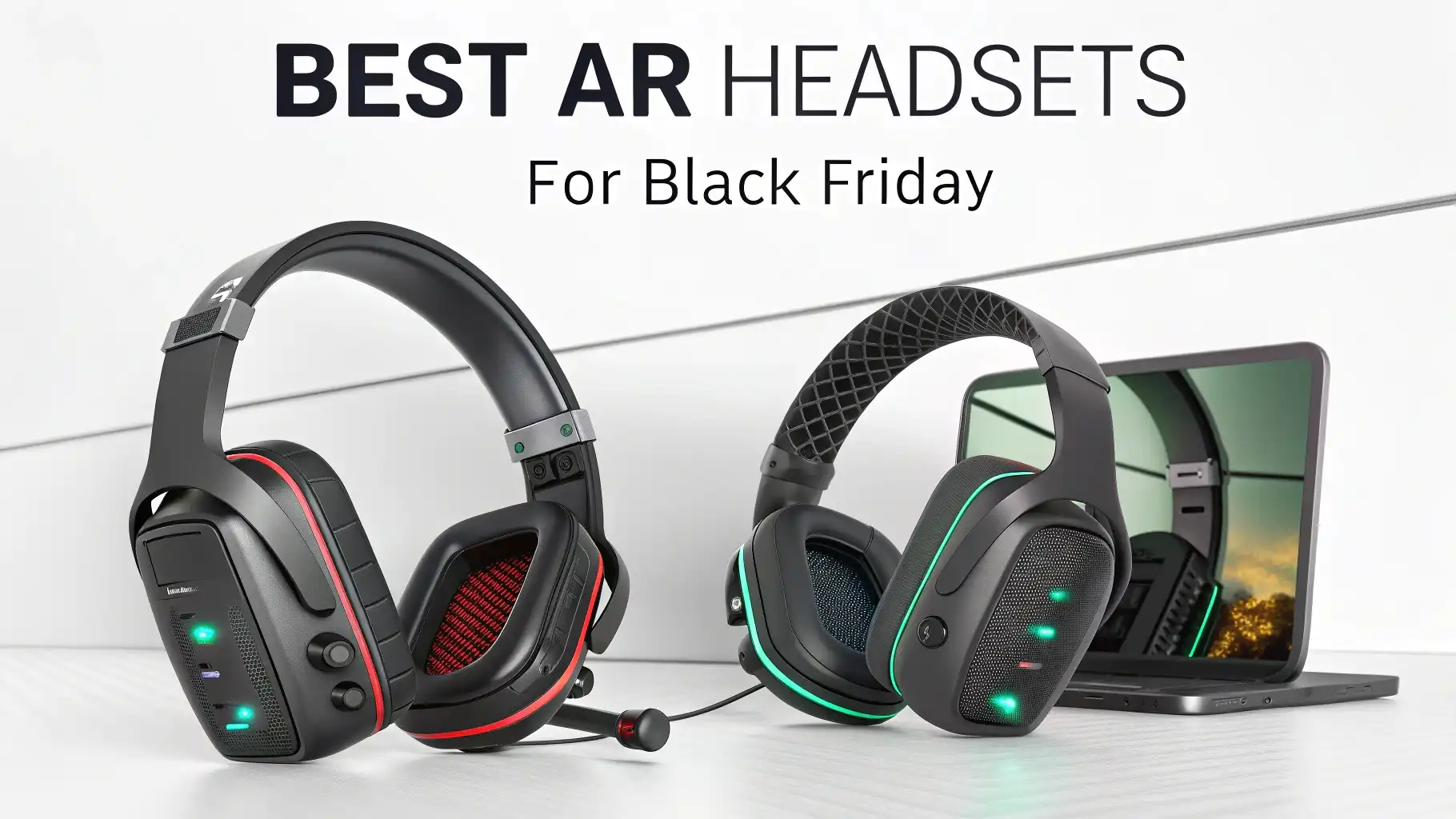
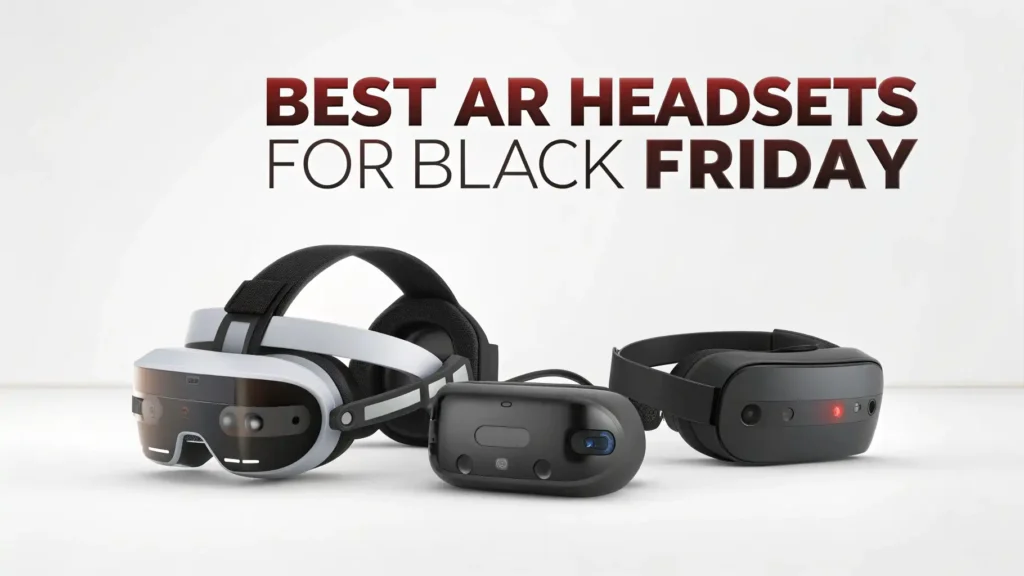
5 Best AR Headsets for Black Friday: Top Deals and Reviews
Black Friday 2026 brings exciting opportunities to grab the latest augmented reality headsets at unbeatable prices.
Whether you want immersive gaming experiences, portable entertainment on the go, or cutting edge mixed reality features, this year offers something special for everyone.
This guide walks you through the five best AR headsets available on Amazon for Black Friday 2026. Each device offers unique strengths, from standalone wireless capabilities to lightweight portable displays.
Key Takeaways
- Budget Friendly Excellence: The Meta Quest 3S delivers incredible value at just $299, offering the same powerful processor as its premium sibling while maintaining access to thousands of VR and AR applications. This makes high quality mixed reality accessible to newcomers.
- Premium Mixed Reality Leader: The Meta Quest 3 512GB stands as the gold standard for standalone AR headsets, featuring 30 percent sharper resolution and pancake lenses that create stunning visual clarity without requiring any external hardware or cables.
- Portable Display Innovation: XREAL One Pro glasses redefine portable entertainment with their massive 171 inch equivalent display and 57 degree field of view, perfect for gaming and movies anywhere while weighing less than regular sunglasses.
- Wide Compatibility Range: Most modern AR headsets work seamlessly with iPhones, Android phones, gaming consoles, PCs, and handheld devices like Steam Deck, making them versatile additions to your existing tech ecosystem.
- Black Friday Timing Strategy: Historical data shows that VR and AR headsets see their deepest discounts during Black Friday week, with savings typically ranging from $50 to $200 off regular prices, making it the optimal purchase window for 2026.
- Comfort Matters for Extended Use: Premium models now feature improved weight distribution, adjustable head straps, and breathable face cushions that allow comfortable wear for 2 to 3 hour sessions without fatigue or discomfort.
Meta Quest 3 512GB: The Ultimate Mixed Reality Powerhouse

The Meta Quest 3 512GB represents the pinnacle of consumer mixed reality technology available today. This headset combines virtual reality gaming with augmented reality passthrough, creating experiences that blend digital content seamlessly with your physical environment.
The device features pancake lenses that deliver exceptional clarity while reducing overall bulk compared to older VR headset designs.
Users appreciate how the 512GB storage capacity eliminates constant game deletion, accommodating extensive libraries of apps, games, and experiences without compromise.
Pros:
- Exceptional visual clarity with 30% sharper resolution than Quest 2
- Massive 512GB storage eliminates space concerns
- Wireless standalone operation requires no PC or console
- Strong mixed reality capabilities blend virtual and physical worlds
- Access to thousands of apps and games in Meta’s ecosystem
- Three month Horizon Plus subscription included
Cons:
- Premium price point at $499
- Battery life limited to around 2 hours of active use
- Heavier than lightweight AR glasses alternatives
- Some users find default strap less comfortable than third party options
Meta Quest 3S 128GB: Best Value for Newcomers

The Meta Quest 3S 128GB delivers phenomenal value for anyone entering the mixed reality space without spending flagship prices. Priced at an accessible $299, this headset packs the same powerful processor found in its more expensive sibling, ensuring smooth performance across the entire Quest game library.
Meta designed the 3S specifically to lower the entry barrier, making premium AR and VR experiences available to budget conscious consumers. The device achieves this without major performance compromises, running the same games and apps as the Quest 3.
Pros:
- Unbeatable $299 price point for Black Friday
- Same processor as Quest 3 ensures great performance
- Longer 2.5 hour battery life
- Includes Gorilla Tag bundle and 40 game access
- Full access to Meta’s extensive app ecosystem
- Amazon’s best seller in VR category
Cons:
- Lower resolution display compared to Quest 3
- Fresnel lenses create more noticeable lens glare
- Only 128GB storage may fill up with large game libraries
- Three position IPD less flexible than continuous adjustment
XREAL One Pro: Premium Portable AR Display

The XREAL One Pro takes a completely different approach to augmented reality, functioning as wearable displays rather than self contained headsets. These lightweight glasses connect via USB C to your phone, laptop, gaming handheld, or tablet, projecting what appears as a 171 inch screen floating in your field of vision.
The 57 degree field of view creates an impressively immersive experience that rivals home theater projectors, yet the entire device weighs only about as much as regular sunglasses. This makes them perfect for travel, commuting, or simply enjoying content in bed without disturbing others.
Pros:
- Massive 171 inch equivalent display in portable form
- Excellent Bose integrated audio quality
- Wide device compatibility across platforms
- Native 3DoF tracking for stable screen positioning
- Lightweight design comfortable for extended wear
- Two IPD sizes accommodate 95% of users
Cons:
- Requires USB C tethered connection to devices
- Premium $649 price point
- No standalone functionality without connected device
- Some users report warmth during extended use
XREAL One: Affordable AR Glasses for Everyone

The XREAL One delivers the core AR glasses experience at a more accessible $499 price point, making portable giant screen entertainment available to a wider audience. While it shares much DNA with the One Pro, this model features a 50 degree field of view rather than 57 degrees, translating to a 147 inch equivalent display.
For most users, this still creates an incredibly immersive viewing experience that far exceeds watching content on phone or tablet screens. The glasses maintain the same excellent build quality and comfortable design that makes extended wearing sessions pleasant rather than tiresome.
Pros:
- More affordable $499 entry point
- Still delivers impressive 147 inch display equivalent
- 120Hz refresh rate perfect for gaming
- Native 3DoF provides stable screen tracking
- Excellent cross platform compatibility
- Lightweight and comfortable for travel
Cons:
- Smaller field of view than Pro model
- Audio quality good but not Bose level
- Requires tethered connection to source device
- Single IPD size may not fit all users perfectly
Rokid Max AR Glasses: Budget Friendly Portable Display

The Rokid Max AR Glasses enter the portable AR display market at a compelling $242 price point, making massive screen entertainment accessible even to tight budgets. These glasses project what appears as a massive 1080p screen into your field of vision when connected to compatible devices via HDMI or USB C.
While not quite matching the field of view or premium features of XREAL products, Rokid Max glasses deliver solid core functionality at less than half the price. This makes them excellent choices for students, casual users, or anyone testing portable AR displays before committing to premium options.
Pros:
- Extremely affordable at $242 price point
- Wide compatibility with HDMI and USB C devices
- Myopia friendly design works with prescription glasses
- No internal battery concerns
- Lightweight and portable design
- Solid build quality for price bracket
Cons:
- Limited to 1080p resolution
- No advanced tracking features
- Audio quality basic compared to premium models
- Smaller field of view than competitors
- Lower brand recognition and support ecosystem
Understanding AR vs VR vs Mixed Reality
Many shoppers feel confused about terminology when exploring headset options. Virtual Reality (VR) creates completely digital environments that replace your view of the physical world, perfect for gaming and immersive experiences.
Augmented Reality (AR) overlays digital information onto your real world view, like smartphone apps showing directions on actual streets. Mixed Reality (MR) combines both approaches, letting virtual objects interact with physical spaces in convincing ways.
Modern headsets like the Meta Quest 3 series handle all three categories, offering flexibility based on your needs.
Display Quality and Visual Comfort Factors
Display technology directly impacts your experience and eye comfort during extended use. Resolution determines image sharpness, with higher numbers creating clearer text and more detailed visuals. The Meta Quest 3 offers superior resolution compared to Quest 3S, making text easier to read in virtual workspaces.
Refresh rate affects motion smoothness, with 120Hz displays eliminating the motion blur and judder that plagued earlier headsets. This matters tremendously for fast paced gaming and reducing motion sickness susceptibility.
Lens technology plays an equally important role. Pancake lenses in premium headsets create thinner profiles and reduce visual artifacts like god rays that appear around bright objects. Fresnel lenses, while bulkier, cost less to manufacture and still deliver good image quality for most users.
Compatibility with Your Existing Devices
Device compatibility determines how useful your AR headset becomes in daily life. Standalone headsets like the Meta Quest 3 series operate independently without requiring phones, computers, or consoles. This wireless freedom allows room scale VR gaming and movement without tethered cables.
However, they can also connect to gaming PCs via USB C or wireless streaming, accessing more demanding VR games that exceed mobile processor capabilities. This dual functionality maximizes versatility and future proofs your investment as gaming libraries expand.
Tethered AR glasses like XREAL and Rokid products function as external displays for compatible devices. Most support USB C connections to modern Android phones, iPhones, iPads, and laptops. Gaming handhelds like Steam Deck, ROG Ally, and Nintendo Switch work excellently with AR glasses, transforming them into portable gaming theaters.
Battery Life and Charging Considerations
Battery performance significantly impacts how you use AR headsets in real world scenarios. Standalone VR headsets typically deliver 2 to 2.5 hours of continuous active use, with the Meta Quest 3S slightly outlasting the Quest 3 due to lower display power demands. Lighter activities like video watching extend battery life to 3 hours or more, while intensive gaming drains batteries faster.
Most devices charge via USB C in approximately 2 hours, with fast charging options available on newer models. You can extend play sessions using portable power banks, though this adds cable management challenges during active gaming.
Tethered AR glasses draw power directly from connected devices, eliminating separate battery concerns. This means unlimited viewing time limited only by your phone, laptop, or gaming handheld battery capacity.
Comfort and Ergonomics for Extended Wear
Physical comfort determines whether headsets gather dust or see daily use. Weight distribution matters enormously, with well designed headsets balancing mass between the front display and rear battery compartment. Poor balance creates pressure points on cheekbones and noses that become painful within 30 minutes.
Premium models feature adjustable head straps with ratcheting mechanisms that customize fit precisely, while budget options may include basic elastic straps that suit fewer face shapes. The Meta Quest 3 receives praise for its improved weight distribution compared to earlier models.
Face cushion materials directly impact heat buildup and sweat accumulation during active use. Memory foam cushions mold to face contours but trap more heat, while mesh materials promote airflow at the cost of less complete light blocking.
Frequently Asked Questions
What is the difference between AR and VR headsets?
AR headsets overlay digital content onto your real world view, letting you see both physical surroundings and virtual elements simultaneously. VR headsets completely replace your vision with digital environments, blocking out the real world entirely.
Mixed reality headsets like the Meta Quest 3 series handle both functions, switching between full VR immersion and AR passthrough modes depending on your activity. AR proves more practical for productivity and everyday tasks, while VR excels for gaming and immersive entertainment experiences.
Do AR headsets work with iPhone and Android phones?
Most modern AR glasses work with both iPhone and Android devices through USB C connections. The XREAL One, XREAL One Pro, and Rokid Max all support iOS and Android platforms, functioning as external displays for compatible smartphones.
However, specific features may vary between operating systems due to different software capabilities. Always check manufacturer compatibility lists for your exact phone model before purchasing, as some older devices lack necessary video output capabilities through their USB C ports.
How long do AR headset batteries last?
Standalone VR headsets like the Meta Quest 3 series typically last 2 to 2.5 hours during active gaming, with video watching extending runtime to around 3 hours. AR glasses like XREAL and Rokid products draw power from connected devices rather than internal batteries, providing unlimited runtime limited only by your phone, laptop, or gaming handheld battery capacity.
However, video output significantly increases power consumption on source devices, often doubling normal drain rates during continuous use.
Can you wear regular glasses with AR headsets?
This depends on the specific headset design. The Meta Quest 3 series accommodates glasses through a spacer insert that increases distance between lenses and your face, though this reduces field of view slightly.
Many users prefer prescription lens inserts designed specifically for VR headsets, which eliminate glasses entirely while providing proper vision correction. AR glasses like XREAL and Rokid typically offer adjustable diopter settings for mild prescriptions, while the Rokid Max specifically advertises myopia friendly design that works with regular glasses underneath.
Are AR headsets worth buying in 2026?
Yes, 2026 represents the best year yet for AR and VR technology adoption. Devices have become lighter, more powerful, and significantly more affordable than previous generations. Content libraries have matured with thousands of quality games, apps, and experiences available.
The technology has moved beyond early adopter status into mainstream readiness, with improved comfort, battery life, and user interfaces that work reliably. Black Friday 2026 deals make premium devices accessible at budget friendly prices, removing previous cost barriers that prevented many people from entering the ecosystem.
What should I use my AR headset for besides gaming?
AR and VR headsets excel at numerous applications beyond gaming. Fitness apps like Supernatural provide engaging workouts that feel more like games than exercise. Productivity applications enable virtual workspaces with multiple floating screens, especially useful when traveling or working in small spaces.
Social VR platforms let you meet friends in virtual environments regardless of physical distance. Educational experiences range from virtual museum tours to interactive science simulations. Media consumption transforms with cinema sized screens for movies and sports. Creative professionals use VR for 3D modeling, art creation, and design visualization.
How much space do I need for VR gaming?
Space requirements vary by experience type. Seated VR works in any chair with no additional space needed, perfect for racing simulators, flight games, and puzzle experiences. Standing VR requires roughly a 3×3 foot clear area around you for arm movement without hitting furniture or walls.
Room scale VR provides the most immersive experience, benefiting from 6×6 feet or larger clear spaces where you can walk around naturally. The Meta Quest 3 series includes space mapping that shows virtual boundaries when you approach real walls, preventing accidents during active gameplay.